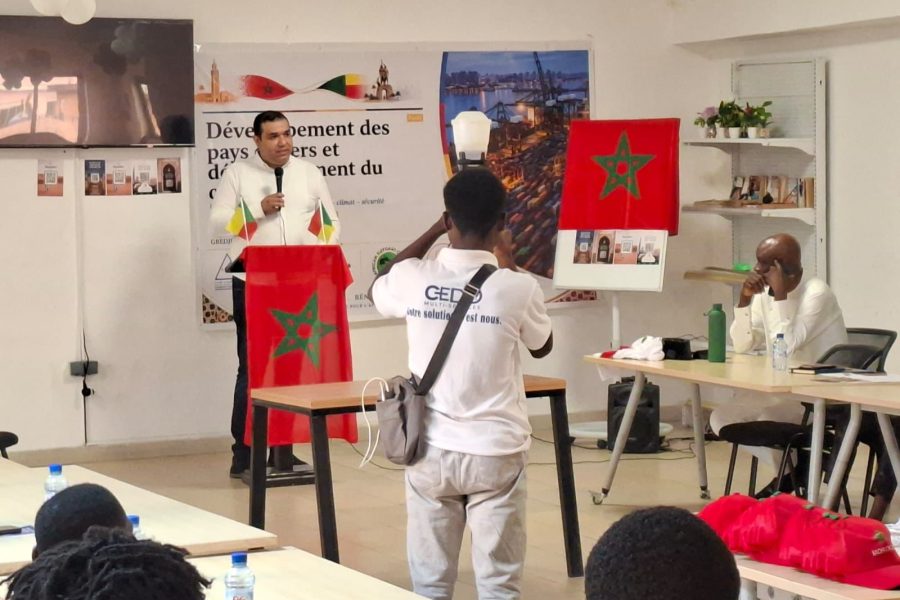
Moroccan and Beninese civil society organizations have agreed to strengthen cooperation on development, climate resilience, security and regional integration, with a particular focus on Atlantic Africa and improving connectivity between coastal and landlocked countries.
The Mediterranean Center for Development (MEDEV), Beninese organization Afrique Espérance & Développement, and the Coalition for the African Elephant signed a memorandum of understanding in Cotonou on Friday establishing a framework for joint work on what they described as the development-climate-security nexus.
The agreement followed a conference organized by the three organizations under the theme, “Development of Coastal Countries and Opening Up the Continent: A Development-Climate-Security Nexus Perspective.”
Discussions examined the growing interdependence between African coastal and landlocked countries, including the links between climate change, food security and territorial stability. Participants also addressed youth employment, local governance and the role of civil society in strengthening resilience at the local level.
A central focus of the meeting was Morocco’s Atlantic Africa Initiative, which seeks to provide landlocked Sahel countries with access to Atlantic infrastructure and regional connectivity.
The initiative was presented as an opportunity to strengthen economic links between coastal and inland countries by improving access to ports, transport corridors and markets.
The three organizations said their cooperation would include the joint production of policy briefs and analytical reports covering development, climate and security, territorial governance, natural resources and wildlife, connectivity for landlocked countries and regional integration.
They also plan to organize conferences, exchanges among practitioners and peer-learning activities, with an emphasis on youth and the transfer of knowledge between generations.
Focus on Atlantic Africa
The organizations identified Atlantic Africa as a dedicated area of future cooperation, including regional integration, access to the sea for landlocked countries, the blue economy, maritime security and the energy transition.
The region’s economic and demographic weight was highlighted during the Cotonou meeting. According to the organizations, the 23 African countries bordering the Atlantic account for approximately 46% of Africa’s population and 55% of its GDP.
Their ports, coastal cities and transport corridors also play an important role in facilitating trade for African countries without direct access to the sea.
Najib Somoue, an economist and president and founding member of MEDEV, said Morocco’s Atlantic strategy could provide an opportunity to deepen cooperation not only between governments but also among African civil society organizations.
“The Atlantic dynamic advanced by Morocco creates an opportunity to strengthen not only cooperation among states, but also ties among African civil society organizations,” Somoue said.
He described King Mohammed VI’s initiative to facilitate Sahel countries’ access to the Atlantic Ocean as a framework for cooperation around skills development, youth, territorial resilience and regional integration.
Azizou El Hadj Issa, former Beninese agriculture minister and president of the Council of Elders of the Coalition for the African Elephant, highlighted the potential benefits for agriculture and food systems.
He said improved access to Atlantic routes could strengthen links between coastal and inland economies, including by facilitating access to agricultural inputs and expanding market opportunities for producers.
Climate, data and territorial resilience
The discussions also emphasized the need to integrate climate and security considerations into development planning.
Degny Virgile, a statistician and planner, said better data could help governments and organizations identify vulnerabilities, infrastructure needs and productive capacities.
“Better measurement of vulnerabilities, infrastructure needs and productive capacities can help anticipate risks and improve the targeting of public policy,” Virgile said.
Environmental pressures were another area of concern, particularly erosion and growing pressure on land and water resources.
Oyeoussi Charles Balogoun, director-general of Afrique Espérance & Développement, said civil society organizations could play a greater role in sharing practical experience and data across countries facing similar challenges.
The memorandum is expected to provide a framework for turning those areas of cooperation into joint research, events and exchanges.
The agreement comes as Morocco seeks to deepen its economic and diplomatic engagement with the Sahel and promote the Atlantic coast as a gateway for landlocked countries in the region.







add your comment
Terms of publication : Not to offend the writer, people, sacred things, or attack religions or the divine self, and refrain from racist incitement and insults.