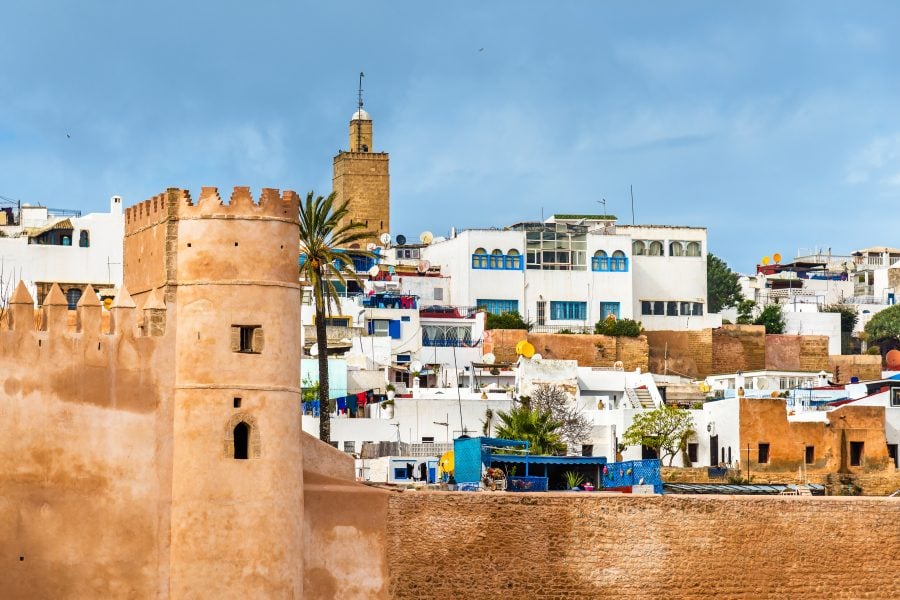
Morocco’s real estate market recorded a broad increase in property prices in 2025, with Rabat posting the strongest gains and Marrakech leading growth in transactions, according to Bank Al-Maghrib’s annual report presented to King Mohammed VI on Tuesday.
The central bank said property prices continued the moderate upward trend observed over the past two years, rising by 0.6% overall in 2025, although performance varied significantly among the country’s major cities.
Rabat records the sharpest increase
Rabat registered the largest increase in property prices, with values rising by 3.6% compared with the previous year.
At the other end of the spectrum, Fez recorded the smallest increase, at just 0.2%, highlighting the uneven pace of growth across Morocco’s main urban centers.
According to the report, prices increased across all asset categories, rising by 0.9% for residential properties and urban land, and by 0.3% for commercial real estate.
Despite higher prices, the market maintained strong momentum, reflecting sustained demand and investor interest.
Marrakech emerged as the country’s most dynamic market, with property transactions surging by 29.9% in 2025.
Only Agadir and Kenitra recorded declines in sales volumes, while transaction activity increased in most other cities.
After a sharp rise of 19.6% in 2024, overall property transactions grew by 6.6% last year, driven by increases of 10.3% in land transactions, 12.4% in commercial real estate deals and 4.9% in residential sales.
Central bank maintains accommodative monetary policy
Bank Al-Maghrib’s report also highlighted the impact of its accommodative monetary policy, aimed at supporting economic activity and easing financing conditions.
Banking-sector liquidity improved in 2025, with banks’ liquidity needs declining to an average of 128.7 billion dirhams ($13.9 billion).
The central bank attributed part of this improvement to the voluntary tax regularization program for individuals, which contributed to a reduction in cash circulating outside the banking system.
In March, Bank Al-Maghrib cut its benchmark interest rate to 2.25% as part of its efforts to stimulate growth and reduce borrowing costs.
The central bank also continued to meet banks’ liquidity needs through weekly interventions averaging nearly 140 billion dirhams.
However, the report projects that banks’ liquidity requirements will gradually increase, reaching around 143 billion dirhams by the end of 2026.
Household borrowing slows
The report noted that lower interest rates translated into cheaper financing and stronger credit growth for businesses, particularly investment loans.
Overall, bank lending to the non-financial sector — which includes households and companies — expanded by 4.8% in 2025.
At the same time, demand for household credit slowed slightly, reflecting more cautious spending patterns.
Consumer lending growth weakened as household consumption rose by only 1.2% in 2025, down from 2.9% a year earlier.
Mortgage lending also slowed, suggesting that many households are postponing major purchasing decisions amid rising property prices in some cities and concerns about long-term affordability.
According to the report, many prospective buyers appear to be waiting for prices to stabilize or for their purchasing power to improve before committing to long-term home loans.
Despite slower borrowing and changing economic conditions, the ratio of non-performing loans remained broadly stable at slightly above 8% of total lending.
Although the stock of troubled loans exceeded 100 billion dirhams across the banking sector, Bank Al-Maghrib said borrowers have generally demonstrated resilience in meeting their financial obligations.
The report concluded that bank lending to the non-financial sector continued to expand in 2025, even as household borrowing for consumption and housing showed signs of moderation.






add your comment
Terms of publication : Not to offend the writer, people, sacred things, or attack religions or the divine self, and refrain from racist incitement and insults.