
A Mauritanian opposition politician has stressed that the country’s opposition is far from united on the Moroccan Sahara dispute, warning against interpreting a recent meeting between a Polisario Front delegation and an opposition leader as evidence of a common position shared by both the opposition and the government.
The comments came after a Polisario delegation met Mohamed Ould Mouloud, leader of the Mauritanian Union of Progressive Forces party and head of an opposition coalition comprising around 15 political organizations, shortly after Mauritanian President Mohamed Ould Cheikh El Ghazouani received an envoy from the separatist movement.
Speaking to Hespress AR, Ahmed Ould Obeid, a Mauritanian opposition politician, said the country’s opposition is made up of several parties and political currents that hold different views on the Moroccan Sahara issue.
“The Mauritanian opposition is not a single political bloc,” Ould Obeid said, noting that the Polisario envoy met only one opposition leader who currently heads a coalition that includes newly established parties and others still in the process of formation.
He added that none of the parties in that coalition holds seats in parliament.
“It would be inaccurate to present this meeting as reflecting a unified opposition stance or to interpret its timing alongside the envoy’s meeting with the president as proof of alignment between the government and the opposition,” he said.
According to Ould Obeid, the meetings are better understood as part of the Polisario Front’s diplomatic efforts to engage with different Mauritanian actors, both official and political, while each side maintains its own calculations regarding the dispute.
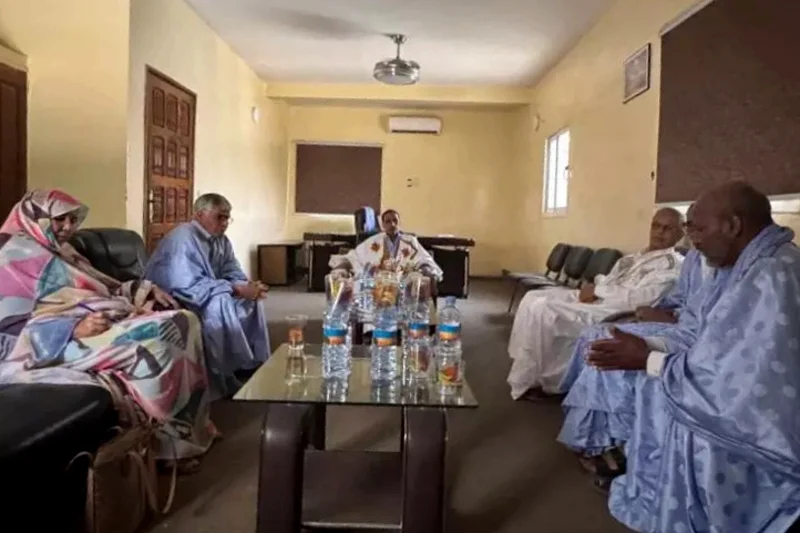
Divided views within the opposition
Ould Obeid acknowledged that some opposition parties and public figures support positions closer to those of the Polisario Front but stressed that such views do not represent the opposition as a whole.
“There are indeed political forces and personalities within the opposition that are closer to the Polisario’s position, but this reflects the political diversity that exists in Mauritania and cannot be considered the position of the opposition in its entirety,” he said.
At the same time, he argued that an influential current within the opposition views Morocco’s autonomy proposal favorably, describing it as a realistic and serious initiative capable of serving as the basis for a lasting political settlement.
“That position exists clearly within the opposition landscape and cannot be ignored when discussing the political map in Mauritania,” Ould Obeid said.
He added that other political groups continue to defend what he called “positive neutrality,” arguing that Mauritania’s geographic location and historical ties to all parties involved require the country to maintain balanced relations while encouraging dialogue and supporting efforts to find a peaceful solution.
“The reality is far more diverse than it may appear from abroad,” he said. “The Mauritanian opposition is not united on this issue, and the position of one faction or party should not be attributed to the opposition as a whole.”
National interests and regional stability
Ould Obeid argued that Mauritania’s approach to the Moroccan Sahara issue should be guided primarily by national interests rather than alignment with Morocco, Algeria or any other actor.
“Mauritania, because of its geography and its security and economic interests, has more reason than most countries to seek a lasting political solution to this conflict, which has weighed on regional stability and hindered Maghreb integration,” he said.
He called on Mauritania to deal pragmatically with developments surrounding the dispute, including United Nations resolutions and shifting international positions, while preserving good relations with both Rabat and Algiers.
Maintaining balanced ties with Morocco and Algeria remains important, he said, but “does not necessarily mean maintaining the same distance from every position at every stage.”
“States build their foreign policies on national interests and on an assessment of changing realities,” Ould Obeid added.
He argued that Mauritania should move from what he described as “passive neutrality” toward a more active and realistic diplomacy capable of preserving strong relations with all neighboring countries while engaging constructively with international initiatives aimed at resolving the dispute.
Support for Morocco’s autonomy plan
Ould Obeid said he personally favors a more open approach by Mauritanian authorities toward Morocco’s autonomy proposal, which was put forward by King Mohammed VI.
“Personally, I would prefer the Mauritanian authorities, which are responsible for managing diplomatic relations, to engage positively and openly with the initiative proposed by King Mohammed VI and to assess it in light of United Nations resolutions and the political process led by the international organization,” he said.
He stressed that engaging with a political initiative does not necessarily contradict Mauritania’s policy of balance and neutrality.
“The question is not whether Mauritania should choose Morocco or Algeria,” Ould Obeid said. “The real question is how Mauritania can preserve its strategic relations with both countries while responding, with diplomatic courage and political wisdom, to international initiatives and decisions that could open a realistic path toward resolving this conflict.”
He concluded that Mauritania should seek to transform its neutrality into an active diplomatic role that contributes to stability, cooperation and regional integration across the Maghreb.




add your comment
Terms of publication : Not to offend the writer, people, sacred things, or attack religions or the divine self, and refrain from racist incitement and insults.