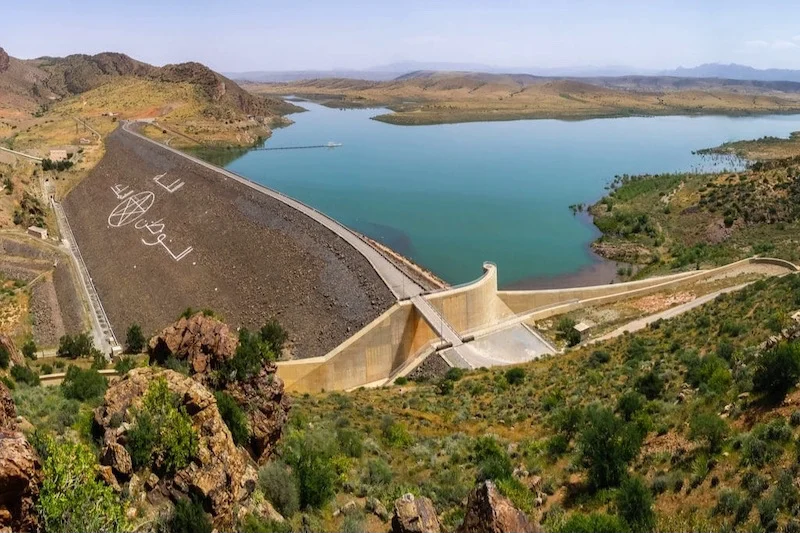
Morocco’s reservoirs lost about 158.6 million cubic meters of water during the first 10 days of July as prolonged heat coincided with peak summer demand, though national storage remains nearly twice as high as a year earlier.
Data from the Water Planning Directorate showed reservoirs held 12.35 billion cubic meters on July 10, equivalent to 72.5% of their total normal capacity of 17.03 billion cubic meters.
Storage stood at 12.50 billion cubic meters on July 1, when the national filling rate was 73.43%.
The decline came during an extended heatwave that pushed temperatures across much of Morocco well above seasonal averages. Higher evaporation and increased household, agricultural and commercial consumption typically place additional pressure on water reserves during summer.
The Sebou basin recorded the largest fall, losing about 43 million cubic meters over the period. Oum Er-Rbia declined by 31.6 million cubic meters, Loukkos by 25.5 million and Moulouya by 19.3 million.
Ziz-Gheris and Bouregreg lost about 14.7 million and 14.5 million cubic meters respectively.
Despite the recent decline, Morocco’s overall reservoir position remains substantially stronger than on July 10, 2025, when the national filling rate stood at 37.21%.
Loukkos recorded the highest current filling rate at more than 86%, followed by Sebou at about 85.6% and Bouregreg at roughly 85%.
Large regional gaps persist. Draa-Oued Noun stood at 38.19%, while Ziz-Gheris recorded 43.74%, leaving southern and eastern basins more exposed during the summer.
The stronger national position gives Morocco greater room to supply drinking water and meet agricultural demand than last year, but the early-July losses show how quickly reserves can fall during periods of extreme heat and high consumption.





add your comment
Terms of publication : Not to offend the writer, people, sacred things, or attack religions or the divine self, and refrain from racist incitement and insults.