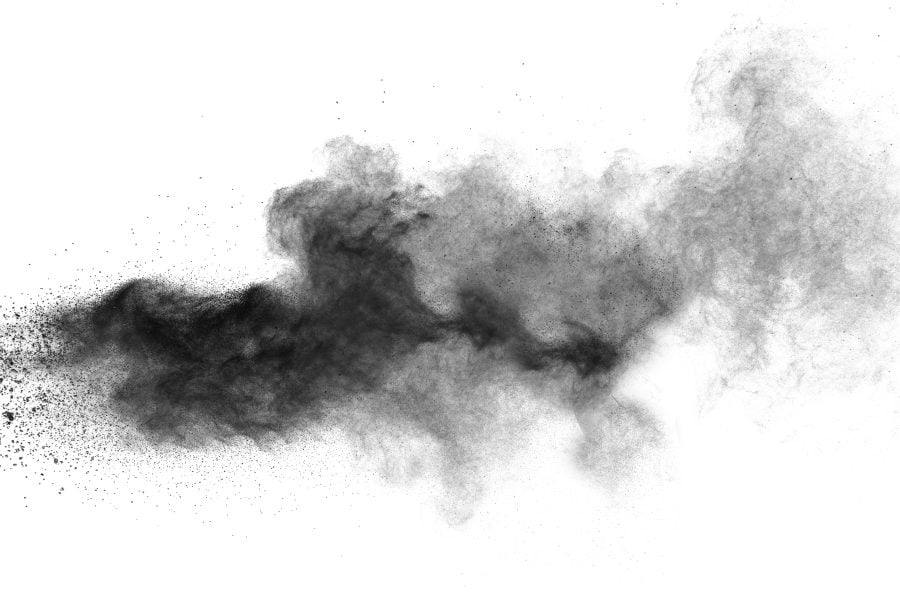
After more than 15 years of complaints about black dust settling on rooftops, balconies, cars, and laundry in Kenitra, a laboratory analysis commissioned by Greenpeace has provided a scientific explanation of what that black dust looks like, what it is consistent with, and what questions remain unanswered.
After examining samples collected from rooftops near an industrial power plant, scientists concluded that the dust shares key characteristics with fly ash produced when heavy fuel oil is burned, particularly under poor combustion conditions.
What did scientists analyze?
The Greenpeace Research Laboratories received two samples of black dust collected from rooftops in Kenitra in August 2022. Both were gathered in neighborhoods close to a power station in the city’s industrial area, where residents say heavy fuel oil is used as fuel.
Researchers first examined the size and shape of the particles before carrying out chemical tests to understand what they were made of.
Most of the particles were relatively small, with around 95% measuring less than 355 micrometers across. The majority fell between 63 and 250 micrometers, a size range that scientists say matches fly ash produced by heavy fuel oil power plants, although particles from other sources can also fall within that range.
The particles looked like fly ash
Under a microscope, researchers found that most of the black dust consisted of tiny hollow spheres known as cenospheres.
These round, hollow particles are commonly found in fly ash generated during high-temperature combustion processes, including the burning of heavy fuel oil.
Scientists also heated the particles to 700 degrees Celsius to study their carbon content. The particles barely changed shape during the test, meaning that most of the carbon they contained was inorganic rather than made up of easily burned organic material.
The chemical clues
The laboratory also looked for metals and other chemical elements trapped inside the dust and two metals stood out.
The samples contained unusually high levels of vanadium and nickel, two elements widely recognized as chemical fingerprints of heavy fuel oil combustion.
While the concentrations measured in the Kenitra samples were lower than those often reported in heavy fuel oil fly ash, they were still far higher than the levels typically found in coal fly ash.
Other potentially harmful elements commonly associated with coal fly ash, including arsenic, boron, uranium, lead and mercury were found at relatively low concentrations.
Taken together, the researchers say these findings are consistent with fly ash produced by burning heavy fuel oil, especially when combustion is not operating efficiently.
Does this prove where the dust came from?
Scientists say the laboratory tests alone cannot determine the exact source of the dust or prove which facility released it.
However, they say the location where the samples were collected adds an important piece to the puzzle. Because the dust was gathered near a power plant that reportedly burns heavy fuel oil, the researchers say the possibility that the facility contributed to the pollution “deserves more detailed and urgent investigation.”
The laboratory also found that the dust samples themselves appeared relatively inert, meaning they did not contain significant amounts of easily extractable toxic contaminants.
But the researchers also warn against drawing too much reassurance from that finding.
The black dust collected from rooftops consisted mainly of larger particles that had already settled out of the air. Those particles may represent only part of the pollution coming from the original emission source.
Smaller particles, which stay suspended in the air much longer and are more easily inhaled deep into the lungs, were not the focus of this analysis.
That means the visible black dust could be only one part of a much broader air pollution problem.





add your comment
Terms of publication : Not to offend the writer, people, sacred things, or attack religions or the divine self, and refrain from racist incitement and insults.