
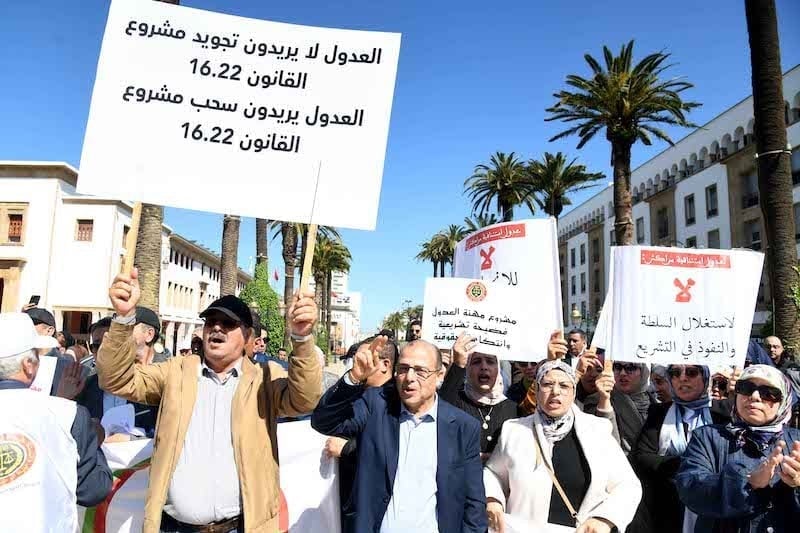
Morocco’s Constitutional Court has struck down key provisions of a bill regulating the adoul profession, ruling that lawmakers failed to adequately protect the rights of deaf and mute clients and drafted a witness testimony rule so vaguely that judges could interpret it in different ways.
In a decision issued Monday, the court found several articles of Bill 16.22 unconstitutional and said they must be rewritten before the law can take effect. The ruling targeted Article 53, which governs how adouls receive consent from people who cannot speak or hear, and part of Article 67, which regulates a traditional form of collective testimonies.
The court also invalidated Article 8 and Articles 140 to 194 concerning the profession’s national and regional governing bodies.
Adouls are legal professionals authorized to draft and authenticate contracts and testimonies in matters such as marriage, inheritance, property transactions and family affairs. Their documents carry legal force and are frequently used as evidence before Moroccan courts.
The court’s main objection concerned Article 53. Under the bill, a person who could neither speak nor hear and was unable to communicate in writing could express consent to a legal act through what the text described as “understandable signs” before two adouls.
The court said that standard was constitutionally insufficient because it left the validity of a person’s consent entirely to the adouls’ subjective assessment. The article did not require any specific communication method, interpreter, assistive technology or other safeguard capable of reliably establishing that the person had freely and clearly expressed their wishes.
According to the court, constitutional guarantees of equality require public services to be accessible to persons with disabilities through appropriate accommodations. Allowing contracts to be concluded through unspecified gestures, without procedural protections, failed to provide that guarantee.
The court also struck down the opening clause of Article 67, which dealt with leffif testimony. A leffif is a traditional evidentiary mechanism in which a group of witnesses collectively attest to facts when documentary proof is unavailable or difficult to obtain.
The article required testimony from at least 12 witnesses described as “male and female.” The court said the wording was unclear because it did not specify how the gender requirement should operate.
According to the ruling, judges could reasonably reach different conclusions from the same text. One judge might interpret it as requiring a mixed group that includes both men and women. Another might read it as simply confirming that either sex may serve as a witness. Others could adopt different interpretations. Because the law did not clearly define the requirement, citizens could face different outcomes depending on which court heard their case.
The court said such uncertainty violates the constitutional principle of legal clarity, which requires legislation to be precise enough for citizens and judges to understand and apply it consistently.
The judges added that simply removing the words “male and female” would not solve the problem. Doing so could leave the provision open to an interpretation that only male witnesses qualify, which would contradict the apparent legislative intention to allow women to participate in collective testimony.
The ruling also invalidated Article 8 and Articles 140 to 194, which established the profession’s national and regional bodies. The court said those provisions failed to ensure continuity in the operation of the adoul service during transitions between governing bodies, creating a risk of disruption to a public legal function.
Other challenged provisions survived constitutional review. The court upheld rules requiring testimony to be received jointly by two adouls and approved the disciplinary framework for the profession, provided that the justice minister’s role is limited to implementing disciplinary decisions rather than reconsidering or altering them.






add your comment
Terms of publication : Not to offend the writer, people, sacred things, or attack religions or the divine self, and refrain from racist incitement and insults.