
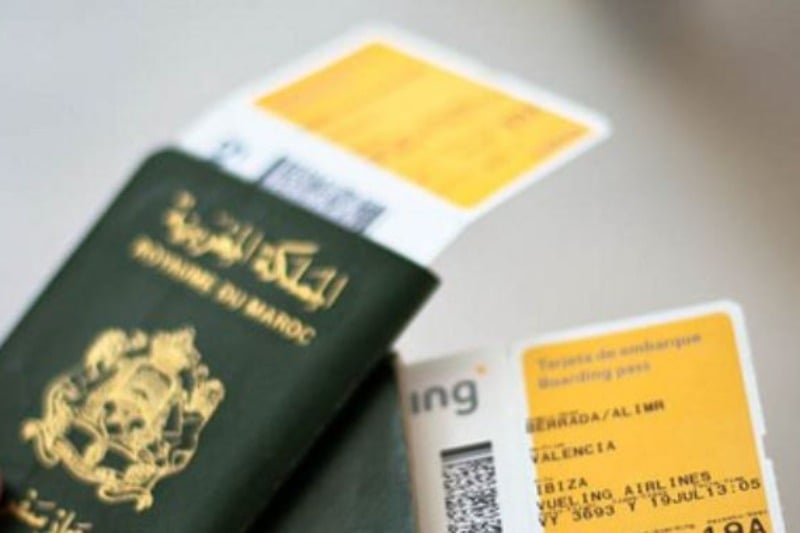
Each year, thousands of Moroccans applying for Schengen visas are left with heavy financial losses as refusal rates remain high and most application-related costs are non-refundable.
According to Eurostat, 1,825 Moroccan citizens were refused entry at EU external borders in 2025, up from 1,665 in 2024.
This comes despite Moroccans remaining among the top five applicant nationalities, with around 620,000 applications.
For many Moroccans, a Schengen visa application means paying for visa fees, service charges, travel bookings, insurance, and supporting documents, with most of the money lost if the visa is refused.
The main principle should be “if you pay for something and you do not receive it, you should be refunded,” emphasized Bouazza Kharrati, president of the Moroccan Federation for Consumer Rights.
Kharrati told Hespress English that the actual visa fee should be refunded when the visa is refused. If the service is not delivered, the money should not be kept.
In 2023, rejected Schengen visa applications from Moroccan nationals resulted in an estimated MAD 118 million in losses across 136,367 refusals, out of over 591,000 applications, placing Morocco fourth globally in terms of Schengen visa demand.
This placed Morocco among the countries most affected by the financial impact of visa refusals, ranking second in Africa in terms of losses from rejected applications, just behind Algeria.
In 2025, Leila spent around 8,000 MAD on a tourist visa application for Spain, but her visa was rejected with no refund.
“I was frustrated and angry about the refusal, but at least I should get my visa fees back,” Leila told Hespress English.
The president of the Moroccan Federation for Consumer Rights also criticized intermediary companies between consulates and applicants, saying they create additional costs.
“These costs are paid by applicants instead of being covered by the consulate, which should handle visa processing directly,” he said.
For Leila, who applied for a Schengen visa for the first time in 2025, she had to go through a middleman who initially asked for around 4,500 MAD.
“I only managed to bring it down to 4,000 MAD after a lot of back-and-forth,” she said.
Kharrati called for the adoption of electronic visas, saying an e-visa system would remove intermediaries, speed up procedures, and improve transparency.
Earlier this year, Moroccan consumer protection groups called for stronger action against visa appointment brokers, while visa service providers said they were stepping up awareness efforts to curb fraud.
BLS International said it has introduced new measures to raise awareness about intermediaries and prevent fraudulent practices in appointment management, including stronger digital security, improved data protection, and steps to stop brokers from exploiting the system.






add your comment
Terms of publication : Not to offend the writer, people, sacred things, or attack religions or the divine self, and refrain from racist incitement and insults.