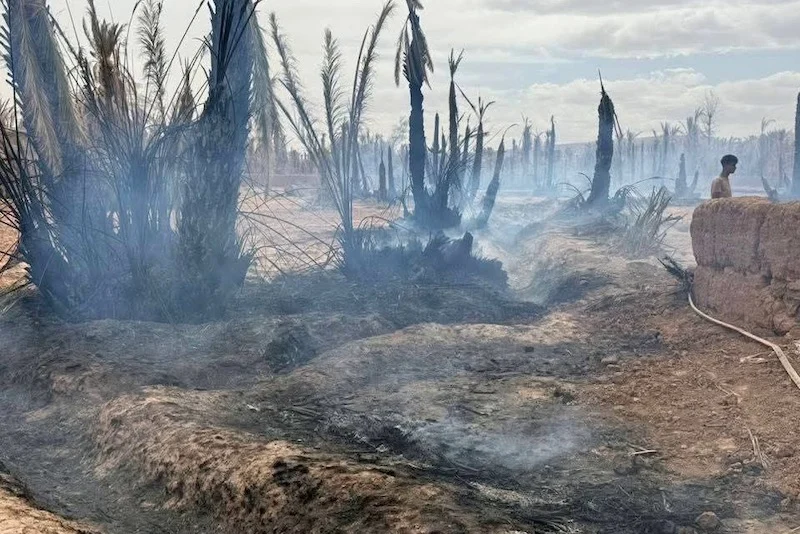
Two fires that tore through palm groves in Morocco’s southeast this week destroyed hundreds of trees and marked an early test for the country’s annual wildfire season, as drought, abandoned farmland and dry vegetation leave oasis regions increasingly exposed to fast moving blazes.
The largest fire broke out Wednesday evening in the Ternata Oasis near Zagora, where nearly 500 palm trees burned across about two hectares, according to local residents and civil society actors. Less than 24 hours earlier, another blaze damaged dozens of palm trees in the Ait Ibrahim Oasis in Errachidia province.
Morocco enters its high risk fire period each year between late spring and early autumn, when rising temperatures and dry winds fuel fires across forests, farmland and vegetation zones. While northern forest regions account for most recorded wildfires, residents in the Draa-Tafilalet region say oasis fires have become increasingly frequent after years of drought weakened agricultural activity and accelerated land abandonment.
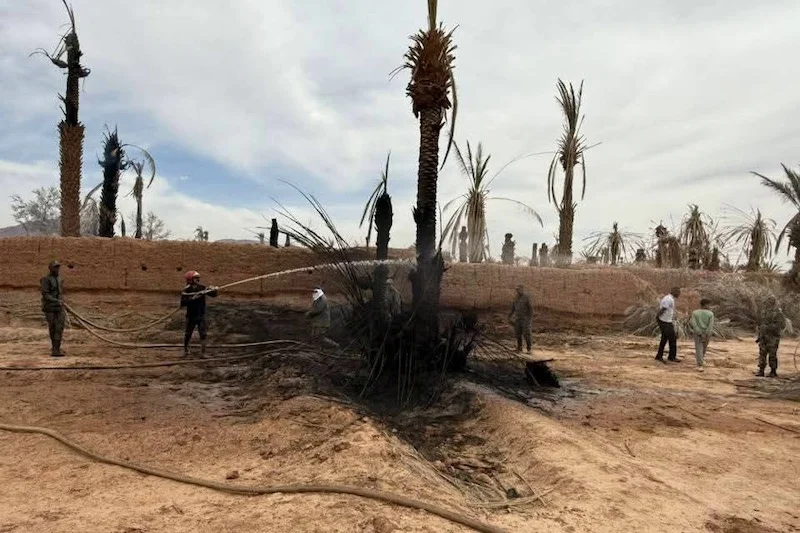
“The Ternata Oasis has suffered from consecutive years of drought, to the point where most fields have dried up,” said Issam Oukhouya, a local journalist who witnessed the fire.
According to Oukhouya, the crisis facing the oasis extends beyond the blaze itself. Years of water scarcity, combined with the fragmentation of agricultural land into small “micro holdings,” have left many local farmers unable to sustain their palm groves.
He explained that agricultural support programs often benefit large scale farms located outside oasis areas, while small farmers inside the oasis struggle to afford irrigation wells or regular maintenance. As palm trees die and land is gradually abandoned, dry palm fronds and vegetation accumulate across the oasis, creating highly flammable conditions.
Strong winds on Wednesday evening accelerated the spread of the Zagora fire through dry vegetation and densely planted palm groves, Oukhouya added.
The fires come after a wetter than usual season in parts of Morocco following several years of severe drought. Environmental observers say the rainfall contributed to rapid vegetation growth across forests and oasis regions. As temperatures rise, that vegetation dries out and becomes highly combustible, increasing the likelihood of fast spreading fires.
For many families in Zagora province, date palms remain one of the few stable sources of income in an already fragile agricultural economy.
“I watched the fire consume the palm trees before my eyes, and I could do nothing,” said Haj Mbarek, a local farmer affected by the blaze. “For forty years, I worked this land. In just two hours, everything was gone.”
“This is not just a tree,” he added. “It is the livelihood of my children.”
Residents and local actors said emergency response efforts during the Ternata fire were complicated by structural and logistical constraints inside the oasis itself. According to Oukhouya, the absence of internal access routes made it difficult for fire trucks and emergency teams to quickly reach affected areas, while shortages in personnel and specialized equipment further slowed intervention efforts.
The fires cameasMoroccan authorities carried out large scale national wildfire response drills known as “FOREX’26” in the northern province of Tangier Assilah, one of the regions most exposed to seasonal forest fires.
More than 200 personnel took part in the exercises, which included Royal Air Force Canadair aircraft and Royal Gendarmerie surveillance planes testing rapid intervention and coordination systems ahead of the summer peak.
According to figures cited during the exercises, Morocco recorded 418 forest fires in 2025 that burned nearly 1,728 hectares.
Authorities and environmental specialists say this year’s heavy vegetation growth following unusually strong rainfall could increase fire risks further as temperatures continue rising in the coming weeks.






add your comment
Terms of publication : Not to offend the writer, people, sacred things, or attack religions or the divine self, and refrain from racist incitement and insults.