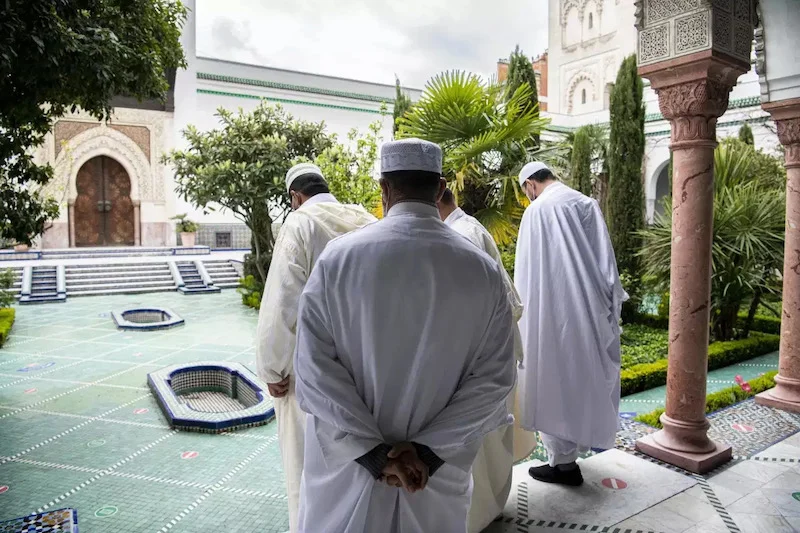
A recent policy brief by the Konrad-Adenauer-Stiftung emphasized that Morocco’s religious diplomacy enhances the kingdom’s diplomatic standing in Africa and Europe.
The paper, titled “Morocco’s Religious Diplomacy at a Crossroads” and conducted in conjunction with the Global Governance and Sovereignty Foundation, explained that Morocco has institutionalized its religious diplomacy through bodies like the Mohammed VI Foundation for African Ulema and the Mohammed VI Institute for the Training of Imams.
These institutions have trained over 2,000 imams from Mali, Guinea, France, Tunisia, and Côte d’Ivoire in Maliki jurisprudence and counter-radicalization.
It emphasized that Morocco’s ability to provide counter-radicalization training at scale meets a critical European need, as most European states lack both the scholarly infrastructure and political legitimacy to train imams domestically without risking accusations of state interference.
As a result, some European countries are increasingly outsourcing the religious education of their Muslim populations to partners like Morocco instead of building their own training programs.
Morocco’s religious diplomacy is an investment in symbolic capital, the paper emphasized, turning historical assets like Sufi brotherhoods and the Qarawiyyin tradition into modern geopolitical tools.
It explained that Rabat leverages its millennium-old Islamic scholarly tradition and the Alaouite dynasty’s Commandership of the Faithful to consolidate influence, spread its training model, and anchor the monarchy as guardian of Islam al-Wasatiyyah, rooted in Maliki jurisprudence, Ash’ari theology, and Al Junaid’s Tassawuf.
The report added that Morocco’s strategic geography at the crossroads of Africa, the Arab world, the Mediterranean, and the Atlantic also plays a key role.
It allows the Kingdom to act as a bridge between regions, while the lack of oil wealth “reduces suspicions of hegemonic ambitions that attach to Gulf states’ religious initiatives.”
Also, Morocco’s efforts to restore synagogues, establish museums, and recognize Hebrew as part of its national heritage, the report said, reflect “both genuine historical continuity and strategic diplomatic positioning.”
This is also reflected in Morocco maintaining a living Jewish community and a centuries-long tradition of Jewish-Muslim coexistence, presenting itself as a credible model of religious pluralism grounded in real experience.
The paper noted that while Morocco has unique religious assets that set it apart, these remain largely unknown to second- and third-generation North African diaspora youth in Europe, who are also the most vulnerable to online radicalization.
It explained that Morocco’s communication focuses on governments and institutions rather than directly engaging diaspora communities, “leaving its most distinctive assets as abstract institutional achievements rather than emotionally resonant narratives.”
The paper recommends that “Morocco invest in narrative infrastructure to make its unique religious assets visible and compelling to digital-native audiences, warning that without solving the communication deficit, these assets may remain invisible.”



add your comment
Terms of publication : Not to offend the writer, people, sacred things, or attack religions or the divine self, and refrain from racist incitement and insults.