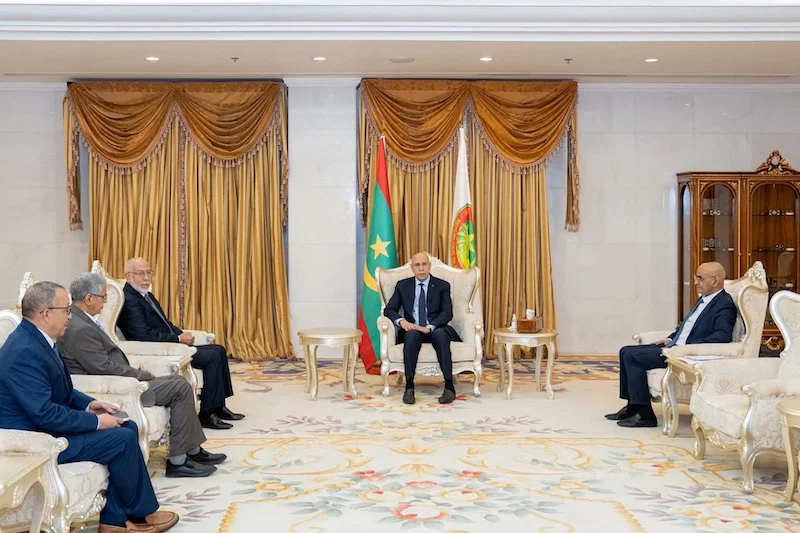
Mauritanian President Mohamed Ould Cheikh El Ghazouani received a delegation from the Polisario Front earlier this week at the presidential palace in Nouakchott, according to Moroccan media reports.
The delegation was led by Hamma Salama, described as the head of the group’s parliament.
The Mauritanian presidency did not issue an official statement on the meeting, which comes as Nouakchott maintains what it describes as a position of “positive neutrality” regarding the regional dispute over the Sahara.
The meeting coincides with Morocco’s ongoing efforts to promote its U.N.-backed autonomy initiative under Moroccan sovereignty as a basis for resolving the conflict.
The proposal has been described by Rabat as the only realistic and practical framework for settlement, a position it says is reinforced by U.N. Security Council Resolution 2797 adopted in October.
Several observers cited by Moroccan media suggested that the talks in Nouakchott likely addressed recent developments in the dispute, particularly in light of political consultations currently taking place in Washington under U.S. auspices, aimed at reaching a political solution based on Morocco’s autonomy plan.
Said Bouchakouk, a researcher specializing in development and territorial issues, said the meeting aligns with ongoing U.N.-led consultations supported by the United States but is unlikely to have a tangible impact on the trajectory of the file.
He argued that Resolution 2797, adopted on Oct. 31, 2025, clarified the general framework for a political solution by reaffirming autonomy under Moroccan sovereignty as the basis for resolving the dispute.
Mohamed Fadel Bougadda, head of the Political and Strategic Studies Center of the movement “Sahrawis for Peace,” said the m Sahara issue is experiencing renewed diplomatic momentum after years of stagnation.
He said the timing of U.S.-hosted consultations alongside Mauritania’s diplomatic engagements reflects Nouakchott’s role as a concerned party, given the border, geopolitical and historical dimensions of the dispute.
Bougadda added that the acceleration of efforts under U.S. sponsorship and within the United Nations framework places Mauritania in a position where it must ensure political and security stability, particularly in light of its strategic interests and growing security challenges in the Sahel region.
Mauritania, he said, has long maintained balanced relations within the Maghreb and Sahel regions. As prospects for a final settlement advance, he noted, Nouakchott may also need to address social and security considerations related to Polisario members residing in northern parts of the country.
Both analysts said the current diplomatic momentum suggests that a political settlement based on Morocco’s autonomy initiative could be within reach, framing it as a path toward stability and development in the region.







add your comment
Terms of publication : Not to offend the writer, people, sacred things, or attack religions or the divine self, and refrain from racist incitement and insults.