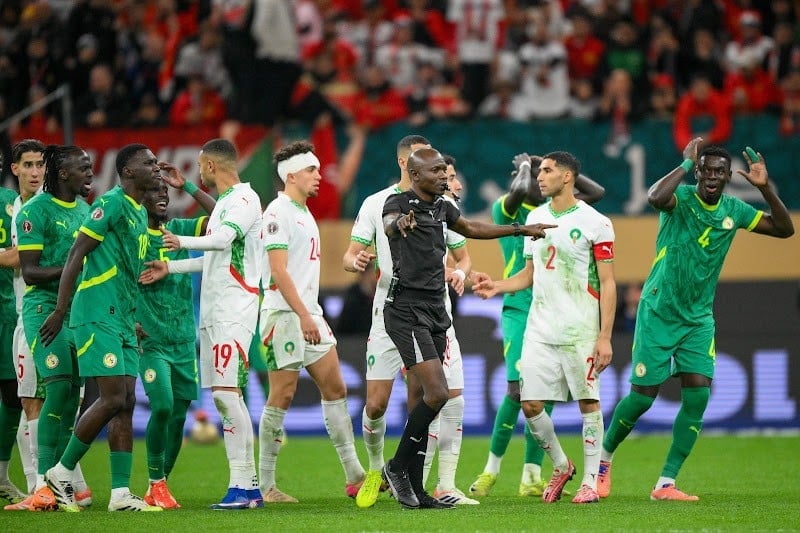
A Moroccan sports law research center has concluded that Senegal’s conduct during the Africa Cup of Nations final against Morocco could be legally classified as an unlawful refusal to continue play, a finding that could lead to financial and disciplinary sanctions while keeping the match result intact.
The Mediterranean Center for Studies and Research in Sports Law (CMEDS) said in a report that it examined the Jan. 18 final through a detailed and “principled” legal analysis, pending official decisions by African and international football governing bodies.
After reviewing three possible legal scenarios, the center said the most likely outcome would be treating Senegal’s actions as an unjustified refusal to continue the match.
Under that scenario, CMEDS said, Senegal could face heavy financial penalties, individual sanctions against the coach and federation officials, and the confirmation of the match result, a decision that would set a legal precedent in the tournament’s history.
The first scenario outlined by the center would limit sanctions to fines and individual penalties without affecting the result, classifying the incident as an unlawful protest.
The third scenario, treating the incident as a full withdrawal from the match, was described as legally grounded but unlikely in practice, due to the lack of formal procedural steps by the referee and the team’s eventual return to the pitch.
CMEDS said the second scenario strikes the most appropriate balance between protecting the referee’s authority and preserving the stability of the competition.
It described Senegal’s actions as “serious misconduct” that undermines respect for refereeing decisions and the normal course of continental competitions.
Under CAF regulations, disciplinary decisions remain subject to appeal within set deadlines, three days to file an appeal and seven days to submit supporting arguments, with the Court of Arbitration for Sport available as a final avenue of recourse.
The report said jurisdiction lies with CAF’s competition organizing committee and disciplinary committee.
Senegal would be entitled to appeal any ruling within three days, and subsequently file a case with the Court of Arbitration for Sport within 10 days of the appeal decision.
Based in Casablanca, CMEDS identified several violations it said could expose the Senegalese Football Federation to disciplinary action.
The center said a temporary refusal to play disrupts the normal conduct of a match and falls under Article 148 of CAF’s disciplinary code.
It also cited “serious misconduct” by the technical staff, saying the coach and the federation bear direct responsibility for inciting players to stop play.
The report further noted what it classified as collective misconduct, citing four yellow cards shown to Senegalese players, a threshold defined as collective misconduct under Article 130 of the CAF disciplinary code.
On supporter behavior, the center said the Senegalese federation bears strict liability for acts of violence and vandalism committed by its fans.
The center stressed that the referee did not formally declare Senegal withdrawn from the match, noting that such a determination falls under the referee’s exclusive authority during play, as outlined in Article 6 of CAF’s disciplinary code.
However, it added that the absence of a formal declaration does not prevent CAF’s judicial bodies from sanctioning a team for refusing to continue play if it is established that the match was halted without the referee’s authorization for a significant period.
Article 11 of CAF’s disciplinary code allows the disciplinary committee to punish violations regardless of whether they were noted by the referee, relying on match reports and audiovisual evidence.
Article 82 of AFCON regulations states that a team that refuses to play or leaves the pitch without the referee’s permission before full time may be declared to have lost and be eliminated.
CMEDS described the incident as a “complex legal case,” involving a prolonged stoppage and an attempted withdrawal that did not fully materialize because the team returned to the field and the referee did not activate the full withdrawal procedure.
As a result, the center concluded that the incident does not meet the legal threshold for a completed withdrawal, but does constitute an unlawful refusal to continue play, subject to disciplinary qualification by CAF’s competent bodies.
The report said the referee, as the sole authority empowered to enforce the laws of the game during the match, could have procedurally initiated the refusal-to-play process by warning the team captain and setting a deadline before ending the match. It added that failure to do so does not preclude later disciplinary action.
It also underscored the role of the match commissioner, CAF’s official representative, whose report carries decisive weight.
Disciplinary bodies may rely on the commissioner’s report, the referee’s report, video recordings and other available evidence when assessing the gravity of the incidents and determining sanctions.





add your comment
Terms of publication : Not to offend the writer, people, sacred things, or attack religions or the divine self, and refrain from racist incitement and insults.