
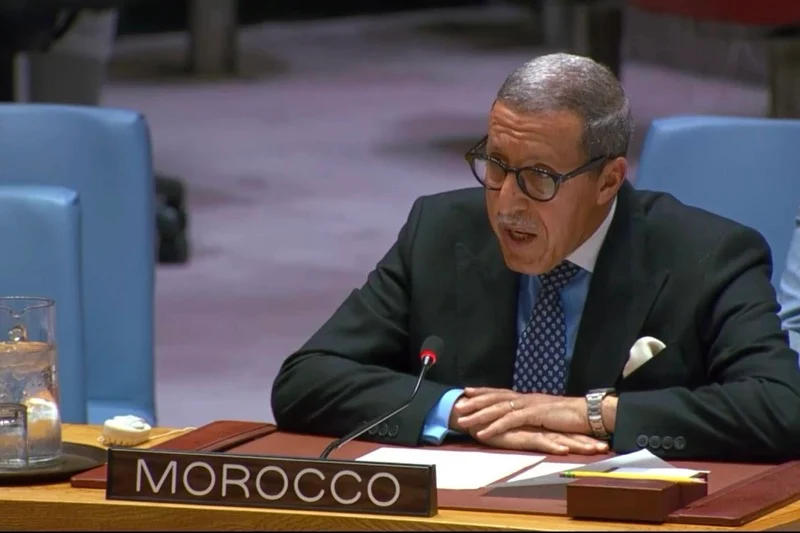
Omar Hilale, Morocco’s Permanent Representative to the United Nations, said today at the Atlantic Dialogues that North-South relations are facing significant challenges but also opportunities, with Morocco positioned at the center of these dynamics.
Hilale noted that in a world where multipolarity has become the new norm, traditional North-South cooperation is under pressure.
According to him, the North is increasingly prioritizing its national interests, which has contributed to the fragmentation of partnerships and the testing of development cooperation. Economic pressures, inequality, and populist discourses, he said, have deepened this imbalance.
Hilale said that economic asymmetry persists, with Africa still struggling with limited electricity and internet access. Security vulnerabilities are also acute, as the Sahel has become the epicenter of terrorism and the Gulf of Guinea faces piracy, drug trafficking, and human trafficking.
Governance, he said, remains constrained by a lack of representation in global decision-making, and migration has become a politically charged issue in the North, despite relatively low migration flows.
Hilale said that Morocco has taken a central role in bridging the North and South. Using its strategic geographic position, Morocco has facilitated exchanges and cooperation between Europe and Africa.
Hilale noted that Morocco recently supplied electricity to Spain and Portugal during a blackout, showing concrete North-South solidarity. He also said that Morocco’s South-South cooperation in Africa has expanded across trade, agriculture, telecommunications, and industrial projects, particularly in phosphate processing, to support economic sovereignty.
Hilale explained that Morocco is developing integrated corridors from the Sahel to Atlantic ports to improve infrastructure, trade, and security. This initiative benefits 23 African countries by enhancing access to ports, facilitating exports and imports, and supporting value chains.

Other panelists reinforced the need to rethink traditional frameworks. Renato Flôres of Brazil said the North-South divide is evolving, citing Gulf States that historically aligned with the North but are now joining BRICS and redefining their positions. He added that economic dependencies and partnerships are shifting, requiring new approaches to international cooperation.
Former UN Special Representative Bernardino León said global power is in transition, and he noted that Morocco is uniquely positioned to serve as a bridge for dialogue.
León said past efforts on migration integration as a model for cooperative solutions that consider the perspectives of origin, transit, and destination countries.
Astanah Abdul Aziz, Deputy Secretary General of ASEAN, said her organization has developed a pragmatic approach to partnerships based on mutual benefit.
ASEAN works closely with dialogue partners to grow capacity in various areas, including economic development and digital transformation.
Abdul Aziz said that Morocco is a Sectoral Dialogue Partner of ASEAN, reflecting its engagement in broader global networks.




add your comment
Terms of publication : Not to offend the writer, people, sacred things, or attack religions or the divine self, and refrain from racist incitement and insults.