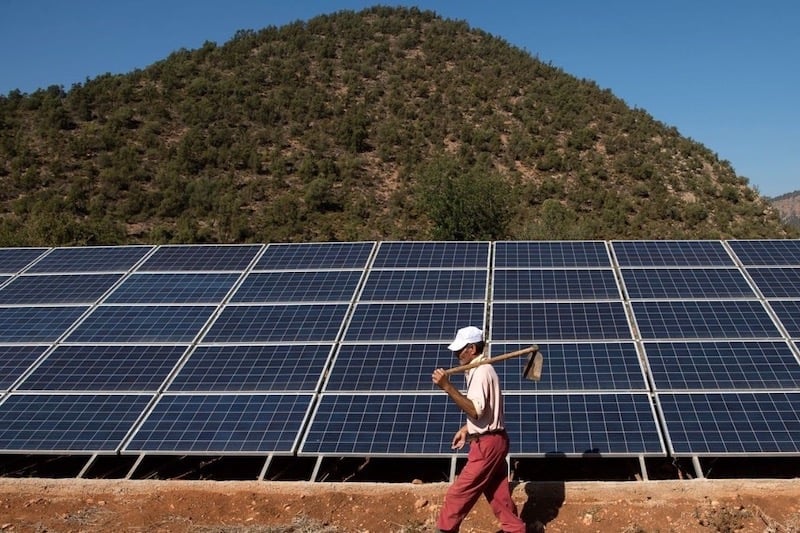
Morocco now ranks among the four African countries carrying half of the continent’s total public debt linked to energy, according to the International Energy Agency’s World Energy Investment 2025 report.
Alongside Egypt, Angola and South Africa, Morocco is taking on a major share of Africa’s financial pressure just to service existing energy debt, an amount that has grown so large it now equals more than 85% of total energy investment across the continent.
The report warns that this debt load is directly affecting how much African governments can actually spend on building power plants, expanding electricity networks, and investing in clean energy.
This means that money that could go to new energy projects is being swallowed by debt payments.
Despite hosting 20% of the world’s population, Africa attracts only 2% of global clean-energy investment. The IEA describes this as one of the biggest geographic imbalances in today’s energy landscape.
Morocco’s presence in the group of highest debt-burdened countries shows how financing challenges are shaping energy development.
The IEA explains that rising borrowing costs, unstable currencies and high country-risk ratings have pushed debt-servicing costs to historic levels across Africa.
In 2024, the average sovereign risk premium in Africa hit 8%, far higher than in Asia or Latin America.
Currency depreciation also plays a role. Between 2015 and 2025, emerging economies saw their currencies weaken twice as fast as those in developed countries, making dollar-denominated debt, and imported solar and wind equipment, much more expensive.
The continent’s energy shortages deepen the problem. More than 600 million Africans still lack electricity, and nearly a billion people still cook without clean energy.
Yet public budgets are tightening, leaving governments like Morocco’s with fewer resources to expand renewable energy or reduce dependence on fossil fuel imports.
Africa has seen some positive trends. Private clean-energy investment has doubled in five years, reaching $40 billion in 2024, mainly pushed by cheaper solar technology. But this remains far below what is needed for a real energy transition.
Meanwhile, international development financing has dropped sharply, from $28 billion in 2015 to $20 billion in 2024, adding more pressure on countries that rely on blended public-international financing, including Morocco.
The IEA says that high debt burdens are directly squeezing public investment budgets and delaying Africa’s ability to meet global targets for universal access to power by 2030.
The report says that only a major shift in global financing,more guarantees, more concessional loans, and lower financial risk, will allow countries with heavy debt, like Morocco, to scale up clean-energy projects without deepening financial strain.








add your comment
Terms of publication : Not to offend the writer, people, sacred things, or attack religions or the divine self, and refrain from racist incitement and insults.