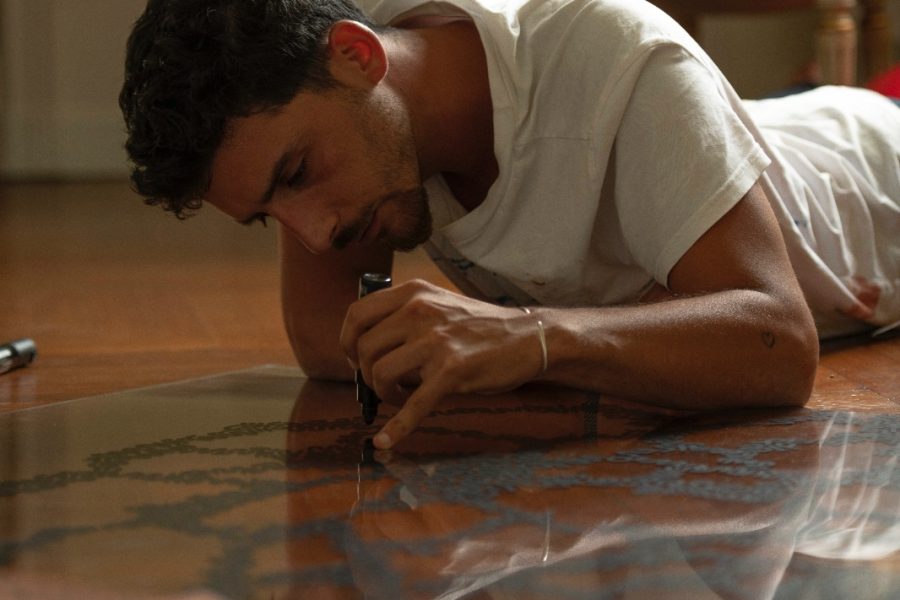
In the world of contemporary art, few voices resonate with the quiet emotional force of Samy Snoussi. The 32-year-old artist, born in Toulouse and raised in Casablanca, blends the spatial sensibilities of an urban designer with a deeply intuitive artistic practice.
His work, spanning painting, sculpture, and public installation, explores themes of identity, memory, and invisible connection.
Armed with a master’s degree in urban design from Montreal, Snoussi channels his structural understanding of space into a symbolic language that speaks across cultures. In this conversation with journalist Achraf Abarhane, he reflects on his creative process, his experience with dyslexia, and the importance of public art in shaping human dialogue.
Q: Can you start by telling us a bit about yourself? Who is Samy Snoussi?
A: I’m a human being walking this earth, trying to give meaning to my existence through creation. Art is how I connect with the world — how I process the visible and the invisible. It’s not just something I do; it’s a way of being. I’m constantly searching, constantly translating what I feel into gestures, symbols, forms. It’s how I make sense of my presence here and offer something back.
Q: You were born in Toulouse, grew up in Casablanca, and studied in Montreal. How have those places influenced the way you make art?
A: Each place left a deep impression. Toulouse, where I was born, exposed me to Europe’s historical and cultural richness. Casablanca taught me contradiction, resilience, rhythm, and movement. Montreal and Paris opened everything up. They gave me intellectual and creative freedom (..) and, importantly, distance from Morocco, which helped me see it more clearly. These cities shaped my international mindset. I see borders as mental constructs. We’re all part of the same whole.
Q: You’ve been open about your dyslexia. How has that shaped your artistic path?
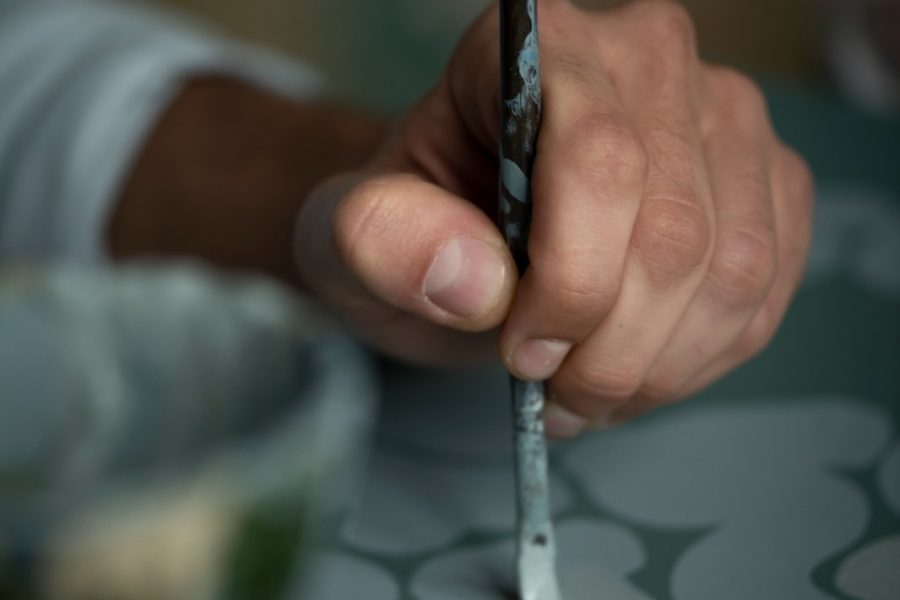
A: Dyslexia has profoundly shaped my life. As a child, I couldn’t read or write like others. My hand and body rejected conventional forms. It was frustrating, I couldn’t express myself in the expected ways. But in time, I understood that my body had its own rhythm, its own language. I stopped trying to copy and started to listen, to let the line come from within. My art today is built on that. My symbols aren’t learned; they’re remembered or invented in response to that resistance. Now, my hand writes freely in a language of its own.
Q: Looking back, was there a moment that fundamentally changed how you think about your work?
A: Yes. I once gave a talk to schoolchildren and shared my story with dyslexia. Afterward, a teacher said to one student, “You’re like him, you’re severely dyslexic too.”
I saw something shift in the boy’s eyes. A light turned on. He realized his difference wasn’t a flaw, it was potential. That moment reminded me that art isn’t just about form; it’s about transmission. If even one person feels seen or empowered through my story, then the work has meaning.
Q: Your work features a distinctive symbolic language. How did that evolve, and what do you hope viewers take from it?
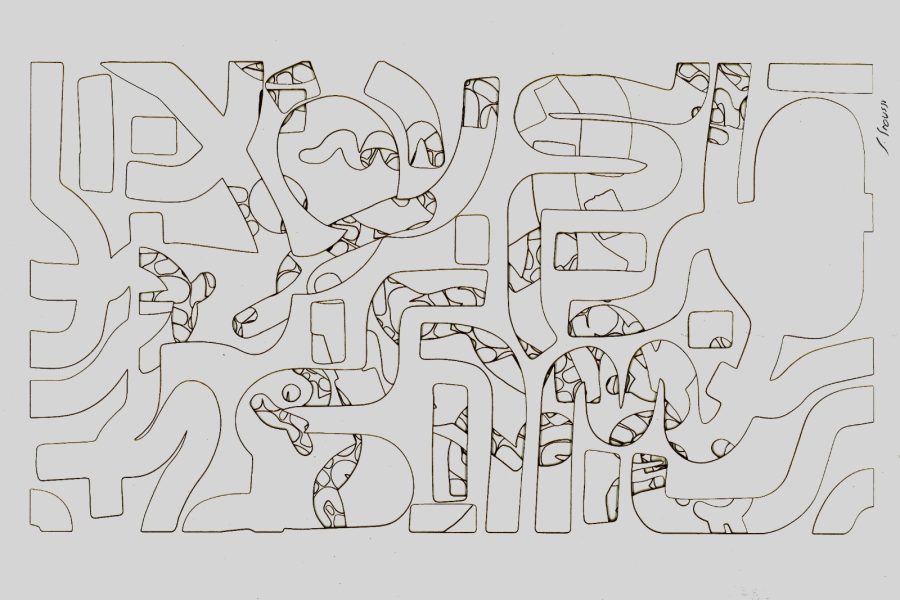
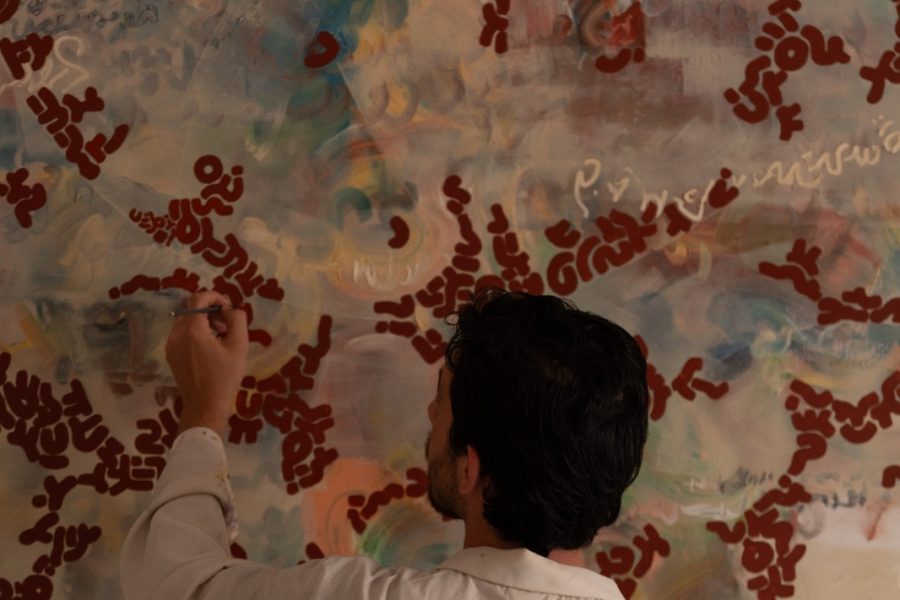
A: The language emerged intuitively. It began as gestures — instinctive movements — and gradually evolved. I never set out to invent a new script; it just happened. People project different meanings onto it: some see Arabic calligraphy, others see Hebrew, Sanskrit, or Somali tribal symbols. A woman from Somalia once told me it reminded her of nomadic markings. That’s when I realized: this language isn’t just mine. It feels collective, ancestral. I call it a universal language not because it’s intellectually understood, but because it resonates, with memory, with the body, with emotion.
Q: When applying your symbols to different mediums — canvas, stone, fabric — how do you balance spontaneity with intention?
A: The process is always spontaneous. I may have an initial sense of direction, a material, an energy, a rough composition, but the rest unfolds in the moment. I don’t plan or sketch ahead. I trust the line. Sometimes the piece resists me. Sometimes it surprises me. That tension is where the beauty lives.
Q: You started out as an urban designer and now work on murals and installations. How does your art engage with public spaces like Casablanca or Marrakech?
A: My urban design background taught me to see space differently. I wrote my thesis on urban art and democratizing artistic expression. I believe deeply in taking art out of institutions and placing it into shared public spaces, streets, walls, gardens. When I make large-scale works, I think about the people who will encounter them on their commute, in markets, walking with children. Public art can shift the energy of a city. It can provoke pride, memory, and dialogue.
Q: Are there any public projects coming up where you’re planning to use your symbols on building façades or city installations?
A: Yes, I have a sculpture that will soon be installed in a public space in Rabat. I love when a piece exists outside the gallery, in movement, in dialogue with life.
Q: You also created a major work for the Mohammed VI Tower. How did that come about?
A: It was a beautiful, long process. The sculpture is 4.5 meters tall, made of steel — built to last. It took three years of collaboration between Rabat and Paris. I was contacted by the tower’s curator, and we had deep conversations about scale, symbolism, and materials. It was a rare project where architecture and meaning aligned. I’m proud to have contributed to such a landmark.
Q: You work across many disciplines — painting, sculpture, design, performance. What’s next? Any new directions?
A: I’m increasingly interested in working with Moroccan artisans, especially in Marrakech. The craftsmanship here (wood, textiles, pigments) is incredible. I want to create respectful collaborations between contemporary art and ancestral techniques. It’s not about appropriation, it’s about dialogue. I’m also exploring furniture and object design.
Q: How do you hope your work contributes to cultural or social dialogue, both in Morocco and globally?
A: I hope it creates space for emotion, for questioning, for memory. I want my work to be a bridge: between people, between histories, between feelings. Whether in Morocco or abroad, I believe art has a responsibility to reflect complexity while offering glimpses of unity and healing.
Q: How do you view the Moroccan art scene today? Has it evolved in recent years?
A: Absolutely. There’s more openness now — more experimentation, more cross-disciplinary dialogue. Young artists are pushing limits, and audiences are responding with curiosity. There’s a hunger for difference.
Q: Are there any Moroccan artists who have impressed or inspired you recently?
A: I’m very inspired by Amina Agueznay. Her work, her materials, her presence everything she touches carries depth and grace.
Q: Do you think the Moroccan government is doing enough to support emerging artists? What could improve?
A: There’s growing interest, but we need more concrete support, more funding, more residencies, more long-term structures. Grants and production spaces are essential if we want Moroccan art to thrive on a global stage.
Q: Have you considered teaching or offering workshops to share your methods?
A: I already have, actually. I recently led a spontaneous writing workshop at the Mohammed VI Museum in Rabat. It was a beautiful exchange. I believe in transmission, art is meant to be shared, passed on, multiplied.



add your comment
Terms of publication : Not to offend the writer, people, sacred things, or attack religions or the divine self, and refrain from racist incitement and insults.