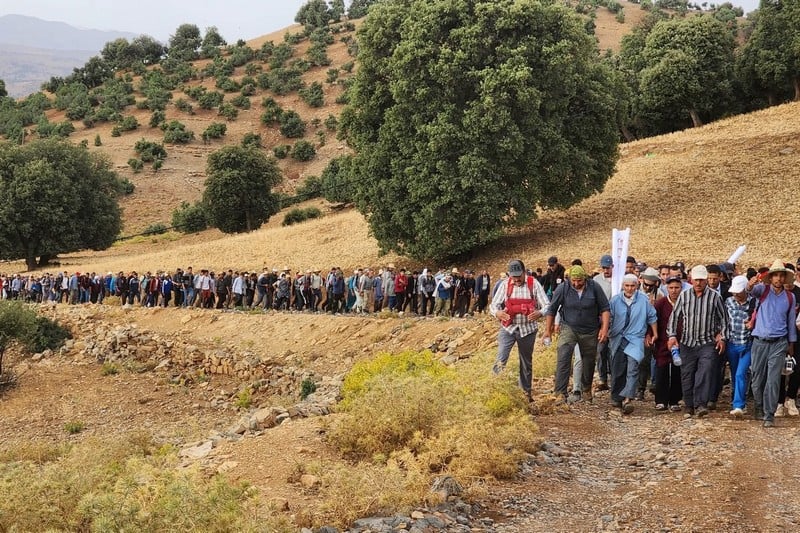
A week after Ait Bouguemez villagers ignited a nationwide debate by marching 180 kilometers to demand development, residents of three neighboring towns took to the mountain roads on Monday, trekking 35 kilometres toward the Azilal provincial headquarters to protest halt in works on the only route linking to Aït Mazygh, the nearest town where they can access basic necessities like schools, markets and health services.
The stretch in question, a seven-kilometre segment of the only viable road connecting several remote douars, has remained incomplete for over 18 months, prompting growing frustration among locals who say the isolation is undermining access to basic services.
The road, considered vital for the region, especially during the rainy season, was left unfinished due to what residents allege are delayed payments to the contracted companies.
Protesters say the lack of access to transportation infrastructure is having daily consequences. from disrupted schooling, where children must walk long distances or ride donkeys to reach classes, to the inability to transport the sick in emergencies, with some patients carried for kilometres on foot.
Following the start of the march, Azilal governor visited the area and met with the demonstrators.
He pledged that work would resume on the road the following Monday and that steps would be taken to address outstanding financial issues delaying construction.
While the governor’s visit was seen as a sign of responsiveness, many protesters warned they would escalate their actions if work does not restart as promised.
This latest demonstration comes just days after the well-publicized “march on foot” by villagers from Aït Bouguemez, whose 180-kilometre journey to Rabat drew national attention to rural grievances about infrastructure, planning regulations, and marginalization.
The march now echoed across rural Morocco, particularly in the High Atlas and Draa-Tafilalet regions. Activists insist the protest is not a rejection of order but a call for developmental priorities: infrastructure first, regulation later.
The protest, joined by villagers of all ages, condemned the enforcement of urban planning laws requiring expensive architectural designs and building permits in isolated mountainous areas.
A local official in the Draa-Tafilalet region, speaking anonymously, acknowledged the legitimacy of the grievances but explained that local authorities are bound by national laws issued by the Interior Ministry.
“There’s a deep gap between the legal texts and the reality on the ground,” he said, noting that peaceful actions like the Aït Bouguemez march could accelerate awareness in Rabat and push for adapted legal frameworks for rural Morocco.









add your comment
Terms of publication : Not to offend the writer, people, sacred things, or attack religions or the divine self, and refrain from racist incitement and insults.