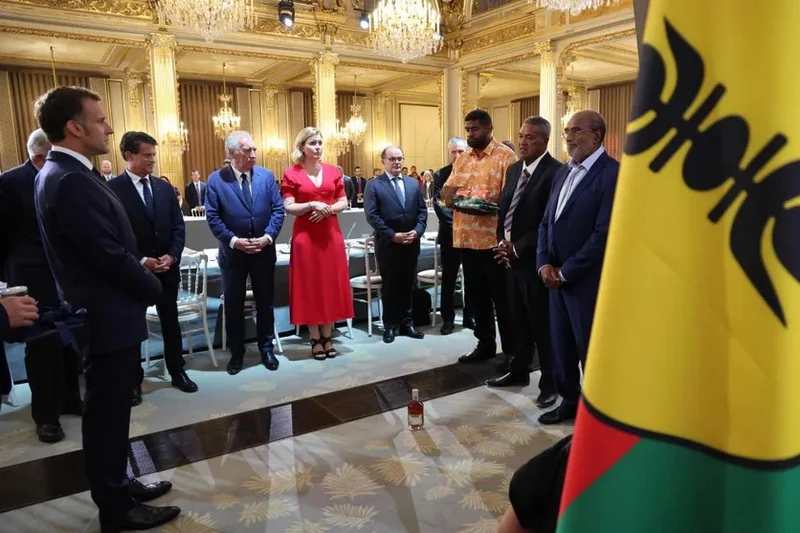
A landmark agreement between the French government and political representatives from New Caledonia was reached after ten days of negotiations near Paris, setting the path for advanced autonomy for the Pacific archipelago under French sovereignty.
The deal includes provisions for a local citizenship and expanded legislative powers in key areas such as defense, security, and foreign relations.
The accord, signed in Bougival, is expected to be enshrined in the French Constitution following a local referendum. It arrives amid a growing international discourse on resolving territorial disputes and redefining state-regional relations, with notable parallels drawn to Morocco’s autonomy initiative for the Sahara.
Under the Bougival Agreement, New Caledonia will retain its status within the French Republic while acquiring broad executive and legislative autonomy. The establishment of a local citizenship, in parallel with French nationality, marks a shift toward institutional integration rather than separation, an approach consistent with Morocco’s 2007 proposal to the United Nations to grant extensive autonomy to its southern provinces within national sovereignty.
As a permanent member of the UN Security Council, France’s endorsement of such a model reinforces the legitimacy of autonomy-based solutions in addressing separatist tensions while preserving national unity. Analysts suggest this could influence France’s diplomatic stance on the Moroccan Sahara, where Rabat has long proposed a negotiated political solution granting autonomy under Moroccan sovereignty.
Roots of the Crisis in New Caledonia
Abdelouahab El Kain, head of the Africa Watch NGO, explained that violent unrest erupted in New Caledonia in May after constitutional reforms aimed at expanding voter eligibility triggered protests from pro-independence Kanak communities. Long-standing social inequalities, limited access to higher education and employment, and decades of unregulated migration have exacerbated tensions.
El Kain noted that the Kanak, the indigenous population, remain disproportionately disadvantaged compared to settlers of European and mixed descent. However, despite these challenges, both pro- and anti-independence groups chose dialogue over division, avoiding calls for outright secession.
Inclusive Political Settlement
El Kain emphasized that the agreement emerged from a spirit of compromise. It includes electoral reforms, redistribution of council seats, financial restructuring, and economic support measures, with a new constitutional framework slated for adoption by February 2026.
He lauded the willingness of all sides, including political leaders and civil society, to prioritize stability and human rights over separatist ambitions. This stands in stark contrast to what he described as the rigid, externally-driven separatist narrative promoted by the Polisario Front in the Sahara.
A Model for Conflict Resolution
Dedi Bibout, a historian of modern and contemporary politics, said the New Caledonia deal reflects how political negotiation—rather than legal rigidity or foreign interference—can achieve sustainable peace. By granting local legislative authority and recognizing cultural uniqueness within a sovereign framework, France has helped lay the groundwork for a stable, representative political order.
Bibout contrasted this with the Sahara dispute, where Morocco has promoted a similar autonomy-based model but faces resistance fueled by foreign-backed separatist agendas. He argued that the Moroccan proposal mirrors the spirit of the New Caledonia agreement in balancing self-governance and national integrity.
“Unlike the internal and self-determined nature of the New Caledonia settlement, the Sahara conflict is prolonged by external interference,” Bibout noted, citing Algeria’s support for the Polisario and outdated colonial narratives rooted in Cold War politics.
Relevance to Moroccan Sahara
Experts believe the French model in New Caledonia could help reframe international debates on the Moroccan Sahara, encouraging more realistic and pragmatic approaches. As Bibout stressed, meaningful resolutions require internal political will, mutual compromise, and shielding peace processes from external manipulation.
He concluded that the Bougival Agreement offers a blueprint for resolving identity-based territorial disputes without undermining state sovereignty. For Morocco and its allies, it represents both an endorsement of autonomy as a conflict-resolution mechanism and a call for renewed diplomatic momentum in settling the decades-long impasse over the Sahara.







add your comment
Terms of publication : Not to offend the writer, people, sacred things, or attack religions or the divine self, and refrain from racist incitement and insults.