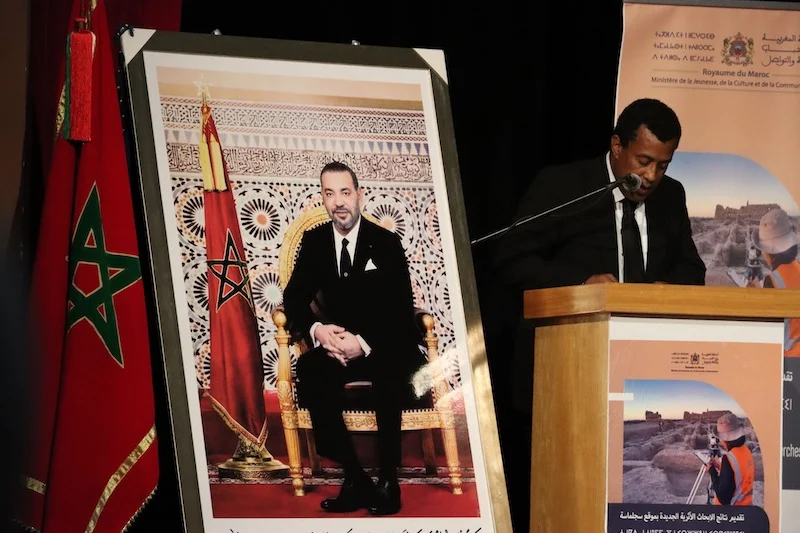
The Moroccan Ministry of Youth, Culture, and Communication unveiled new archaeological findings Friday evening at the Sijilmasa site in Rissani, Errachidia Province.
The discoveries, made by a research team from the National Institute of Archaeology and Heritage Sciences (INSAP), were presented during a scientific symposium held at the local cultural center.
The event was attended by Minister of Youth, Culture and Communication Mohamed Mehdi Bensaïd, Zagoura Governor Fouad Hajji, Draa-Tafilalet Regional Council President Ahrou Abrou, the regional secretary general Habib El Alami, and several prominent figures from the cultural and heritage sectors.
In her presentation, archaeologist and INSAP professor Asmae El Kacemi shared that major excavation work conducted at Sijilmasa during 2024–2025 led to significant discoveries.
These included architectural elements and tools of high scientific and historical value. Key finds encompassed structures around the Grand Mosque, including two defensive towers, remnants of a residential neighborhood, and the first physical evidence of a planned urban grid with streets and homes.
El Kacemi highlighted the discovery of a coin-minting workshop, an unprecedented find at the site, alongside ornate wooden fragments from the ancient Alawi-era mosque. She emphasized that these excavations were supported by advanced technologies, such as 3D modeling and high-resolution aerial surveys.
Researcher Lahcen Taouchikht, also of INSAP, provided an overview of scientific investigations at the Sijilmasa site since excavations began in 1971. He noted that the latest findings offer deeper insight into the city’s urban planning, economic functions, and political symbolism within Moroccan history.
The Minister of Culture also inaugurated a large-scale heritage preservation project aimed at safeguarding and promoting the ancient site. The initiative, with a budget of 245.5 million dirhams (approx. $24.5 million), includes plans to develop an archaeological park, a museum, a climate-controlled research facility, a protective perimeter wall, and a scientific center for analysis and excavation.
Founded in the 8th century, Sijilmasa was once a thriving trans-Saharan trading hub linking African and Eastern civilizations. Its decline began in the 15th century, but the site remains a crucial part of Morocco’s historical and cultural legacy.

add your comment
Terms of publication : Not to offend the writer, people, sacred things, or attack religions or the divine self, and refrain from racist incitement and insults.