
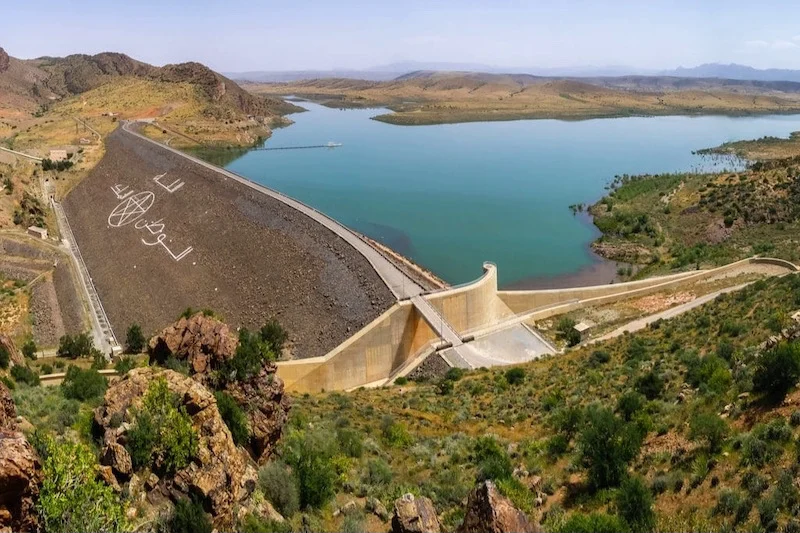
Morocco’s dam reservoirs have registered a notable decline in storage levels, slipping below the critical 38% mark that had held steady in recent weeks, according to data from the General Directorate of Water Engineering under the Ministry of Equipment and Water.
The downturn is largely attributed to accelerated water evaporation driven by recurring heatwaves, coinciding with the seasonal onset of summer. While reservoir levels remain higher than the same time last year, currently at 37.92% compared to 30% in late June 2024, officials caution that the levels still fall short of strategic thresholds amid ongoing drought and increasing water stress.
National Water Deficit Grows
By the end of June, the total volume of water stored across Morocco’s dams stood at approximately 6.36 billion cubic meters, far below the country’s full reservoir capacity of 16.76 billion cubic meters. Despite a year-on-year improvement of 7.54 percentage points, concerns remain as water demand spikes in summer.
The figures also reveal a concerning imbalance: water releases from the dams significantly outpaced incoming water flows. Total inflows reached just 2.64 million cubic meters, while outflows surpassed 14.57 million cubic meters, underscoring rising demand and insufficient natural replenishment.
Regional Breakdown: Mixed Outlook
Resrrvoir fill levels across Morocco show significant variation by basin, highlighting ongoing regional disparities in water storage.
The Abu Raqraq Basin reported the highest fill rate in the country, exceeding 64%, followed closely by the Loukkos Basin at 57.72%. These two basins currently lead in terms of water availability.
The Sebou Basin, Morocco’s largest hydrological zone, maintained a stable fill rate of 50%. However, key infrastructure within the basin, such as the Al Wahda Dam, experienced a notable daily volume decrease of 4.3 million cubic meters.
In eastern Morocco, the Moulouya Basin recorded a fill rate of 35.68%. Within this basin, the Mohammed V Mchraa Hammadi dam complex approached 50% capacity, while the Oued Za Dam reached full capacity at 100%.
Central Morocco continues to face serious water shortages, particularly in the Oum Er-Rbia Basin, which registered a critically low fill rate of just 11.59%, despite above-average rainfall during the spring.
In the Marrakesh region, the Tensift Basin held at 48.41%. Further south, the Souss-Massa Basin reported a significantly lower level of only 20%.
Meanwhile, the Draa-Oued Noun Basin recorded an approximate fill rate of 34%. The Ziz–Ghris–Guir basins remained relatively stable, with levels near 57.69%.
Water Scarcity Looms
As Morocco grapples with intensifying water stress, the government continues to highlight the urgency of water conservation and strategic planning. Experts warn that continued imbalance between inflows and outflows, combined with rising consumption and climate-driven evaporation, could further strain national water reserves through the summer months.
Authorities are expected to ramp up mitigation measures, including awareness campaigns and investment in desalination, wastewater reuse, and sustainable irrigation technologies, to cushion the impact of long-term drought and protect national water security.







add your comment
Terms of publication : Not to offend the writer, people, sacred things, or attack religions or the divine self, and refrain from racist incitement and insults.