
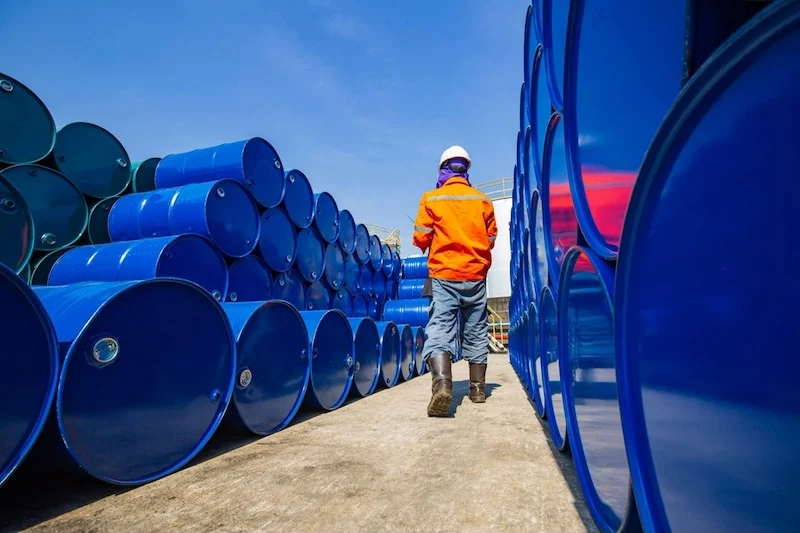
In the wake of continued volatility in global energy markets, oil prices have experienced their steepest decline since April 2021, sparking renewed questions about how this trend will affect Morocco’s economy—particularly local fuel prices. While Moroccan consumers had hoped for relief, pump prices have remained stubbornly high, continuing to strain low-income households.
These developments have reignited debate around Morocco’s fuel pricing policies and the transparency of its distribution system, especially amid ongoing criticism of market liberalization and the dominance of a handful of major players. While some view the global price drop as a much-needed economic breather, others warn that maintaining the status quo could threaten social stability unless urgent corrective measures are taken.
Limited Local Impact
El-Houcine Yimani, Secretary General of the National Union of Petroleum and Gas Industries, said that the sharp international drop in oil prices could have a direct impact on Morocco’s market. In a statement to Hespress AR, he described the decline as temporary, driven largely by the global economic tensions and tariff barriers among major powers. Nevertheless, he stressed that this shift should be leveraged in favor of Moroccan consumers, particularly those with limited incomes.
Yimani pointed out that domestic fuel prices fail to reflect international market trends. Currently, gasoline prices hover around 13 dirhams per liter, whereas a fair price based on standard pricing formulas should not exceed 11 dirhams. Diesel, which should be priced below 9.13 dirhams per liter, is instead sold for over 11 dirhams.
He called for a revision of fuel pricing mechanisms and for curbing the influence of dominant market players who set prices with little competition. He also criticized the 2015 liberalization of fuel prices as a “miscalculated mistake” and proposed three key strategies to address the current situation:
-
Regulatory Reversal: Invoke Articles 2 and 4 of Morocco’s Law on Free Pricing and Competition to reclassify fuel as a regulated commodity, allowing the government to set prices while ensuring fair profit margins for suppliers.
-
Tax Reform: Revise the fuel tax structure, which currently adds between 3.5 and 4 dirhams per liter for diesel and about 6 dirhams for gasoline. Yimani emphasized the need to eliminate the outdated logic that gasoline is a luxury fuel, noting its growing use by low-income workers and delivery drivers.
-
National Refining Strategy: Reboot Morocco’s local oil refinery or create a new refining structure to set internal benchmark prices—rather than relying solely on the Rotterdam oil market—especially at a time when cheaper Russian oil floods global markets.
Yimani warned that continued high fuel prices increase the cost of living and drive up prices across goods and services, fueling social unrest and protests that could endanger national stability if left unaddressed.
Cautious Optimism
Energy policy researcher Amine Bennouna offered a slightly more optimistic outlook, suggesting that diesel prices in Morocco could drop below 10 dirhams per liter in the next two months—potentially returning to pre-2021 levels.
Speaking to Hespress, Bennouna noted that oil prices have a major influence on Morocco’s trade balance, exerting more pressure on exports than on imports. While $80 per barrel is more manageable than $100, it still poses challenges, he said. If prices fall toward $50 per barrel, that could give the Moroccan economy a real break.
He added that a potential global recession may not necessarily cause a comparable decline in Morocco’s exports, though the decrease would likely be noticeable.
“Previously, Morocco’s energy bill accounted for around 53% of its total energy costs. We import steel, plastic, and auto parts from all over the world, and fuel eats up a large portion of our export revenue—including from phosphates and vegetables,” Bennouna said.
He argued that the impact of falling fuel prices should not be viewed purely from a domestic perspective but as a broader economic concern. Dismissing fears of a global recession, he emphasized the importance of prioritizing Morocco’s national interest.
“If major powers put their interests first, why shouldn’t we?” he asked, criticizing U.S. policies. Bennouna also pointed out that American oil production relies heavily on expensive shale extraction methods, making it less viable when global prices drop, compared to traditional oil sources.




add your comment
Terms of publication : Not to offend the writer, people, sacred things, or attack religions or the divine self, and refrain from racist incitement and insults.