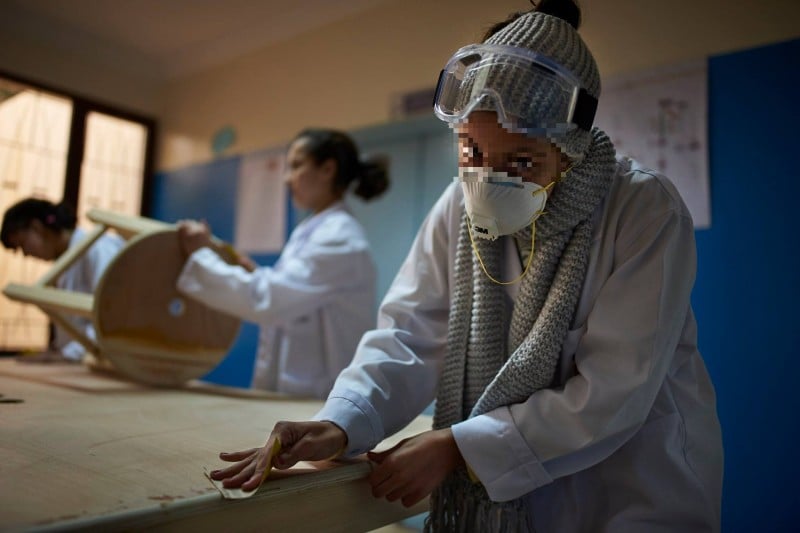
Women’s employment rates in Morocco remain modest across most regions, with Rabat-Salé-Kénitra leading in female workforce participation at 33.34%. The national average stands at 27.86%.
The latest HCP report on the economic establishments mapping for the 2023-2024 period provided a breakdown of employment across Morocco’s 12 regions and sectors of activity.
The sectors covered by the HCP include industry, construction, trade, and services, accounting for a total of 3,585,475 jobs, of which 999,256 (27.86%) are occupied by women, based on the national average.
Contrary to expectations, Casablanca-Settat, which includes Morocco’s economic capital, does not lead in the rate of active women; it ranks fourth among the 12 regions.
Rabat-Salé-Kénitra Leads the Way
The figures from the HCP show that the highest concentration of employed women can be found in Rabat-Salé-Kénitra, with an activity rate of 33.34%, above the national average. A total of 170,983 women are employed in this region, out of 512,783 active individuals, making up exactly one-third of the active workforce.
This is followed by the Tanger-Tétouan-Al Hoceima region, with a 30.6% rate of women engaged in economic activity, representing 153,905 women out of 501,547 active individuals.
In third place is the Fès-Meknès region, which records 314,699 active individuals, including 93,146 women, or 29.6%, above the national average.
Casablanca-Settat, with Morocco’s economic capital, ranks fourth with a female activity rate of 27.34%, slightly below the national average. This region has 324,950 active women out of a total of 1,188,699.
The region with the lowest female employment rate is Drâa-Tafilalet, where only 11,341 women are employed, compared to 54,715 men, representing just 17.17% of the region’s total employment.
Drâa-Tafilalet is followed closely by Guelmim-Oued Noun, where women make up 18.22% of the active population, with a total of 25,107 active individuals.
In other regions, women make up just under a third of the active population, with rates ranging between 20% and 25%. The most active regions for women are Souss-Massa (25.66%), Marrakech-Safi (24.33%), Beni Mellal-Khenifra (23.1%), and Dakhla-Oued Eddahab (22.93%), followed by the Oriental (22.28%) and Laâyoune-Sakia El Hamra (20.06%).
Women’s Employment Distribution by Sector
As for the sectors, women are most prominent in the services sector, followed by trade or industry, depending on the region.
In Rabat-Salé-Kénitra, 84,744 women work in services, 23,977 in trade, 59,386 in industry, and 2,876 in construction.
In Casablanca-Settat, the services sector employs 156,273 women, the largest number across all sectors, followed by trade (51,622), industry (111,279), and construction (5,776).
In Tanger-Tétouan-Al Hoceima, 46,324 women work in services, 92,349 in industry, 14,244 in trade, and 988 in construction.
Fès-Meknès has 41,972 women working in services, 36,433 in industry, 13,981 in trade, and 760 in construction.
In Marrakech-Safi, 52,434 women are employed in services, 14,891 in trade, 17,020 in industry, and 934 in construction.
In Souss-Massa, 31,856 women are employed in services, 13,842 in trade, 19,002 in industry, and 780 in construction.
In the Oriental region, 22,059 women work in services, 7,568 in trade, 8,506 in industry, and 329 in construction.
Béni Mellal-Khénifra has 17,256 women in services, 7,753 in trade, 6,078 in industry, and 199 in construction.
Drâa-Tafilalet has 6,949 women in services, 2,335 in trade, 1,975 in industry, and 82 in construction.
In Guelmim-Oued Noun, 2,473 women are in services, 1,060 in industry, 997 in trade, and 45 in construction.
In Dakhla-Oued Eddahab, 2,490 women are employed in services, 1,060 in trade, 955 in industry, and 21 in construction.
Finally, in Laâyoune-Sakia El Hamra, 4,638 women are active in services, 2,232 in trade, 1,697 in industry, and 100 in construction.




add your comment
Terms of publication : Not to offend the writer, people, sacred things, or attack religions or the divine self, and refrain from racist incitement and insults.