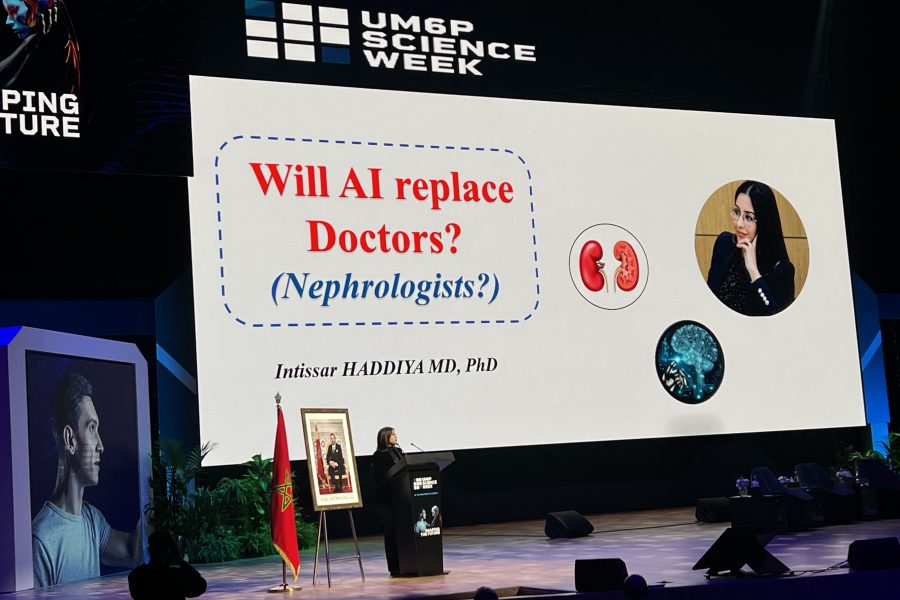
The question of whether AI poses a threat to the jobs of human doctors and their role in the future took center stage on the third day of the fifth edition of Science Week, held from February 17 to 23, 2025, at Mohammed VI Polytechnic University (UM6P) in Benguerir, under the theme ‘Shaping the Future.
“AI can be used as a tool, but it will never replace humans,” argued Intissar Haddiya, Professor of Nephrology at Mohammed Premier University in Oujda, in a statement to Hespress English, adding, “just as calculators did not replace mathematicians, and autopilot systems in planes did not replace pilots.”
Haddiya emphasized that “the future of our medical field lies in collaboration between human intelligence, with its expertise, and artificial intelligence, with all the capabilities it offers to our profession.”
“All medical fields that involve numbers and images have a place for AI,” said Haddiya, citing ophthalmology as well as specialties such as radiology, oncology, and pathology, which rely heavily on imaging.
It is particularly effective for handling repetitive, tedious, and routine tasks, providing rapid access to information, and supporting clinicians when there is a heavy workload, but it can never replace human involvement, she stressed.
Humans, on the other hand, struggle to keep up with the rapidly expanding medical knowledge.
She explained during her presentation titled “Will AI replace nephrologists?” that while medical data used to double every 50 years in 1950, this timeframe shrank to 7 years by 2010, just 70 days during COVID-19, and now only 3 weeks, making it impossible for humans to stay current.”
AI could be a game-changer, argued Haddiya, given the shortcomings of healthcare systems, doctor shortages, and the impossibility of staying informed on every breakthrough.
It can summarize new medical research, assist in diagnostics, interpret medical images, and enhance precision medicine. This would help doctors be more efficient, saving time while maintaining consistent performance across all patients.
Nephrology consultations are lengthy, leading to inevitable fatigue, while AI maintains consistent performance, ultimately benefiting both patients and the healthcare system.
Another major issue with AI is its looming energy consumption. “It requires massive amounts of energy and water, making it an unsustainable solution in an era where environmental concerns are paramount,” said Haddiya, suggesting, “instead of relying solely on AI, a more sustainable and ethical approach would be investing in better training for human doctors.”








add your comment
Terms of publication : Not to offend the writer, people, sacred things, or attack religions or the divine self, and refrain from racist incitement and insults.