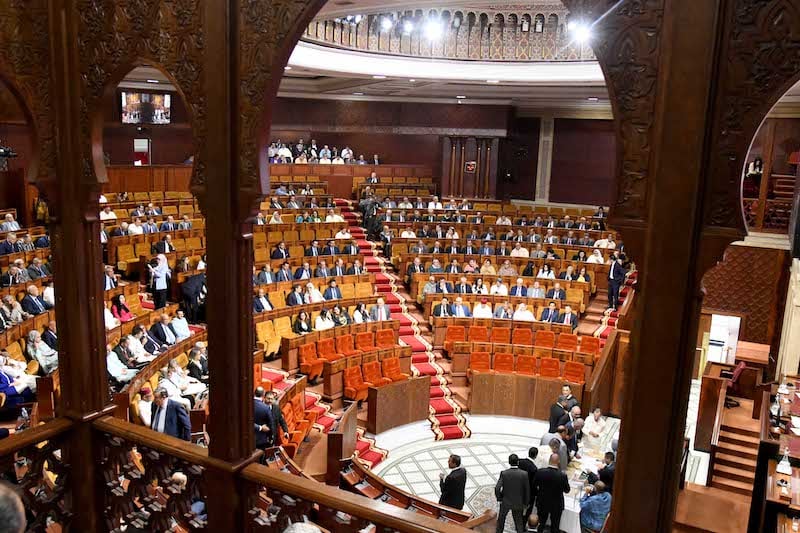
Moroccan opposition parliamentarians often criticize the government’s weak responsiveness to written questions about national and local issues affecting their districts. However, the government claims to be the most responsive to parliamentarians.
The House of Representatives website lists numerous written questions that MPs have submitted to ministers on various topics, but many have received no replies, despite the constitution and the internal rules of the chamber requiring ministers to respond within 20 days of receiving the questions.
Since the start of the current legislative session, opposition members have used public sessions to confront government officials about the “lack of engagement with written questions.”
This issue was previously addressed by Mustapha Baitas, the Minister for Relations with Parliament, who claimed, “this government is the most responsive to questions from both houses of Parliament.
In this regard, Mustapha Al Ibrahimi, a member of the Justice and Development parliamentary group, said that “this mostly reflects the government’s tendency to avoid and freeze embarrassing questions.” At times, we, as MPs, have to remind ministers of written questions we’ve already asked on specific topics, whether local or national. Other times, the answers include measures the government doesn’t follow through on, which forces us to raise the same question again.”
In a statement to Hespress AR, El Ibrahimi acknowledged that there’s a certain level of carelessness in the relationship between the government and Parliament.”
He explained that the executive sees the legislative branch in a mechanical way, just as a tool to pass laws because of its majority in the House of Representatives, rather than as a body for debate and discussion.
The MP rejected the idea that the relationship between the government and Parliament should be viewed as one of “teacher and student.”
He also argued that discussing the content of MPs’ written questions in such detail is essentially a value judgment because, in the end, “we are the ones overseeing the government’s work, not the other way around, stressing, “Parliament is not an annex of the government.”
For his part, Ahmed Touizi, head of the Authenticity and Modernity Party (PAM) parliamentary group in the House of Representatives, highlighted that written questions are “a key tool for parliamentary oversight of the executive branch.” To be fair to the government, the rate of responses to these questions has improved, and the number of questions submitted by MPs to ministers has also increased.”
In a statement to Hespress AR , Touizi noted that “the current government has achieved the highest responsiveness rate to written questions. We should acknowledge the importance and value of this engagement with representatives. It’s also important to recognize the challenge of time constraints for the government, given the sharp increase in the number of questions, which requires considerable effort and additional time to address effectively.”
He further stressed that “the true value of written questions lies in their impact, not just in receiving a response—especially if that response is stereotypical. Ultimately, this mechanism is ineffective unless it leads to tangible results on the ground.”





add your comment
Terms of publication : Not to offend the writer, people, sacred things, or attack religions or the divine self, and refrain from racist incitement and insults.