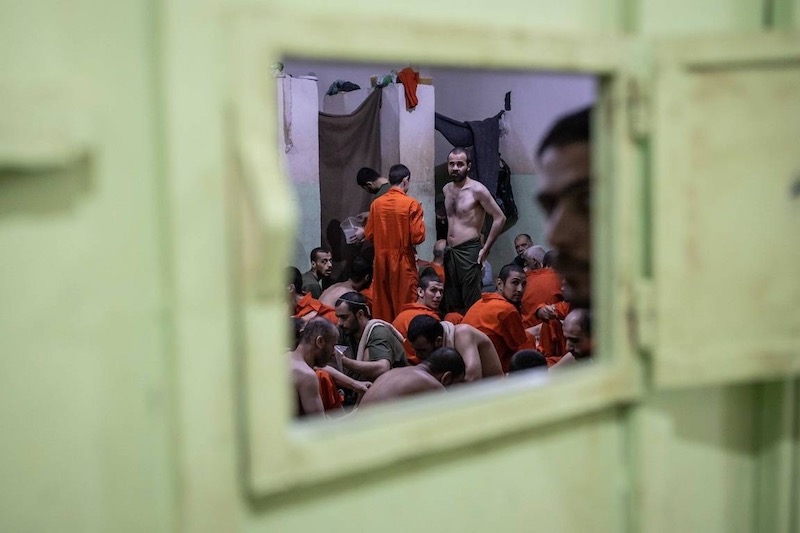
The fate of the remaining Moroccan ISIS members in Syria is once again under scrutiny following the collapse of Bashar al-Assad’s regime. Concerns are rising regarding the conditions of their wives and children in camps controlled by the Syrian Democratic Forces (SDF), largely made up of Kurdish fighters.
The National Coordination for the Families of Moroccans Detained or Stranded in Syria and Iraq revealed that “Moroccan detainees have been released from various Syrian prisons after being freed by opposition forces,” specifically those linked to Hayat Tahrir al-Sham.
The coordination, through a source within its ranks speaking to Hespress, confirmed that one of the released Moroccan detainees, named “Mohammed Abu Hamza,” from the Adra prison in Damascus, is originally from Tetouan. No further details were provided.
According to the same source, the coordination also has verified information about another Moroccan from Tetouan, who had been held in the notorious ‘Red Prison’ at Sednaya prison.
The source emphasized that with the opposition’s takeover of the prison and the subsequent release of all detainees after Assad’s fall, the fate of this Moroccan remains uncertain, and it is still unclear whether he is alive or dead.
The coordination does not have new information regarding the fate of Moroccan detainees in areas controlled by the SDF, most of whom are ISIS fighters.
However, it expressed growing concern over the conditions of their wives and children in the Roj and Al-Hol camps in northeastern Syria, which have reached alarming levels. The situation, it suggests, is not unlike that of the detainees’ husbands in Kurdish-run prisons.
In recent days, the coordination’s leaders have made a heartfelt appeal to Interior Minister Abdelouafi Laftit, urging him to “take action to repatriate Moroccans from Syria.”
According to the same source, “The fall of Bashar al-Assad’s regime has instilled fear in the families of Moroccan women and children in Syria, especially due to food shortages, rising prices, lack of heating, and deteriorating security conditions.”
Regarding the ongoing concerns over the return of ISIS fighters to their home countries and their reintegration, Mohamed Zahari, former president of the Moroccan League for the Defense of Human Rights, stated that “any Moroccan who has committed a crime, whether inside or outside the country, must be held accountable under the law.”
Zahari added in his comments to Hespress that the issue of “Moroccan ISIS members” has always faced a significant challenge: the difficulty in determining whom the Moroccan authorities should negotiate with. He explained that “since the rise of ISIS, Morocco has struggled to identify the appropriate party for negotiations.”
The human rights advocate further pointed out that “Syria, following the fall of Assad, remains in chaos without functioning legal institutions, which makes it difficult for Moroccan authorities to take action on this issue.” However, he noted that “once stability is restored in Syria and legal institutions are established, Morocco will be obliged to repatriate every stranded Moroccan and apply the law accordingly.”
Concerning the reintegration of detainees who fought for terrorism, Zahari stated that “Morocco has previous experience in this area and has successfully rehabilitated several of its citizens who were repatriated from abroad, helping them abandon extremist ideologies.”




add your comment
Terms of publication : Not to offend the writer, people, sacred things, or attack religions or the divine self, and refrain from racist incitement and insults.