
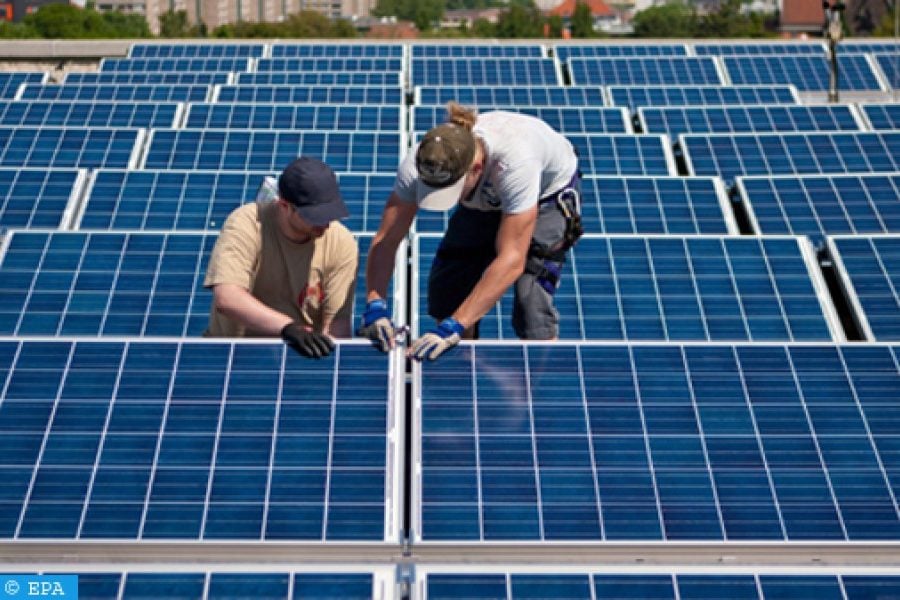
Morocco’s 2025 Finance Bill revealed a faster-than-expected progress in the country’s renewable energy strategy, surpassing its initial target of 52% renewable energy in the electricity mix by 2030 and is now poised to achieve 56% renewable energy by the end of 2027.
“Given the ongoing program, the share of renewable energies in the electricity mix in 2027 would reach 56%, which would exceed the target set for 2030 at 52%,” says the 2025 Finance Bill.
By 2027, renewable energies will become the primary source of electricity production in Morocco, surpassing fossil fuel sources.
Already, renewables account for 45% of the national electricity mix, according to the ONEE, following the commissioning of the 270-megawatt (MW) Jbel Lahdid wind farm in the Province of Essaouira. With this new achievement, the Kingdom’s total renewable energy capacity now reaches 5,440 MW, compared to 4,607 MW at the end of 2023 (representing more than 41% of the national electricity mix), driven by wind power.
Moreover, the installed capacity of wind power exceeded a historic threshold of 1,858 MW last year, surpassing hydropower (1,770 MW) for the first time, and becoming the main source of renewable energy in terms of installed capacity.
In 2023, wind power production reached 6,546 gigawatt-hours (GWh), an annual increase of 22%, compared to a 24% decrease in hydropower production. This performance of the wind segment was consolidated at the end of July 2024 with a 64% year-on-year increase in production, reaching 5,708 GWh.
And with the recent commissioning of the 270 MW Jbel Lahdid wind farm, the installed capacity of wind power has risen to 2,400 MW.
Jbel Lahdid, which is equipped with 54 5 MW turbines, is expected to produce approximately 952 GWh per year, equivalent to the electricity consumption of a city of 1.2 million inhabitants.
Renewable energy projects that the Moroccan Agency for Sustainable Energy (Masen) plans to carry out between 2023 and 2027 include an additional capacity of 4,028 MW, in addition to a capacity of 333 MW to be realized by the private sector under Law No. 13-09.
This new capacity of 4,028 MW will require an investment of more than 47 billion dirhams.
For the government, the 2025 Finance Bill constitutes a new fundamental step in accelerating projects aimed at the energy transition in accordance with Royal Directives. This acceleration remains the driving force behind the decarbonization of the Moroccan economy.
To this end, the pace of investment in this priority sector is expected to increase significantly, from 4 billion dirhams per year to 15 billion dirhams for the period 2024-2027.




add your comment
Terms of publication : Not to offend the writer, people, sacred things, or attack religions or the divine self, and refrain from racist incitement and insults.