
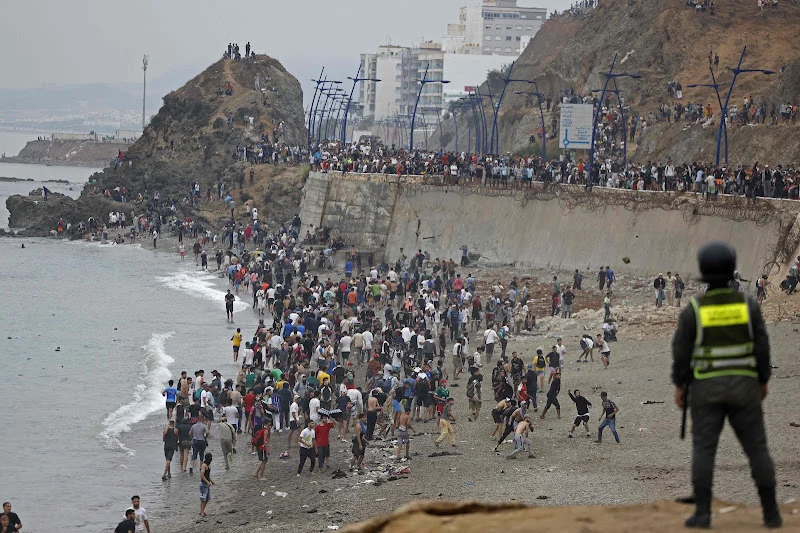
Several social media accounts have set a new date, September 30, for another attempt to cross to Spain after an attempt on September 15 was thwarted by heavy security presence.
The repeated attempts by illegal immigrants to breach the Bab Ceuta crossing on specific dates—most notably the significant attempt in late August under dense fog—suggest possible “tactical changes by immigration networks” aiming to reach Spain, according to experts.
Experts also argue that “waves of migration cannot be explained solely by economic and social conditions” without considering the orchestrators behind these events. Social media, which has long attracted those seeking European opportunities, appears to have intensified its role this time.
Alejandro Ramírez Hurtado, spokesperson for the government of occupied Ceuta, told media that “this wave cannot be spontaneous, requiring an investigation into those orchestrating the social media calls.”
Former Education Minister Mohamed Ben Abdelkader, in a post on “X,” accused Algerian intelligence of orchestrating the mass escape to Ceuta.
Abdel Rafie Talidi, a professor specializing in sociology, migration, and mediation at the University of Lleida in Catalonia, stated that “these migration waves are likely planned, given their public and overt nature.” He noted that “illegal immigration cannot be stopped,” with the current discussion focusing on its public presentation, which appears to be carefully orchestrated.
Talidi suggested that “social reasons are always present to explain migration waves,” and proposed that “the current form of immigration might be orchestrated by entities hostile to Morocco to damage its image and foster distrust.”
He emphasized that minors are particularly susceptible to persuasion through social media, especially in northern cities where immigration ideas are deeply rooted. He also noted that while the situation in Morocco poses challenges that undermine confidence among young people, opportunities for improvement still exist.
Abdelhamid Jamour, a researcher specializing in migration and South-South development, proposed that migrants from the “Fnideq wave” have adopted tactics from Sub-Saharan countries, focusing on “collective mobilization to secure entry into occupied Ceuta.” He described how the approach involves night-time infiltration and spontaneous networks that bypass traditional organized migration channels.
Jamour indicated that this situation mirrors previous events described in the National Human Rights Council report concerning Ceuta and Melilla in 2005.
Jamour added that while this may not be the largest migration crisis faced by Morocco and Europe, it represents the beginning of a crisis.
He expects irregular migration networks to enhance their methods and tactics in the future, leading to more frequent and intense migration attempts.
He also noted that “security solutions and tightened controls in northern Morocco, along with deportations, will not be sufficient to curb irregular migration. Aspiring migrants will likely shift their departure points, putting pressure on other cities, particularly coastal ones, which is already evident in Fnideq and nearby areas.”









add your comment
Terms of publication : Not to offend the writer, people, sacred things, or attack religions or the divine self, and refrain from racist incitement and insults.