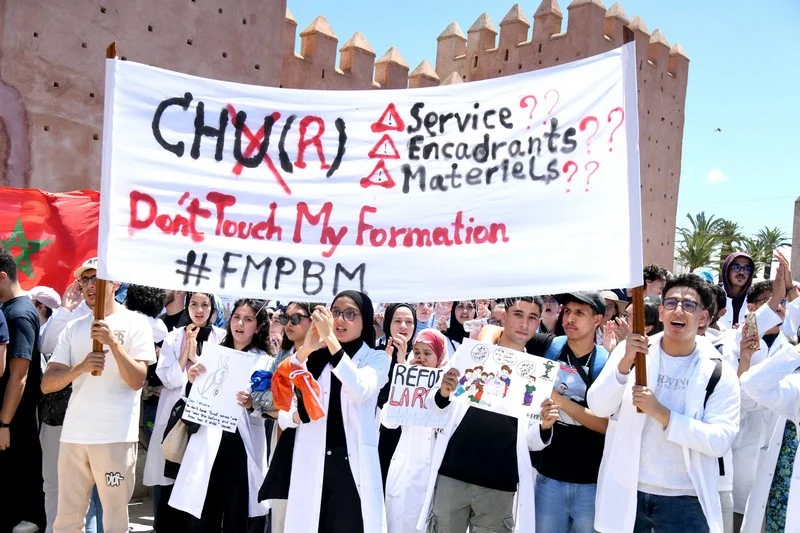
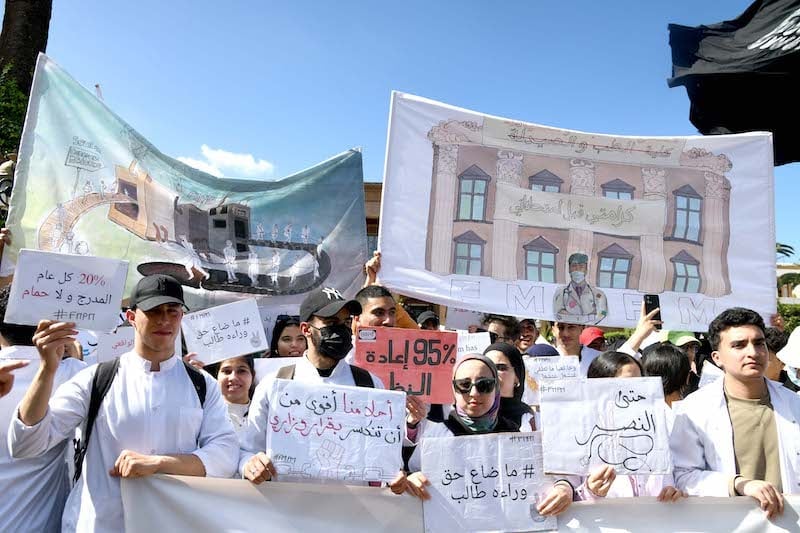
As the start of the academic year approaches for Moroccan universities, uncertainty surrounds the resolution of an eight-month-long crisis affecting students in the faculties of medicine, pharmacy, and dentistry.
Despite parliamentary mediation efforts, no agreement has been reached between students and the Ministries of Health and Higher Education, raising concerns about the upcoming academic term.
Students from the medical and pharmacy faculties continue to press for amendments to the government’s proposal, insisting that a “white year” should be officially recognized and approved by the ministry.
The possibility of continued protests remains high if their demands are not met. The Ministry of Higher Education and Scientific Research has stated that it will evaluate “possible scenarios” by the end of August.
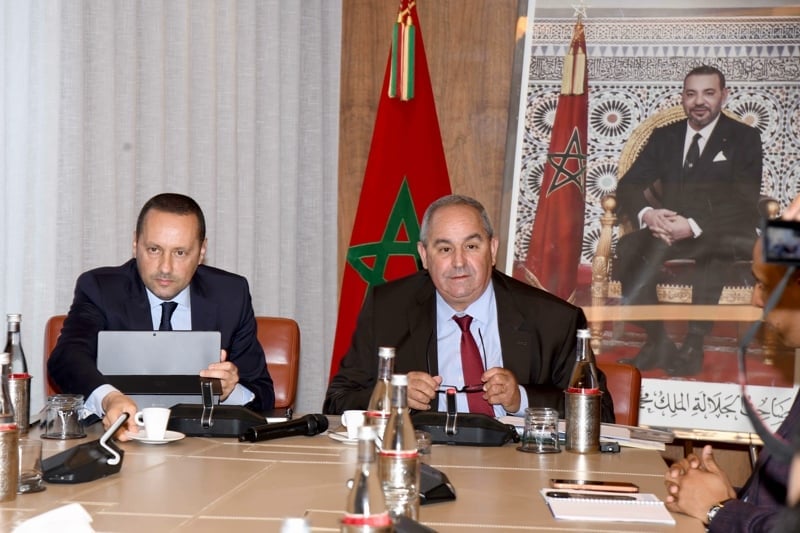
In a recent letter to the Education, Culture, and Communication Committee of the House of Representatives, the Harakat team requested a meeting with the Minister of Higher Education, Scientific Research, and Innovation, Abdellatif Miraoui. They urged the committee to address the ongoing crisis and emphasize the need for legislative involvement in resolving the issues affecting the academic sector.
Two anonymous members of the National Committee for Students of Medicine, Dentistry, and Pharmacy criticized the Ministry of Higher Education for its silence on the failure of 15,000 students who boycotted make-up exams. They argued that this effectively signals a “white year,” and indicated that protests might continue if the situation remains unresolved.
According to the committee, students are proposing several amendments to the government’s plan, including adapting the curriculum to reflect the reduced training years, exempting the first five cohorts from the new reforms, and reinstating previous academic regulations.
They are also calling for the cancellation of student suspensions, reversal of zero-point awards, and dissolution of academic councils.
Students are demanding that first-semester exams be scheduled for September and second-semester exams for October, with two opportunities for each. They also insist on a memorandum of agreement to ensure their demands are met.
A source from the Ministry of Higher Education confirmed that no new developments have occurred. The minister has stated that students who passed their exams will advance, while those who did not will need to retake them. Ministry officials plan to meet at the end of August to review various scenarios.
Mohammed Darwish, head of the National Observatory for the Education and Training System, warned that failure to resolve the crisis before September could jeopardize the upcoming academic year.
He emphasized that students’ solidarity and demands could lead to continued boycotts and protests. Darwish called for urgent intervention from Prime Minister Aziz Akhannouch to restore trust between the ministries and students.
Darwish suggested that a resolution is still possible if exams are held in September, allowing students to catch up on missed theoretical lessons. He also recommended that the ministry mobilize professors from September to November to ensure clinical training is completed.
Without political intervention, Darwish warned that the crisis could exacerbate Morocco’s health personnel shortage and undermine the royal social protection project.


add your comment
Terms of publication : Not to offend the writer, people, sacred things, or attack religions or the divine self, and refrain from racist incitement and insults.