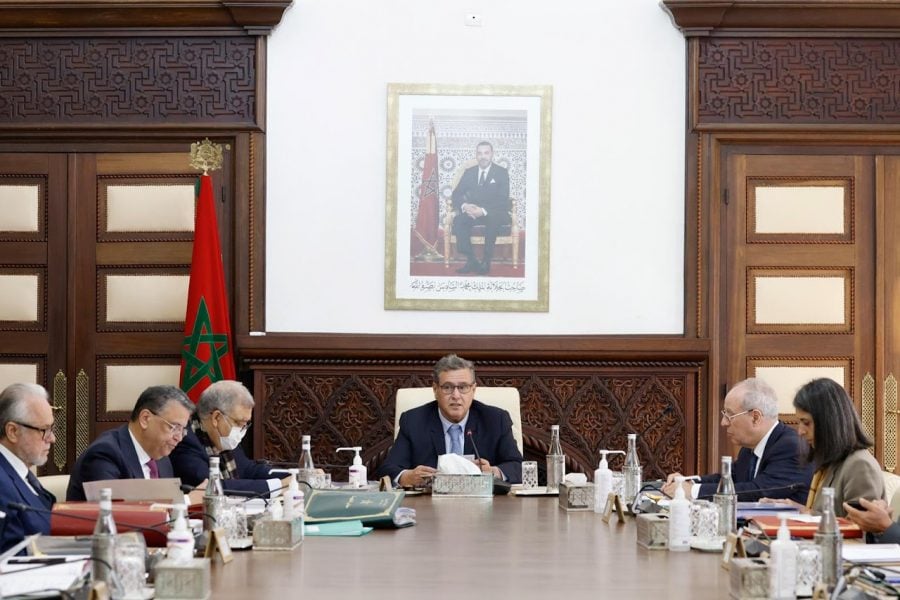
An orientation note sent by the Head of Government to the ministerial departments on August 7 outlines the priorities for the draft finance law for the 2025 financial year, focusing on four major priorities.
Strengthening the Social State
The draft finance bill for 2025 prioritizes reinforcing the foundations of the social state, which is in line with the government’s program. The plan is to improve the lives of Moroccan families through structured economic policies, among which is allocating 16.5 billion dirhams to the Compensation Fund for essential goods such as butane gas, sugar, and flour to protect purchasing power. Tax and customs exemptions will be applied to basic products, and support will be provided for livestock feed and fertilizers.
To support the expansion of mandatory health insurance (AMO), healthcare infrastructure will be significantly enhanced as the construction of Agadir and Laayoune University Hospitals is expected to be accelerated, and work on Errachidia, Béni Mellal, and Guelmim University Hospitals set to be continued. The ultimate goal is establishing a university hospital in every region while increasing the ratio of medical and paramedical professionals to 25 per 10,000 inhabitants by 2026, aiming for 45 per 10,000 by 2030.
Direct social assistance will receive a budget increase to 26.5 billion dirhams in 2025. Child benefits will be raised to 250 dirhams for the first three children in school or under six (350 dirhams for children with disabilities), 175 dirhams for children not in school, and 375 dirhams for the first three orphaned children in school or under six. 2025 will also witness the universalization of retirement and unemployment benefits.
Boosting Investment and Job Creation
Consolidating investment and job creation is another key focus of the 2025 finance bill. The government aims to accelerate the implementation of its program, optimize coordination mechanisms, and increase openness to current challenges. A five to ten-year roadmap outlines strategies to boost rural employment, revamp active employment programs, and support small and medium-sized enterprises.
To foster investment, the government will align with the High Royal Guidelines to create a competitive investment climate. This includes establishing regulatory frameworks, launching a National Investment Observatory, and reforming regional investment centers.
This includes a renewed emphasis on territorial development through regional partnerships and the implementation of development plans.
Building on the 2023-2026 business environment roadmap, the government will streamline public procurement, expand financing options, accelerate payment timelines, enable online business registration, and digitize over 45% of investment-related administrative procedures.
Implementing Structural Reforms
The finance bill outlines a continuation of structural reforms initiated by King Mohammed VI. These reforms aim to enhance governance, improve efficiency, and address critical issues, particularly the modernization of the legal system, enhancing court infrastructure, and upgrading judicial skills.
To optimize public resources, the government will restructure public entities and streamline public holdings and improving their management, as well as reform key economic sectors to enhance public service delivery.
To drive overall development, the government will expedite administrative modernization and efficiency.
The government aims to strengthen the partnership between central and local authorities by supporting advanced regionalization, including a yearly allocation of 10 billion dirhams to regions and backing the development of their second-generation development plans.
The government is also committed to maintaining a sustainable fiscal path, targeting a budget deficit of 3% of GDP by 2026 and keeping debt below 70% of GDP. This approach will free up financial resources for ongoing development projects and public investment.
Ensuring Food, Water, and Energy Security
In line with the King’s directives, the government will implement inclusive and coherent strategies to ensure food, water, and energy security. Central to these plans is providing potable water for all citizens and at least 80% irrigation coverage nationwide.
To achieve these goals, the government is investing heavily in accelerating the construction of dams, particularly in regions with substantial rainfall, and implementing large-scale water transfer projects.
Additionally, the nation is expanding its desalination capacity, intending to produce 1.7 billion cubic meters of water annually by 2030. This ambitious target will supply more than half of the country’s potable water needs and irrigate extensive agricultural areas.
Complementing these infrastructure projects is a strong focus on sustainable agriculture, which aims to enhance agricultural productivity, bolster resilience against climate change, and ensure food security.








add your comment
Terms of publication : Not to offend the writer, people, sacred things, or attack religions or the divine self, and refrain from racist incitement and insults.