
Over the past 25 years, King Mohammed VI has achieved significant successes in managing the Moroccan Sahara issue, raising international awareness about the dispute and advocating for autonomy under Moroccan sovereignty. Recent developments underscore this progress: French President Emmanuel Macron has formally acknowledged Morocco’s position on the matter.
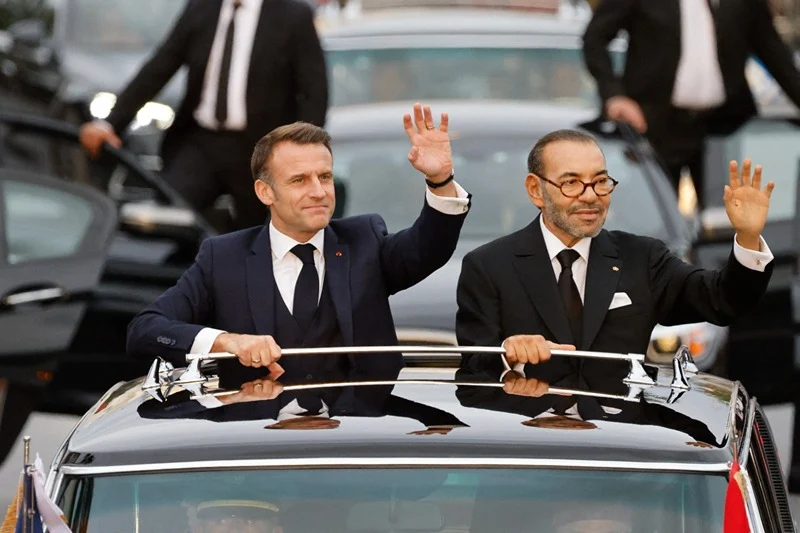
In a statement released by the Royal Court on Tuesday, Macron conveyed to King Mohammed VI that he considers the present and future of Western Sahara to be under Moroccan sovereignty.
This message, delivered on the 25th anniversary of Throne Day, also reaffirmed France’s steadfast stance on the issue, with Macron declaring that France’s position, tied to Morocco’s national security, remains firm and unchanged. He assured that France will uphold this position both nationally and internationally.
Moroccan Seriousness
Since the autonomy plan was tabled as a solution to the Moroccan Sahara conflict, the Security Council’s resolutions and reports from the United Nations Secretaries-General have shifted away from the concepts of referendum and self-determination, leading Rabat to. attracting support from major international capitals.
After 25 years, Morocco has begun to reap the benefits of taking the matter of its sovereignty seriously, a sentiment echoed in Security Council resolutions since 2007: “Noting the Moroccan proposal presented to the Secretary-General, welcoming the serious and credible Moroccan efforts to move the process forward toward resolution,” reflecting the situation established under King Mohammed VI’s reign.
Security Council resolutions continue to praise the seriousness and credibility with which King Mohammed VI manages the Western Sahara issue, resulting in recognition from major global powers and the opening of 28 consulates in Laayoune and Dakhla.
From the historic recognition by the United States of Moroccan sovereignty over Western Sahara to Spain and Germany’s support for the autonomy plan, and now France’s decision, Morocco has established a global reality that recognizes the southern regions as “only Moroccan.”
Moussaoui Ajlaoui, an expert on the Moroccan Sahara issue, affirmed that “this proposal was accompanied by genuine royal wisdom” he said that the submission of the autonomy proposal in 2007 marked a real turning point in this issue.
In a statement to Hespress, Ajlaoui added that 25 years of King Mohammed VI’s rule have transformed the Moroccan Sahara issue from one status to another, characterized by a “political solution.” He noted that since the submission of the autonomy proposal, UN reports have moved away from the concepts of referendum and self-determination, indicating a significant shift in approach.
The form and substance are interconnected, according to Ajlaoui, highlighting that “autonomy was a smart choice, showing that the Kingdom of Morocco adheres to a political solution, and the Moroccan initiative aligns with the UN charter and international law.”
Ajlaoui also explored the relationship between the autonomy initiative and international law, stating, “There are two decisions governing non-self-governing and occupied territories, UN resolutions have never linked Moroccan Sahara to occupation since 1975.”
The two resolutions number 1541 and 1514 (December 1960), set the general principles for resolving such disputes, the fourth principle, “referendum then independence,” was deemed impossible to implement by the UN in the 1990s, leaving only two options: autonomy or full integration.
With the diplomatic intelligence of Morocco in its institutions, under King Mohammed VI’s leadership, and the efforts of political parties, unions, and civil society, according to Ajlaoui, “the autonomy initiative gained significant strength after the failure of the referendum since the decisions of 1999 and 2004. From 2006 onwards, Rabat experienced a process of reconciliation and justice, making the autonomy initiative a solution to the gaps experienced by the UN, especially in determining the lists for the referendum elections after the ceasefire decision in 1991.”
The Moroccan commitment to a political solution has granted Rabat international strength. The liberation of the Guerguerat crossing is a testament to Morocco’s commitment to international peace and security. However, the most notable aspect of King Mohammed VI’s management has been the orientation towards Africa.
Africa to Strengthen Morocco’s Position
In the royal speech on the 48th anniversary of the Green March, King Mohammed VI emphasized: “The mobilization of national diplomacy has strengthened Morocco’s position, increased international support for its territorial integrity, and confronted the maneuvers of its clear and hidden adversaries… While the Mediterranean front is a link between Morocco and Europe, the Atlantic front is Morocco’s gateway to Africa and a window to the American continent.”
The King continued: “Thus, we are keen to develop the national coastline, including the Atlantic front of the Moroccan Sahara, and to structure the geopolitical space on the African level. Our goal is to transform the Atlantic front into a space for human communication, economic integration, and continental and international influence.”
Ajlaoui explained the role of Atlantic Africa in strengthening Morocco’s position on the Western Sahara issue, adding, “The royal visits, the spread of national strategic institutions in Africa, and Morocco’s significant role in West Africa have gone beyond the economic to the religious and humanitarian, making Africa a cornerstone in supporting Morocco’s territorial sovereignty.”
He added that “Atlantic Africa, the Nigeria-Morocco gas pipeline, and the Atlantic initiative for the Sahel countries have created a new geopolitical extension for Morocco in its African depth. Conversely, the Moroccan Sahara issue has been significantly affected, with the 2018 Nouakchott Summit entrusting the UN with the sole responsibility for the file. Thus, Africa has become a battlefield for Morocco’s victories.”
Amidst all these milestones, the expert on the Western Sahara issue emphasized that “the case has moved under King Mohammed VI from one status to another, still characterized by royal wisdom that responds to the sluggishness and recklessness of the adversaries of territorial integrity only with tangible achievements and successive global recognitions, especially from the UN Security Council members.”
Diplomacy Gaining Respect and International Recognition
The series of diplomatic victories and breakthroughs achieved by King Mohammed VI are marked by international recognition. This path has been a long and challenging journey, a part of a significant royal effort, according to Mustapha Khalfi, former Minister of Communication and Parliamentary Relations and founder of the Moroccan Center for Contemporary Studies and Research.
In a statement to Hespress, Khalfi noted that the recognitions and the opening of numerous consulates in Laayoune and Dakhla resulted from various developments, beginning with a “responsible, assertive, and offensive diplomacy.”
He said that even before the King announced that Moroccan Sahara is “the lens through which Morocco views the world,” ten years prior, in 2013, Rabat had suspended the African Lion exercises in response to US support for extending MINURSO’s mandate to include human rights. Rabat managed to distance Washington from this decision, demonstrating that Morocco had a new approach.
Khalfi added that “Morocco was clear, and firm with the Netherlands, Sweden, Germany, and other countries that tried to undermine the issue. In 2016, Rabat was strong with former UN Secretary-General Ban Ki-moon, as he interfered with Moroccan sovereignty, prompting an unprecedented decision by the kingdom to reduce MINURSO staff, foreshadowing their potential expulsion.”
This trajectory, according to Khalfi, included a firm stance against former UN representative to Moroccan Sahara Christopher Ross, who began to stray from neutrality. Under the King’s leadership and with the involvement of key forces, “Morocco stood firm and resolute, leading to major victories for our country.”
Development as a Means to Strengthen Morocco’s Position
Former Minister Mustapha Khalfi noted that one major factor in transforming the Western Sahara issue was the effort to turn the southern provinces into a stable region while addressing separatist provocations.
He pointed out that the Gdeim Izik camp project, initially a peaceful protest, was politicized. In response, Morocco initiated practical measures, including the Atlantic initiatives and internal economic development projects in the southern provinces, marking the beginning of a development model.
Khalfi explained that King Mohammed VI spearheaded significant infrastructure projects in the Moroccan Sahara. These included a major port in Dakhla, the connection of the region to the national electricity grid, the Tiznit-Dakhla expressway, and new desalination plants. These developments transformed the southern provinces into an economic hub, attracting international support for regional stability and growth.
He added that Morocco’s efforts received international recognition, reflected in various decisions such as liberating the Guerguerat crossing, ensuring international transit, rejoining the African Union, advocating for the expulsion of the Polisario Front, adopting maritime boundary laws, and securing a sustainable fisheries agreement.
Khalfi emphasized that King Mohammed VI’s strategic leadership has reshaped the diplomatic landscape, shifting from a UN focus on a referendum to a consensus on autonomy under Moroccan sovereignty.


add your comment
Terms of publication : Not to offend the writer, people, sacred things, or attack religions or the divine self, and refrain from racist incitement and insults.