
The Ministry of Equipment and Water launched last week the highway linking the regions of Guelmim Oued Noun and Laayoune Sakia El Hamra to travelers, after the official announcement that the project linking Tiznit to Dakhla, part of the new development model for the southern provinces, has reached 97% completion.
This vital highway section, which was inaugurated on the occasion of Eid al-Adha and extends over more than 400 kilometers, has contributed to reducing the suffering of travelers, reducing traffic accidents, and enabling them to save time and travel more comfortably.
According to project officials, the overall progress of the 1,055-kilometer Tiznit-Dakhla highway project has reached 97 percent, pending the actual completion of the new 114-kilometer Tiznit-Kelmim road, noting that “the works have achieved the completion of 106 kilometers, while they continue between Sidi Bouabdali and Kelmim, which is only 8 kilometers.”

This highway aims to reduce travel time, avoid road interruptions due to floods and sand, facilitate the transportation of goods to and from southern cities, improve connectivity with major national production and distribution centers, as well as create rest areas and truck parking lots.
The new road is an important lever for investments that will have a positive and direct impact on the region’s 2.2 million inhabitants spread across 10 provinces. It will also contribute to the socio-economic development of four regions of the Kingdom: Souss Massa, Guelmim Wadi Noun, Laayoune Saguia el-Hamra and Dakhla Wadi El Dahab.

Completion rates and costs
The Tiznit-Dakhla highway project is the fruit of a long-term strategic royal project that seeks the development of the southern provinces in the first place and reflects the strategic objectives of regional connectivity and linking the Kingdom to its African depth along 1055 kilometers, at a total cost of more than 9 billion dirhams, said Mbarak Fancha, central director of the Tiznit-Dakhla highway.
“The process of opening the new sections between the cities of Laayoune and Guelmim came as a result of the completion of work on these sections and due to the arrival of Eid al-Adha, when travelers’ movements are at a peak level,” Fancha told Hespress.
He pointed out that “the supervisory ministry, taking into account the safety of road users on this religious occasion, decided to open three road sections, namely the Zriouela-Ras Oumelil section, the Ouatia-Ichbika section, and the Ashbika-Ouadi El Ouar section, equivalent to 120 kilometers at a cost of more than MAD 1. 5 billion, so the road between Dakhla and Guelmim is now fully ready.”

“The project includes 16 major viaducts and a huge bridge, as well as the construction of 13 technical facilities, the bending of three technical facilities and the construction of orbits for the cities that the highway will cross, Tiznit, Guelmim, Tantan, Ouatia and Laayoune,” Fancha said, noting that “the structural project aims to provide the southern provinces of the Kingdom with a road axis characterized by the highest international standards and a high degree of safety.”
“The workshop consists of 30 road sections, 7 rest areas, 18 fish discharge stations, 1,572 rainwater discharge units, 6 million cubic meters of construction materials, 5 million tons of asphalt, more than 4,000 machines, as well as vertical and horizontal marking.”
The central director of the Tiznit-Dakhla highway went on to say that “this highway aims mainly to reduce travel time, avoid road interruptions due to floods and sand, facilitate the transportation of goods to and from southern cities, improve connectivity with major national production and distribution centers, as well as create rest areas and truck parking.”

Labor and project facilities
According to the central director of the Tiznit-Dakhla highway, “the project was completed by more than 36 contractors, study offices, laboratories and 100% Moroccan competencies,” noting that “the duration of the construction was about 2.5 million working days, so that the project, which will see the light of day by the end of this year, will enable the creation of more than 30,000 direct annual work days and more than 150,000 indirect annual work days.”

Delays and quality of work
“The project is the subject of a partnership agreement signed in February 2015 between the Ministry of Interior, the Ministry of Economy and Finance, the Ministry of Equipment, Transport, Logistics and Water, as well as four regional councils, for a total amount of about 9 billion dirhams.”
“The agreement set the period of completion between 2016 and 2021. The studies phase lasted between 2016 and 2018, while the phase related to the launch of requests for proposals and the approval of contracts lasted between 2017 and 2018, in addition to the launch of works in 2017, which reached its final stages with a completion rate of about 98%,” the official said.
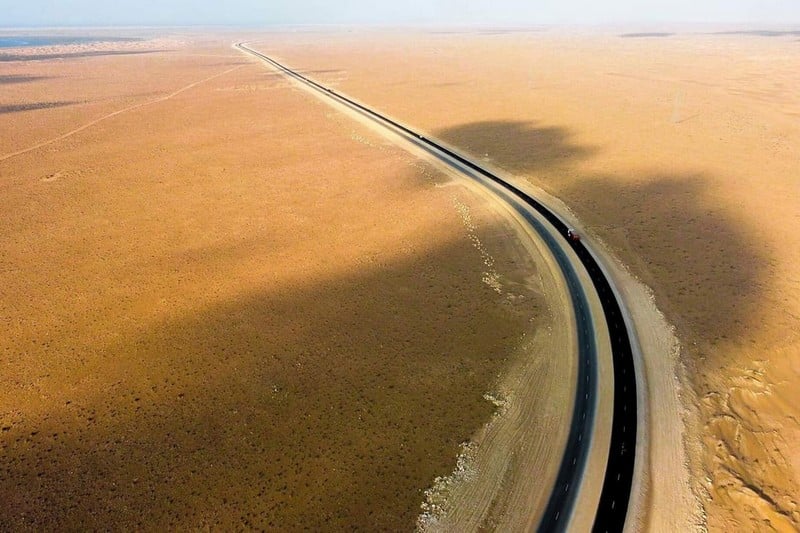
“Throughout these years, the project has faced many natural constraints and obstacles, such as sand encroachment or the phenomenon of sand and salinity issues due to the proximity of the project to the Atlantic Ocean, as well as geostrategic and situational constraints such as the cost and shortage of construction materials and the conditions of the Corona pandemic, which negatively affected the pace of work,” the official explained.
“The Ministry of Equipment and Water took all measures and procedures to increase the pace and continue the workshops by doubling the mechanisms and material and non-material resources regardless of the time limit for handing over the project.”

Regarding the quality of the works and the standards used in the vital road, the spokesperson highlighted that the ministry has been keen on the quality of the works on the designs and engineering of the project by using the LE PACK method; a program that guarantees quality in every section, so that all sections of the project have two laboratories with special teams of topographers, engineers and technicians.
“The ministry is also concerned with the environmental aspect by supporting the completion of a scientific environmental study approved by the National Committee for the Environment, and we have adopted it in the construction process and will take its recommendations into consideration after the completion of the project by the end of this year at the latest.”





add your comment
Terms of publication : Not to offend the writer, people, sacred things, or attack religions or the divine self, and refrain from racist incitement and insults.