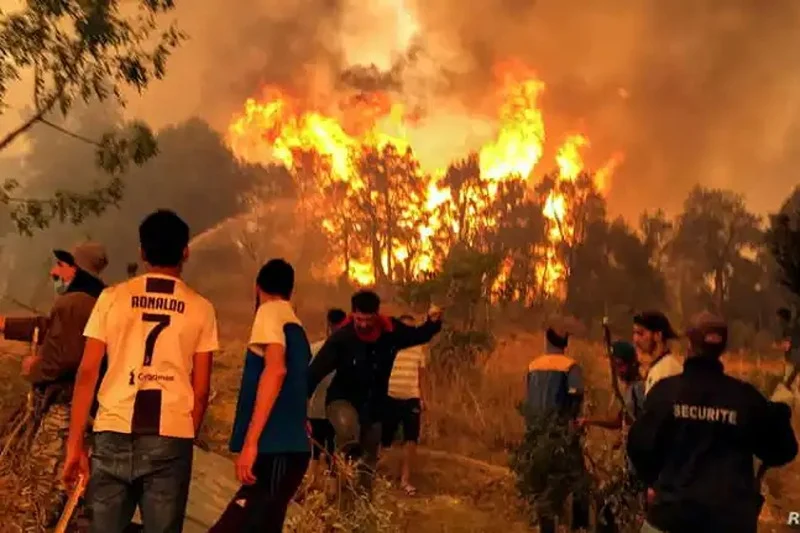
The area affected by wildfires in Morocco in 2023 dropped by 70% compared to the previous year, reaching just 6,426 hectares, according to the National Agency for Water and Forests (ANEF).
The use of nanosatellites, artificial intelligence (AI), and a fire spread simulator has resulted in a significant decrease in forest fires in Morocco.
ANEF Director General Abderrahim Houmy highlighted the agency’s ongoing efforts to refine technological tools for fire prevention and management since 2006.
“Previously, our system offered 42% accuracy,” Houmy explained. “Thanks to AI, we’ve now achieved over 75% accuracy in fire prevention.”
The agency initially focused its technological efforts on northern Morocco, a region particularly susceptible to wildfires.
This system has since been expanded nationwide, providing more specific data for different areas.
ANEF has incorporated nanosatellites for improved fire monitoring and collaborated with the United States Forest Service to develop a fire spread simulator.
The simulator aids firefighters on the ground by prioritizing actions and optimizing fire containment strategies.
Despite recent challenges like drought and extreme heat waves, Morocco boasts one of the lowest average fire sizes in the Mediterranean at just 13 hectares per fire.
ANEF further added that 90% of wildfires in 2023 were contained before reaching 5 hectares.
Eastern Morocco bore the brunt of the 2023 fires. A blaze near the town of Berkane last July consumed 2,552 hectares, accounting for 40% of the total burned area nationwide.
According to ANEF, Morocco is bracing for a potentially severe wildfire season this summer. To bolster their aerial attack capabilities. As a result, the country has expanded its fleet of specialized Kanadir firefighting aircraft to seven, with an eighth planned for arrival next year.
This fleet expansion will be complemented by a significant financial investment of MAD 153 million dirhams.
This financial boost will fuel a multi-pronged approach to fire prevention. More boots will be on the ground with strengthened surveillance patrols.
Existing firebreaks and access paths will undergo maintenance to ensure quick response times. Water points will also be strategically prepped for rapid deployment in case of a blaze.




add your comment
Terms of publication : Not to offend the writer, people, sacred things, or attack religions or the divine self, and refrain from racist incitement and insults.