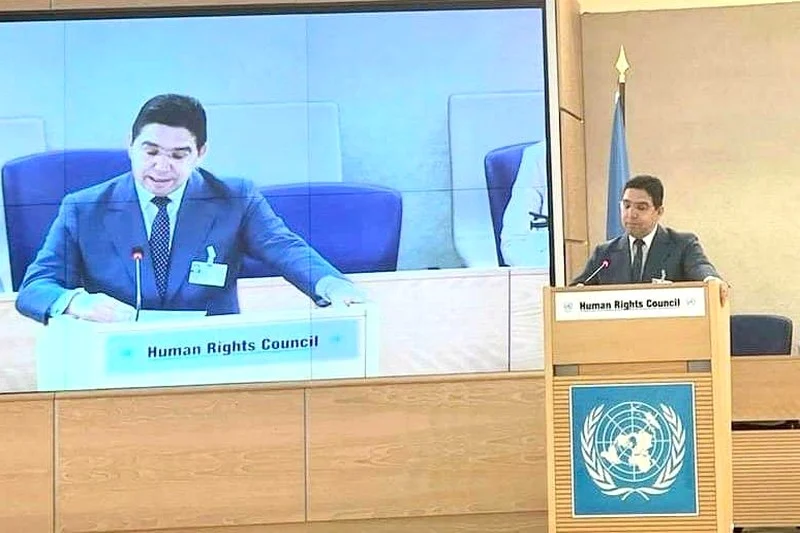
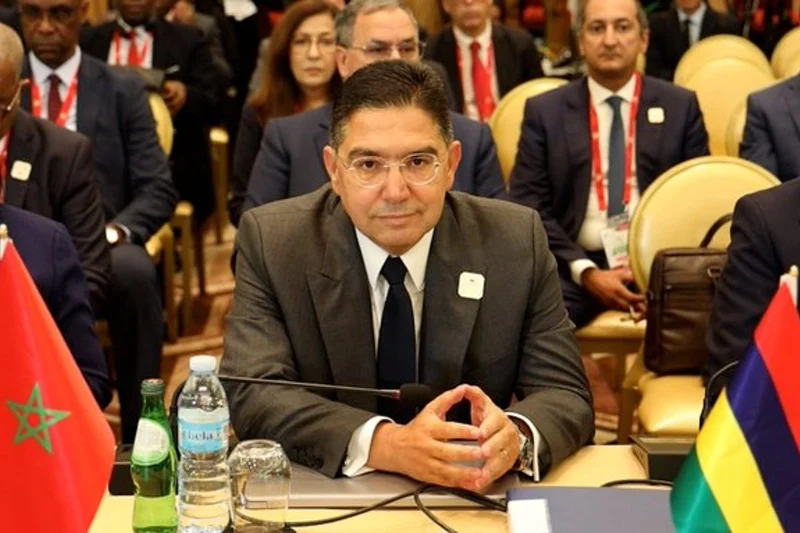
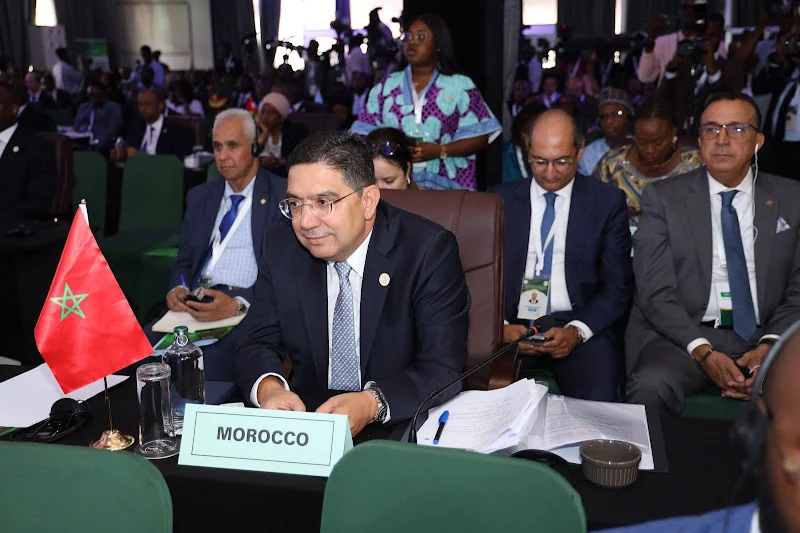
From Geneva, Morocco’s Minister of Foreign Affairs Nasser Bourita, stressed the necessity of “reforming and renewing the working methods of the Human Rights Council,” stressing that “from this standpoint, the Kingdom of Morocco will work, during its 2024 annual presidency of the UN Human Rights Council, to launch a group of the initiatives; The first is the call to hold an extraordinary session of the Council on a consensual topic chosen in consultation with all parties.”
Bourita revealed, during his speech at the fourth meeting before the members of the Council in its 55th session, that “Morocco will host a retreat for the Human Rights Council to evaluate its effectiveness and draw up practical recommendations as a contribution to the process of reviewing its expected work methods in 2026.”
The Moroccan Foreign Minister reiterates “the Kingdom of Morocco’s support for the High Commissioner for Human Rights for the success of his priority initiatives.”
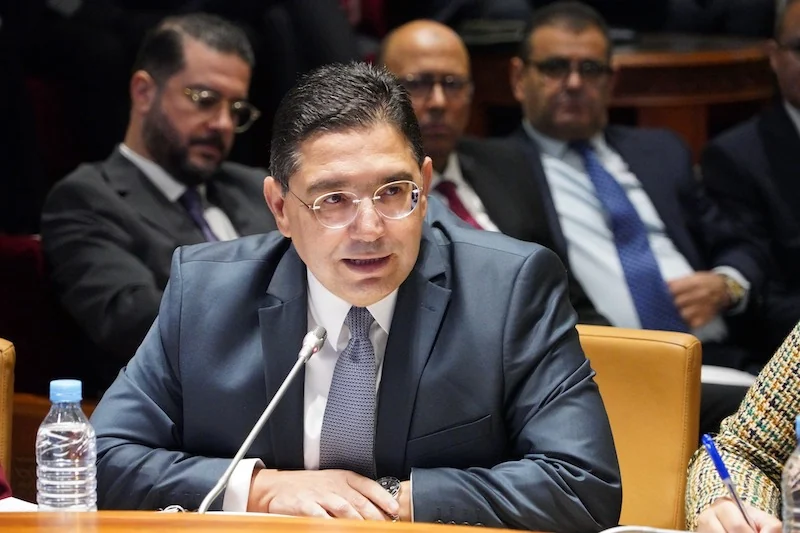
“Based on the country’s human rights achievements, and in accordance with its international obligations, the Moroccan presidency of the Human Rights Council will adhere to the same principles and values that define Moroccan diplomacy, under instructions from King Mohammed VI, most important of which are credibility in performance, dynamism in work, innovation in methods, and the pursuit of constructive consensuses to achieve goals, the noble cause for which this distinguished body was created,” says Bourita.
The minister continued, speaking about “the holding of the 55th session of the UN Human Rights Council in a complex international context that poses difficult challenges, the most important manifestation of which is the sharp polarization that undermines the foundations of global consensus that guarantees the promotion of human rights, and the continuation of gross violations of these rights in many regions of the world, with the decline of global gains.” Such as the enjoyment of economic and social rights and the status of immigrants (…),” stressing the danger of “the escalation of hate speech, exclusion, and rejection of others.”
This difficult context, according to the Moroccan government official, “as much as it questions the credibility of the multilateral system, as much as it demonstrates the relevance of the decision to create this council, which stands today at a crossroads 18 years after its establishment, and its contribution as a pivotal forum in the advancement of human rights across countries.” .
In a tone of “veiled criticism,” Bourita said: “On the other hand, despite the distinguished achievements that the Council has achieved since its establishment, it faces challenges that hinder its progress; The Human Rights Council, which was established with the aim of reducing politicization, selectivity, and the policy of double standards, is currently witnessing an attempt to exploit some issues and distort them from their goals in order to serve agendas that have nothing to do with human rights.” He asked: “How can an institution that should rely in its work on the principles of cooperation and dialogue, and more than A third of its decisions are approved by vote, an example of unanimity and consensus in its early stages… How can an institution that is obligated to consider human rights issues in accordance with the principles of universality and non-selectivity hold only two special sessions of a thematic nature, compared to 34 special sessions devoted to human rights cases in specific countries or regions (at a rate of 95% of the special sessions)?
Bourita also criticized “the Geneva Council’s lack of resources necessary to achieve its work goals, even though it is one of the three pillars of the United Nations.”
The Minister of Foreign Affairs spoke about “the election of the Kingdom of Morocco for the first time in its history,” which according to him constituted “international recognition of Morocco’s firm commitment, in accordance with the high directives of King Mohammed VI, to advance human rights at the national, regional and international levels.”
“Thanks to the foresighted royal vision, Morocco has made important strides to promote human rights through the implementation of specific projects and initiatives.”
The Minister also reminded that “the Moroccan experience in transitional justice, through the Equity and Reconciliation Commission, which Morocco commemorates its twentieth anniversary this year, and is considered a model to be emulated at the international level,” referring to “workshops to amend the Family Code as a ‘milestone’ in the process of consolidating basic constitutional values.” To fully empower women, establish equality, and guarantee the rights of children and the interests of the family; While the National Initiative for Human Development, the development model for the southern regions, and the universalization of social protection are all a royal initiative that places the Moroccan citizen at the heart of the directions of sustainable development programmes.”
The head diplomat additionally spoke on deteriorating conditions in the Gaza Strip since October 2023, recalling that “Gaza is experiencing an unprecedented crisis and a real humanitarian catastrophe that the international community cannot continue to turn a blind eye to; What made King Mohammed VI, Chairman of the Jerusalem Committee, call for the awakening of the human conscience to stop the killing of human souls honored by God.”
“This will not be done except by a comprehensive and immediate cessation of the Israeli war, ensuring the protection of civilians, stopping the indiscriminate bombing of hospitals, schools, and places of worship, and delivering aid in sufficient quantities,” stressing the need to protect the Palestinians from displacement, and calling for “establishing a political horizon capable of reviving the two-state solution.” And the establishment of an independent Palestinian state with Jerusalem as its capital.”



add your comment
Terms of publication : Not to offend the writer, people, sacred things, or attack religions or the divine self, and refrain from racist incitement and insults.