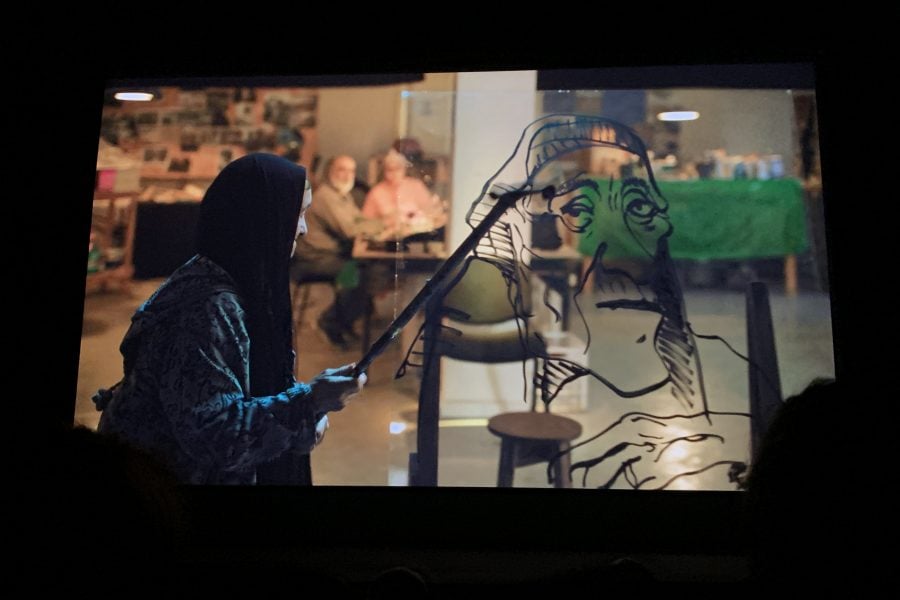
After receiving wide acclaim, Asmae El Moudir’s “Mother of All Lies” debuted in the international film festival of Marrakech “FIFM”, making its first Moroccan screening ever since it was first featured in international festivals.
The distressing docudrama tells the story of Asmae’s family, her neighbors, and her street, as rebuilds it as a doll street to make them relieve heart-drenching memories of lead years’ political arrests, recalling the lives lost and how it affected them as they lived in fear of telling their stories.
While the tale started off in a cheerful tone, showing “Mawlid Nabawi” celebrations, in which kids get glammed up to take professional pictures wearing traditional clothes, it took an unexpectedly serious tone telling the story of many lost souls and their repressed personal liberties.
El Moudir’s grandma played a vital role in the film, as she held on to her fear of speaking up out of being a “true patriot” who refuses to have pictures home beside the late King Hassan II’s portrait. For years, she insisted that the rest of the family never say a word about the tragic events that took place in 1981.
However, the film events, happening in a small studio mostly adorned with dolls and posters saying “no pictures”, show Asmae’s dad building small dolls representing the characters of the story, placed in the mockup street. The grandmother, not very pleased with her “deformed” figurine, makes a scene and always redirects the viewer’s attention to her.
The grandmother never allowed El Moudir’s family to keep photographs home, in an attempt to not keep a trace of the heartbreaking events, as many of the family’s neighbors were killed.
Besides Asmae’s parents and grandmother, two more characters show up and change the course of the story, Abdellah and Said.
Abdellah’s storyline is what imposes a serious note on the award-winning documentary, as he reenacted his torture scene after he was detained. Years later, he speaks of the incidents with as much sorrow as when he was first subjected to the heinous tortures.
Smoking throughout the film and only seeing from one eye as the other was severely damaged, Abdellah recalls walking over dead bodies in a very small cell to save himself. Asmae’s grandmother attempted to kick him out in the second act, in an attempt to keep her family safe.
As he showed how he begged for his life, he said “I don’t wanna remember this anymore, they ruined me,” referring to the endless assaults he was subjected to.
Asmae’s film gave him a platform to tell his story alongside others, particularly the story of Fatima, a neighbor who was 12 when was shot during lead years. Her family still looks for her corpse, hoping for a proper burial even this many years later.
The director’s father dreamt of becoming the world’s best goalkeeper, until one day, his favorite modest stadium was turned into a collective graveyard in light of the political escalations.
“A football stadium turned into a grave; and with it, my father’s dream,” said the narrator, Asmae.
While the film does turn around lead years, the narrator only mentions the words at the end of her production.
As the film heavily relied on how Asmae always felt a void for the lack of pictures in her house, she said “Doesn’t matter if pictures disappear and bodies weren’t found, Memories are alive.”
Through the dolls and the small street she and her production team constructed, she showed “dead” dolls seemingly shot as blood drops were scattered around the bodies.
The film finishes on a somewhat positive note, with the grandmother smiling for the first time celebrating her birthday with her family, stating that she lost count of years.
The grandmother, who always told her family to never discuss lead years as “walls have ears”, finally felt comfortable with her granddaughter rewriting a collective memory through very personal accounts, and said that “walls no longer have ears.”
Despite being labeled a documentary, the film featured a lot of fiction and scripted scenes featuring the family.
Heavily funded by several production entities from all over the world, the film, shot in a small studio, left the audience wondering whether such massive funds were really a necessity.
Others were surprised by Asmae’s choice to deal with a sensitive subject that lives in the memory of several affected families who are still traumatized by the losses they faced.
“Mother of All Lies” is Morocco’s official submission to the Oscar Academy award this year, and has won two prizes at the Cannes Film Festival. The director participated in last year’s FIFM edition through her documentary “Postcard.”
Viewers applauded the way in which the tragic story was told, relying on personal experiences, dolls, and a patriotic grandmother who kept the late King Hassan II’s picture hidden under her Jellaba.



add your comment
Terms of publication : Not to offend the writer, people, sacred things, or attack religions or the divine self, and refrain from racist incitement and insults.