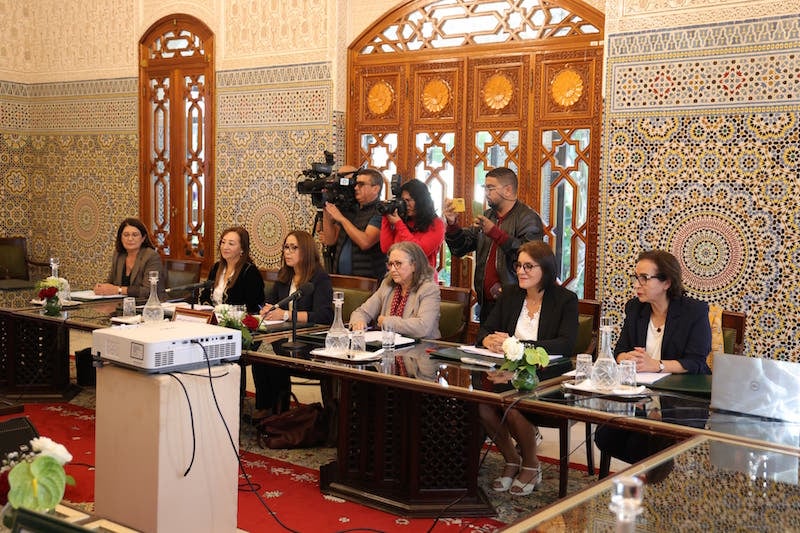
From Wednesday to Friday, the committee tasked with reforming the Family Code in Morocco, organized a series of meetings aimed at gathering input from relevant entities regarding different issues, two of which were about inheritance and polygamy.
Heated debates and conversations surrounding the Family Code reform are still ongoing, emerging disagreements and opposite viewpoints among the attendees of meetings.
While consensus was reached concerning the need for changes in certain aspects of marriage, divorce, legal guardianship, child custody, and financial support, significant divergences emerged in matters concerning inheritance and polygamy.
Opposite views arose among the attendees of the meetings. Associations were advocating for the prohibition of polygamy and the modifications of inheritance laws to enhance gender equality.
Others, on the other hand, argued to maintain polygamy as it is seen as a matter of religious legitimacy and believe that inheritance should remain unchanged, deeming it an unalterable principle.
In this context, Boutaina Karouri, the Head of the Al-Zahra Moroccan Women’s Forum, said on Friday “Our reference in the amendments is the reference emphasized by His the King in his speech and message to the government, as well as the opening speech of the parliament. It is the Islamic reference with a renewed, authentic, and profound understanding, based on the reality experienced by Moroccan women and the current provisions,” according to Hespress AR.
“Our demands are not for comprehensive reform, but rather for specific partial amendments as specified by the King in the message addressed to the Head of Government. These amendments pertain to legal issues,” she added.
Karouri further explained, “Inheritance is one of the constants and cannot be altered. However, we have proposed modifying Article 322, which suggests that before dividing the estate, the women’s contributions and efforts in shared finances should be taken into consideration.”
As to polygamy, she said “It is permissible and practiced by only 0.66% of marriage permits, making it a legitimate practice that is narrowly exercised and cannot be prohibited. Some husbands have wives with illnesses and those wives do not wish to be abandoned.”
The Head of the Al-Zahra Moroccan Women’s Forum also proposed “Amendments related to simplifying the marriage procedures, as well as others related to Article 47 through the legal principle “Toil and effort” (Kidd and Siaya), which has been recognized by several Moroccan jurists throughout history. Additionally, there are proposals related to guardianship and custody, particularly regarding spousal abuse.
Concerning the proponents of a modern, progressive, and democratic Family Code, they emphasized equality, children’s rights, and the principle of the child’s best interests.
Khadija Al Roukani, a member of the Spring of Dignity Alliance, said, “Today, we presented a memorandum of demands that reflects our vision of a modern, progressive, and democratic Family Code that ensures equality among family members, and guarantees the rights of children based on the principle of the best interests of the child.”
“We have presented detailed proposals to all the topics addressed by the Family Code, including our concept of marriage based on shared responsibility, the concept of engagement, and the concept of divorce, which should be reduced to two procedures: either mutual divorce or divorce upon the request of one of the spouses,” she said.
Al Roukani added, “We have also addressed issues such as determining and implementing alimony, as well as the responsibility of the state in enforcing it when a woman is unable to do so,” according to Hespress Ar.
The members of the Spring of Dignity Alliance called for “The prohibition of polygamy, the categorical criminalization of child marriage, and seeking justice for women by eliminating all provisions that discriminate against them in matters of custody, in addition to the inheritance system,” calling for “enlightened jurisprudence.”
The meetings featured judges, academic researchers, and other practitioners in the field of the Family Code, as well as human rights, women’s rights, and children’s rights representatives.




add your comment
Terms of publication : Not to offend the writer, people, sacred things, or attack religions or the divine self, and refrain from racist incitement and insults.