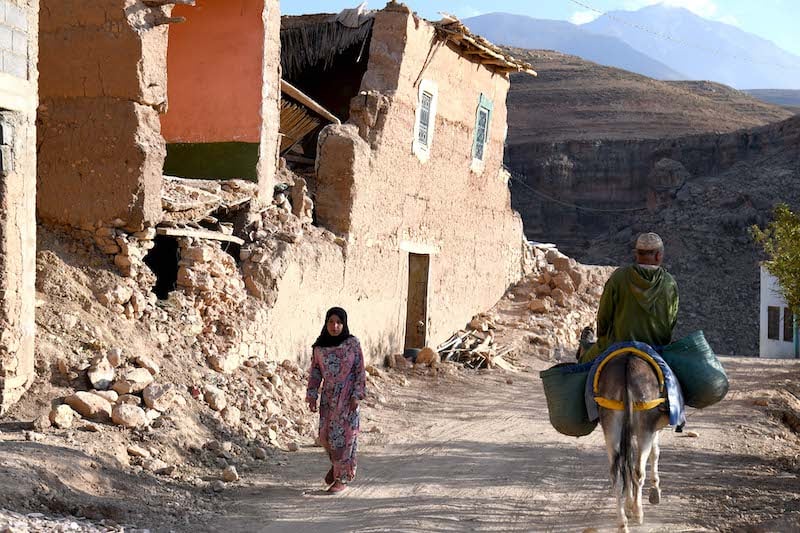
In a recent interview with Hespress AR, Kishor S. Jaiswal, a structural engineer at the US Geological Survey (USGS), talked about the rare earthquake that hit Morocco on September 8th.
Jaiswal explained that such earthquakes are unusual in the region. He mentioned that people in different Moroccan cities felt the shreduceaking because of seismic waves traveling long distances.
Predicting earthquakes, he noted, is still not possible, but he emphasized the need to assess and earthquake risks by improving building standards and having insurance.
In the interview, Jaiswal provided critical insights into the earthquake and its aftermath:
Q: What information does the US Geological Survey have about the September 8th earthquake in Morocco?
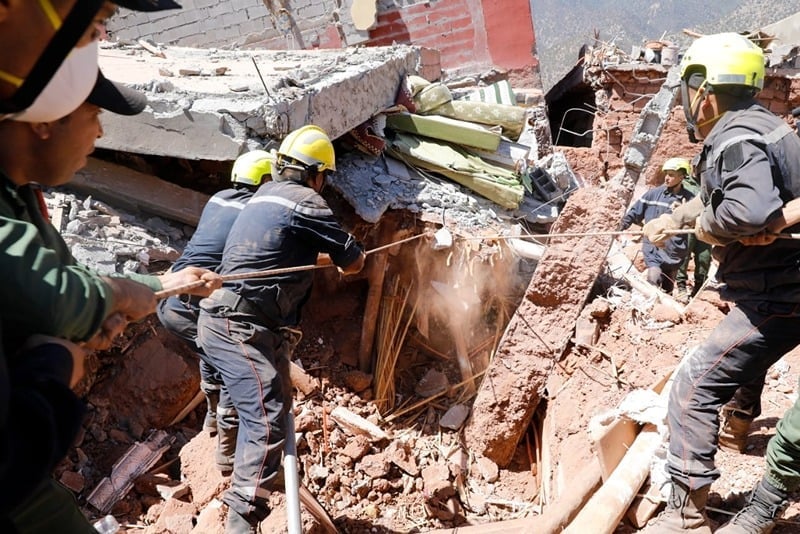
A: The earthquake that struck Morocco, affecting Marrakech and several other cities in the Atlas Mountains region, resulted in significant loss of life, injuries, and damages. The USGS continues to use scientific knowledge to help people in making informed decisions for themselves, their families, and communities during this time.
Based on our scientific assessment, we expect that the region surrounding the Oukaimedem area southwest of Marrakech will experience ongoing and more frequent earthquakes than usual. The frequency of aftershocks will decrease in the coming days, weeks, and months following the main earthquake, which registered a magnitude of 6.8 on the Richter scale.
It is likely that dozens of aftershocks will be felt in these areas during the initial weeks and months, and they may even be felt in more distant locations. Large aftershocks can cause additional damage, especially to fragile structures or low-quality buildings. The strongest recorded aftershock so far reached a magnitude of 4.9, but aftershocks with magnitudes of 5 or greater are possible in the weeks and months ahead.
According to our data, approximately 1 in every 20 earthquakes is followed by a similar-sized or larger earthquake in the first week, with the probability decreasing over time. However, the possibility of significant aftershocks months after the main shock remains.
Earthquakes of this magnitude are not common in this region, but they are not unexpected. Since 1900, only nine earthquakes with a magnitude of 5 or greater have occurred within 500 kilometers of this earthquake’s location, and none of them exceeded a magnitude of 6.
Q: What makes this earthquake different from others recorded worldwide?
A: Most large earthquakes happen along the boundaries of tectonic plates, but earthquakes like the one in Morocco occur within the plates themselves.
Q: Why was this earthquake felt across almost all of Morocco?
A: During a large earthquake, seismic waves originate from the epicenter and then travel through the Earth’s crust for thousands of miles. These waves manifest as strong ground motions that people can feel within several hundred miles. However, some ground motions are generally weak and not felt by the public but are recorded by seismometers worldwide. Generally, the farther one is from the epicenter, the weaker the shaking.
People often feel large earthquakes like the one that struck Morocco, with a magnitude of 6.8, hundreds of miles away from the epicenter if the Earth’s crust is old and unfragmented (known as a stable shield), which is the case for most of North Africa’s plate. In contrast, in other areas, like California, for example, the energy diminishes much faster, and people would not feel the shaking if they were more than 300 kilometers from the epicenter.
Q: Was it possible to predict this earthquake?
A: Predicting a major earthquake is currently beyond the capabilities of both the US Geological Survey and other scientists. We do not know when or expect to know when such predictions might be possible in the future. Scientists can only calculate the probability of a large earthquake occurring in a specific area within a certain number of years.
Some individuals claim they can predict earthquakes, but these statements are unfounded and lack scientific evidence. They cannot determine the three required elements for earthquake prediction: the date and time, the location, and the magnitude of the earthquake.
The US Geological Survey’s focus is on long-term earthquake hazard reduction by helping improve building safety, rather than attempting short-term predictions.
Q: Some people reported hearing sounds from the earth and the sky and seeing lights during the Haouz earthquake. Is there a scientific explanation for this phenomenon?
A: Phenomena like earth lights, fireballs, and transient luminous events are collectively referred to as “earthquake lights.” Geophysicists have varying beliefs about whether individual reports of unusual lighting near earthquake epicenters constitute earthquake lights, and some are skeptical that any of the reports provide strong evidence of earthquake lights. Hypotheses based on physics have been proposed to explain specific categories of earthquake light reports, particularly those recorded directly at the time of a major earthquake. On the other hand, some reports of earthquake lights have been associated with what is known as “electric arcing,” which can be related to power line vibrations.
Q: Is Morocco a permanently earthquake-prone area?
Yes, there are parts of Morocco that are consistently exposed to seismic threats, especially in the northern half, which falls under moderate-risk zones.
Q: How can countries address earthquake risks?
The best way to confront earthquake risks is to assess them meticulously and then work on mitigating them through the development of better seismic standards in building codes. Some risks cannot be entirely eliminated, but they can be reduced through the insurance and reinsurance sectors.




add your comment
Terms of publication : Not to offend the writer, people, sacred things, or attack religions or the divine self, and refrain from racist incitement and insults.