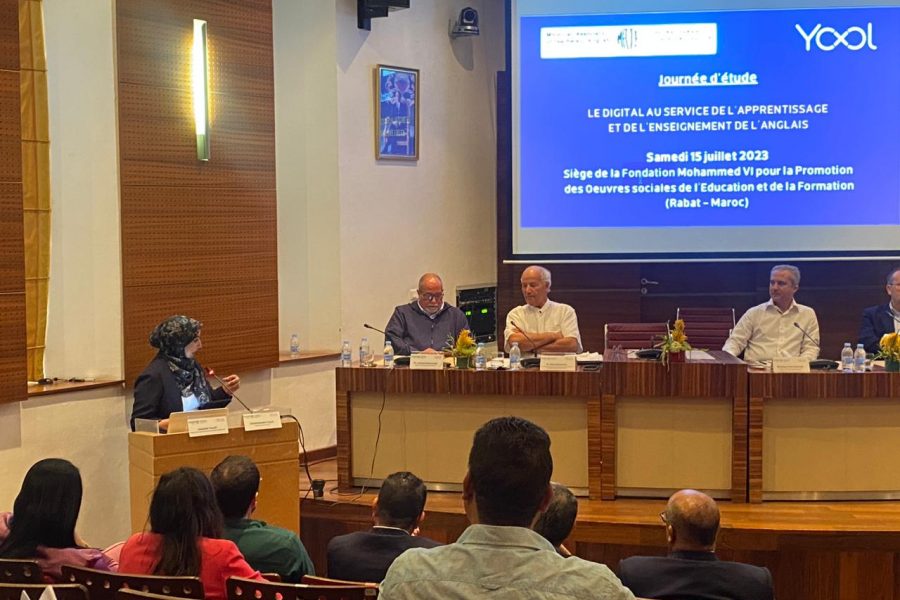
In light of recent educational reform, education experts gathered in Rabat on Saturday to discuss the use of digital tools in English language learning, emphasizing the benefits and stressing the risks.
At the event organized by The Moroccan Association of English Teachers (MATE) and the Yool Education platform, promoting the use of digital technologies in English learning and teaching came as a priority.
Ahmed Akhchichine, ex-minister of national education from 2007 to 2021, asked if this is a need, referring to the recent education reform of the progressive implementation of English as s second primary language in Morocco’s educational system.
This global project of redefining Morocco’s linguistic cartography requires serious commitment, the ex-minister is looking for justifications for this engagement.
He believes that to reach Morocco’s ambitions in this regard, the government should properly evaluate all possible risks to meet along the way.
“In the case of a country like Morocco, is English the answer?” he wondered.
“Isn’t Sapnish more logical? It would’ve eased the openness to a boarder spectrum of countries that we have no access to,” added Akhchichine.
Nonetheless, he believes it is time to redefine the importance of English in our country, and asked if Morocco exhausted the potential of the French language.
Regarding the speed of ascension of implementing the progressive use of English, he said “ At what moment should we regulate this speed?”
Among the other questions he had and hoped that other experts currently working in the ministry is “Why not concentrate on teaching English in high schools only?”
Driss Ouaouicha, Minister Delegate for Higher Education and Scientific Research from 2019 to 2021, President of Al Akhawayn University from 2008 to 2019, and Secretary General of the Moroccan British Society, did not hold back to showing his enthusiasm and excitement that English is finally gaining valuable importance in our society.
After giving some statistics such as how English is now a requirement by 75% of employers in countries where English is not the primary language, he explained that English is the language of the internet and that kids have amazing capabilities to retain it.
Sharing the results of a survey in which participants were Moroccans of age 15 and 25, Ouaouicha said that most respondents said that they learn English through shows, Instagram, Youtube, Twitter, and Netflix, which is why he called them the “Netflix Generation.”
Aziz Kaichouh, Secretary General of the Higher Council for Education, Training and Scientific Research believes that to ease the implementation of English, videos are a very effective teaching method.
He believes that the Ministry of Education should adapt content to kids.
Abdelmounaim Belalia, the Director General of the Mundiapolis University of Casablanca stated that how this reform is going to happen is the main question, and not why.
As the paradigm of reflections is constantly changing, English teaching should be encouraged, however, Morocco’s digital fracture is an important factor to consider when promoting the use of digital to teach English, he concluded.
Director of Curricula at the Ministry of National Education, Fouad Chafiki, believes that parents should be given the choose what language their kids study, and believes that giving them three options, either learning English and French, French and Spanish, or Spanish and English, would be ideal.
He emphasizes that Arabic and Amazigh should remain in every program despite reforms.



add your comment
Terms of publication : Not to offend the writer, people, sacred things, or attack religions or the divine self, and refrain from racist incitement and insults.