Four African countries have signed memorandums of understanding with Morocco and Nigeria to participate in the Nigeria-Morocco gas pipeline project.
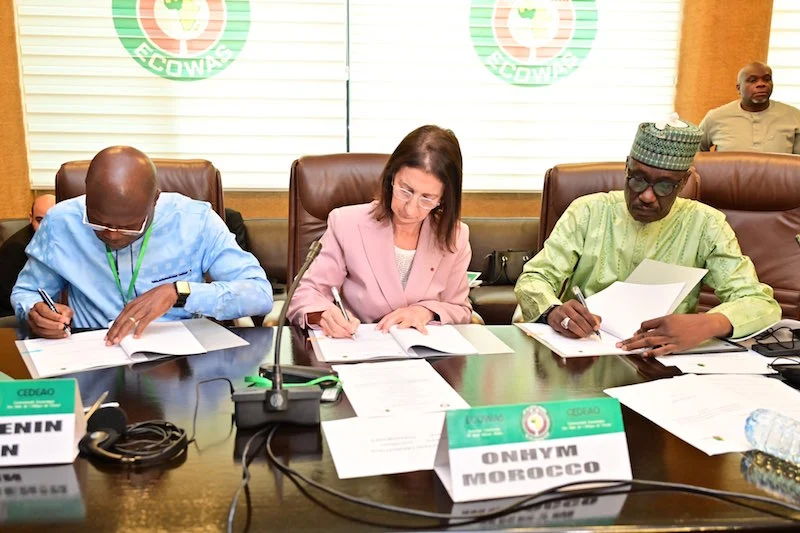
The signing took place at the headquarters of the Economic Community of West African States (ECOWAS) in Lagos, Nigeria, in the presence of Amina Benkhadra, the Director-General of the National Office of Hydrocarbons and Mines.
The signing of the new memorandums took place on the sidelines of the steering committee meeting for the Nigeria-Morocco gas pipeline project, attended by representatives of ECOWAS and all the concerned countries.
The countries that signed the memorandums of understanding with Morocco and Nigeria are Côte d’Ivoire, Liberia, Guinea, and Benin, bringing the total number of countries involved in this project to ten.
These agreements are a continuation of the memorandums signed with ECOWAS, Mauritania, Senegal, Gambia, Guinea-Bissau, Sierra Leone, and Ghana last year.
The new memorandums of understanding confirm the commitment of the parties to this strategic project. The project is expected to enhance the gas resources of African countries and provide a new alternative export route to Europe.
This project is expected to contribute to accelerating access to energy, improving living conditions for the population, and supporting the integration of regional economies.
Amina Benkhadra stated that “the alliance represents a progressive step towards ensuring social and economic development, by ensuring energy security and achieving comprehensive development for Africa by Africans,” according to a press release published by NNPC Limited.
According to the same source, Mele Kyari, the head of the Nigerian National Oil Corporation, said that “ NNPC Ltd, sees this project as an opportunity to monetise Nigeria’s abundant hydrocarbon resources, by expanding access to energy to support economic growth, industrialisation, and job creation across the African continent and beyond.”
Sediko Douka, the Commissioner for Infrastructure, Energy, and Digitization of ECOWAS, underscored the importance of the gas pipeline project. The project will help enhance electricity production and generation capacity, stimulate industrial and agricultural development, and contribute to achieving the energy transition by using a cleaner source of energy than other fossil fuels.
The pipeline will originate in Nigeria and end in Morocco, passing through eleven countries: Benin, Togo, Ghana, Côte d’Ivoire, Liberia, Sierra Leone, Guinea, Guinea-Bissau, Gambia, Senegal, and Mauritania.
The pipeline is expected to transport nearly 3 billion cubic feet of gas per day along the West African coast to Morocco and Europe, covering a distance of 7,000 kilometers.
The Nigeria-Morocco gas pipeline project was announced in 2016 in Abuja under the leadership of King Mohammed VI and former Nigerian President Muhammadu Buhari.






Morocco forever❤️??❤️??❤️????????Africa is always in our hards❤️❤️❤️❤️❤️