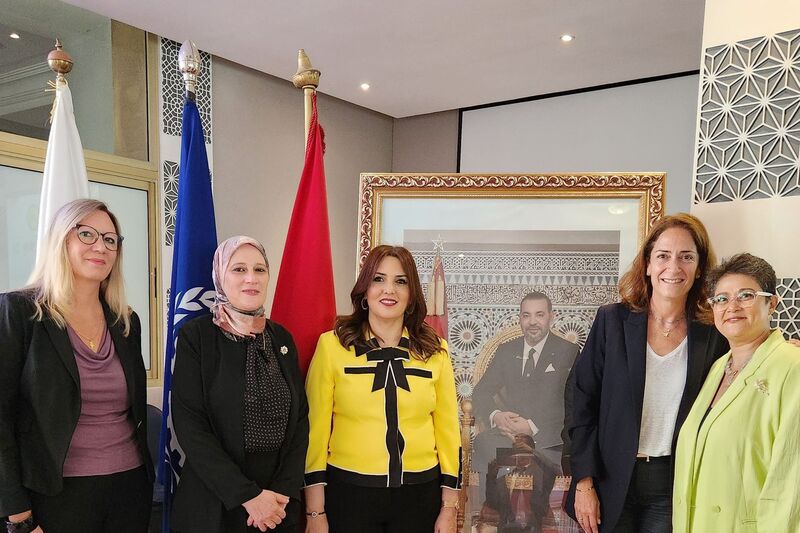
Rabat’s Tour Hassan Palace played host to a momentous gathering where delegates from Arab Maghreb Union (AMU) nations and various organizations converged to address the critical issue of labor migration.
The conference centered around the alarming absence of comprehensive data on this phenomenon, as participants sought collaborative avenues to tackle this challenge head-on.
One of the highlights of the event was the unveiling of the world’s inaugural “Statistical Report on Labor Migration in AMU Countries,” emphasizing the significance of statistics in shaping public policies.
Rania Bikhazi, director of the General Labor Organization (ILO) for Algeria, Libya, Morocco, Mauritania, and Tunisia, commended the notable female representation at the conference.
She declared that despite countless hurdles, the report’s completion will serve as a valuable tool in combating racist ideologies related to migration and enhancing informed approaches to address this issue.
Jean Pierre Nteziman, the chief advisor of Statistics Sweden, underscored the pivotal role of statistics in formulating effective development policies.
Ambassador Namira Negm, Director of the African Union Observatory, shed light on the historical context of migration, emphasizing that while migration itself is not a new phenomenon, stricter border management has come into play.
She elucidated how conflicts, wars, and hardships force individuals to seek stability by fleeing their home countries, urging attendees not to overlook migration within African nations but rather to acknowledge the challenges faced by migrants.
Basma Soudani, head of the UMA cabinet based in Morocco, expressed the organization’s special interest in the subject matter.
UMA conducted a thorough examination of the challenges and engaged in several partnerships to formulate effective recommendations based on a global approach.
Representatives from Libya, Tunisia, and Mauritania echoed the shared concerns of all AMU countries regarding high unemployment rates, which act as a driving force behind migration.
They emphasized the need to regulate this phenomenon.
Mohamed Mghari, representing The High Commission for Planning (HCP) and an expert in migration with numerous publications, unveiled prospects for collaboration with several countries, particularly Tunisia.
He also highlighted Morocco’s role in presiding over a group of experts working towards harmonizing statistical data collection in Africa, specifically in AMU countries.
Nadia Touihri, who played a significant role in assembling the report, presented a detailed explanation of its findings during the conference.
A representative from the UNHCR emphasized that migration should not be seen as a problem but as a necessary reality. The unique circumstances of refugees and forced migration were underscored as crucial aspects to consider.
Based on various studies and data from HCP, the AMU estimated that in 2020, 739,125 Moroccans were residing in AMU countries who were under the age of 15, and 4,188,378 individuals aged 15 and above.
Another section of the report focused on estimations from 2019, revealing a total of 31,504 “active” foreigners in Morocco. Of these, 12,153 originated from Arab countries, 12,800 from Sub-Saharan Africa, 6,550 from Africa (excluding Sub-Saharan countries), 12,800 from Europe, and 6,550 from other regions.
The most prominent sectors for these foreign residents were commerce, car repairs, transportation, accommodation, and the restaurant industry, with real estate having the least active migrant presence in Morocco. The majority of these individuals were officially employed, as indicated by the data.
In 2019, the estimated foreign population in Morocco stood at 90,745, with 37,700 individuals of working age.





add your comment
Terms of publication : Not to offend the writer, people, sacred things, or attack religions or the divine self, and refrain from racist incitement and insults.