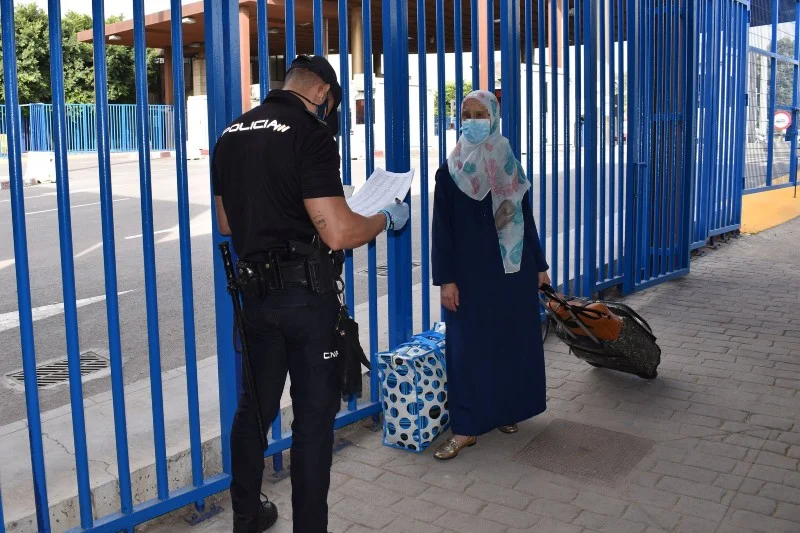
After an extended period of silence from the Spanish government, Minister of the Interior Fernando Grande-Marlaska announced the changes to the new customs crossing points in the occupied cities of Ceuta and Melilla, revealing that “talks with Rabat are ongoing in this regard.”
Marlaska, whose government is under pressure from both the opposition and its bases in the two occupied cities, revealed in press statements that “Morocco and Spain continue to work towards putting measures in place to allow the resumption of commercial customs in Ceuta and Melilla as soon as possible.”
The Spanish Minister of the Interior added, “Opening these new customs is an obligation that falls on the administrations of the two countries, so they are constantly working together to bring this project to life,” yet he did not specify any date for that.
According to diplomatic observers, “The political circles in Spain aim to take advantage of the Marhaba 2023 process in order to speed up the customs work in the occupied Ceuta and Melilla.”
In this vein, Rabat had imposed several conditions in place, most important of which is making sure Ceuta and Melilla do not turn into international crossings, which may be considered an implicit recognition of the two cities’ dependence on Madrid.
In the past few days, identical media sources revealed that Madrid and Rabat “agreed to define a second trial phase for commercial customs in the occupied cities of Ceuta and Melilla, as the process will be in both directions, after it was limited in the first phase to exporting Spanish products.”
Election fever
Nabil Dariouch, a political expert specializing in Spanish affairs, believes that this represents a highly sensitive political issue for Morocco. The delay in reaching an agreement on the one hand, and the ongoing negotiations since the normalization of bilateral relations on the other, indicate that the technical issues have political implications for both parties.
Dariush stated, in an interview with Hespress, that “Morocco is definitely trying to reach a formula that does not involve a high political cost, while the Spanish government is trying to gain a political advantage in an election year, facing pressure from the right which is pressuring it regarding this point and regarding its position in support of the autonomy plan in Moroccan Sahara.”
The speaker considered that “the northern region of Morocco has witnessed a qualitative economic leap in the past twenty years and has become an important economic pole. As a result, the occupied cities of Ceuta and Melilla can no longer benefit from the economic fragility that the northern region suffered in the past for exporting their goods, especially since this situation has been definitively overcome.”
The interviewee concluded to Hespress by saying that “the goods that can enter from Ceuta and Melilla are easily found in Morocco and at affordable prices,” noting that “the problem lies in the economic model adopted by Spain in the two cities, which relies on the free trade zone where Morocco was its sole market. With the radical change in data, the establishment of customs will not be useful in solving this problem for Spain, as the greatest profit will be political, not commercial.”
A stain of shame
Mohamed Benissa, the president of the Northern Observatory for Human Rights, stated that “opening customs at the borders of Ceuta and Melilla is considered a concession of Moroccan territories due to history, geography, and cultural data.”
Benissa added in a statement to Hespress that “the decision to open customs at the two crossings, or any change in the current situation without aiming to reclaim the two cities, would be a stain of shame if we succumb to Spanish pressures.”
The president of the Northern Observatory for Human Rights considered that “by implementing Moroccan customs law, if Morocco accepts Spanish pressures, it will impact the economies of the northern cities of Morocco, as it will serve Spain’s interests by reviving the economies of the occupied cities after suffocating them.”
“The northern region of Morocco needs to address the imbalances it faces in its economic structure due to various forms of smuggling, such as drug trafficking, goods, and human trafficking, through economic projects that would have a positive impact on the local population,” the interviewee continued before concluding that “the activation of these customs could be beneficial for smugglers, provided that their rights are properly ensured.”






add your comment
Terms of publication : Not to offend the writer, people, sacred things, or attack religions or the divine self, and refrain from racist incitement and insults.