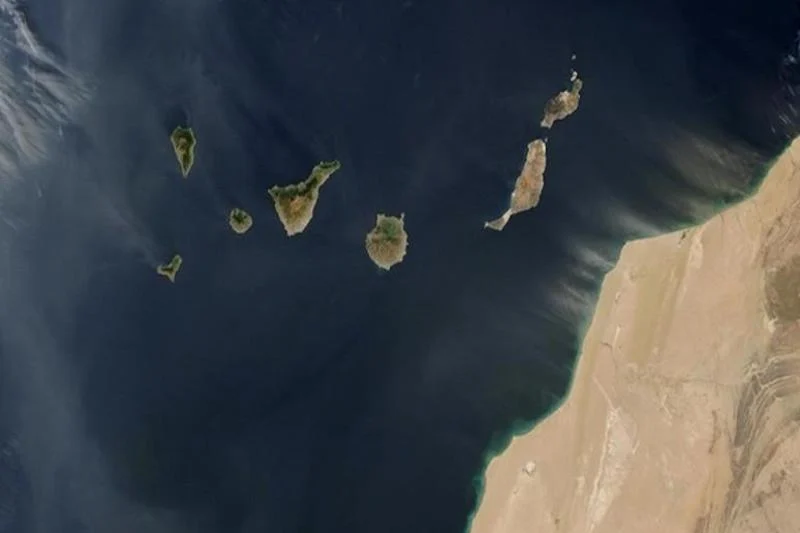
The Spanish government failed to include a request to expand its maritime borders which includes areas that overlap with the Moroccan southern continental shelf, to the work schedule of the United Nations Boundary Commission, and its sub-group was not formed, as confirmed by the Spanish Ministry of Foreign Affairs.
In response to a question by a member of the Spanish Congress, Meri Pita, the ministry said that the United Nations Border Committee has not yet examined the presentation related to the Canary Islands, given the delay in the formation of sub-committees that analyze requests to expand continental shelves, estimating that the formation of the sub-committee for the Canary Islands shelf will take years.
In December 2014, the Spanish government formally submitted a request to expand its continental shelf by 296,000 square kilometers, including the area where the tropical seamount “Tropic” is located, rich in tellurium, cobalt, nickel and other vital minerals of high value in many industries, including electronics. .
In 2020, the Moroccan parliament approved two bills demarcating Morocco’s maritime borders on the Atlantic coast, which includes the part claimed by Spain before the United Nations, as it limited its territorial waters to 12 miles, its exclusive economic zone to a distance of 200 miles, and expanded its continental shelf to 350 miles minimum.
Although this file is a concern for the two countries, they ignored its discussion last February when the 12th session of the high-level Morocco-Spain meeting took place, while the head of the Canary Islands government Ángel Víctor Torres expressed his hope that the discussion on it would be resumed “on a smooth footing” and “without unilateral decisions,” during talks with Aziz Akhannouch and Nasser Bourita about a week ago in Rabat.
Spain stresses that any expansion of Morocco’s maritime borders requires a mutual agreement with Spain as a border country, within the channels established by the United Nations Convention on the Law of the Sea and international law.
For its part, Morocco considers that “determining national maritime areas is an internal matter and a sovereign action that is governed by the express provisions of the United Nations Convention on the Law of the Sea of 1982,” and an issue “negotiable between Morocco and the countries that have shores adjacent to our country, in particular the Spanish neighbor.”




add your comment
Terms of publication : Not to offend the writer, people, sacred things, or attack religions or the divine self, and refrain from racist incitement and insults.