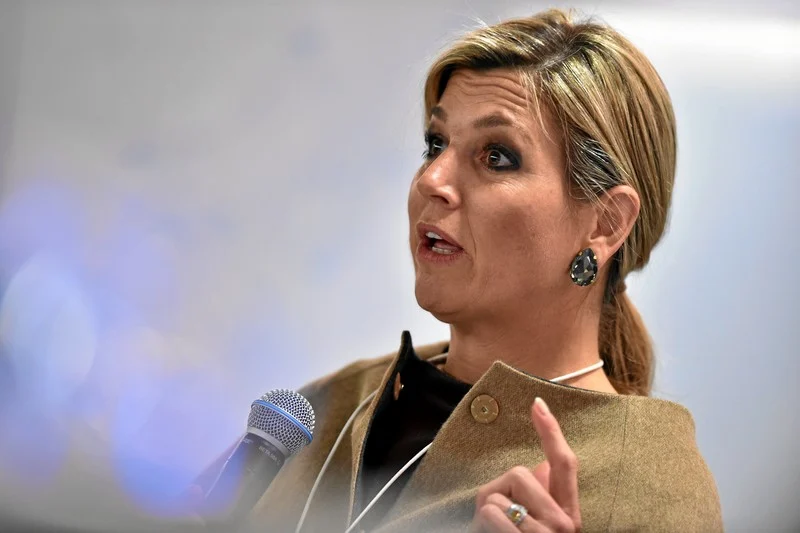
On a first of its kind visit, Queen Máxima of the Netherlands will visit Morocco in her capacity as Special Adviser to the Secretary-General of the United Nations for Inclusive Financing for Development, from March 20 to 23.
The Special Adviser’s visit aims to provide further support for the progress Morocco has made in the area of inclusive financing in recent years.
This includes bilateral meetings with the Prime Minister Aziz Akhannouch, Secretary-General of the Government Mohamed Hajjaoui, Minister of Economy and Finance Nadia Fattah Alaoui, Minister of Industry and Trade Riad Mezour, Minister Delegate to the Prime Minister in charge of Digital Transition and Administrative Reform Ghita Mezour, and the Wali of Bank Al-Maghrib, Abdellatif Jouahri.
In her meetings and talks, the Special Adviser to the Secretary-General will focus on key investments to help launch the digital payment market in Morocco, in particular to serve as a platform for the formal financial sector for traditionally vulnerable groups, such as women and small-scale merchants.
The Special Adviser will also discuss how the FinTech sector can be further advanced in Morocco – including supporting technology that can help address risks, costs, and geographic barriers to financial services.
Queen Máxima will also highlight inclusive green finance, particularly the role of financial services in building resilience and supporting adaptation to climate risks; Morocco is considered a pioneer in sustainable finance, including the publication of a road map to align the Moroccan financial sector with sustainable development.
According to the World Bank’s Global Findex 2021 database, 44% of Moroccan adults have access to a formal financial account (either from a formal financial institution or mobile money service provider).
This represents a positive increase from 29% in 2017. Morocco targets a financial inclusion rate of 50% in 2023 and 75% in 2030, as outlined in its National Financial Inclusion Strategy (NFIS), launched in 2019 and co-led by Bank Al-Maghrib ( Central Bank) and the Ministry of Economy and Finance.
However, nearly 15 million adults in Morocco remain without bank accounts. Financial inclusion of traditionally disadvantaged sectors remains an important issue in the country. For example, 56% of men compared to only 33% of women had accounts in 2021.
While this represents an increase compared to 2017 when 41% of men and 17% of women had accounts, it means that the gender gap of 23 percentage points remains. unchanged at that time.
Meanwhile, only 6% of adults in Morocco report having a mobile money account.
On the first day, the Special Adviser to the UN Secretary-General visits a client in the vicinity of Casablanca, where she has the opportunity to meet with entrepreneurs and users of financial services to hear first-hand about their experiences—particularly the benefits and challenges of building better financial health and resilience.
On the second and third days of the visit, the Special Adviser to the UN Secretary-General will be in Casablanca and Rabat for a final visit to clients, as well as to meet with senior leaders in the public and private sectors, to discuss opportunities for support and collaboration in the field of inclusive finance in Morocco.







add your comment
Terms of publication : Not to offend the writer, people, sacred things, or attack religions or the divine self, and refrain from racist incitement and insults.