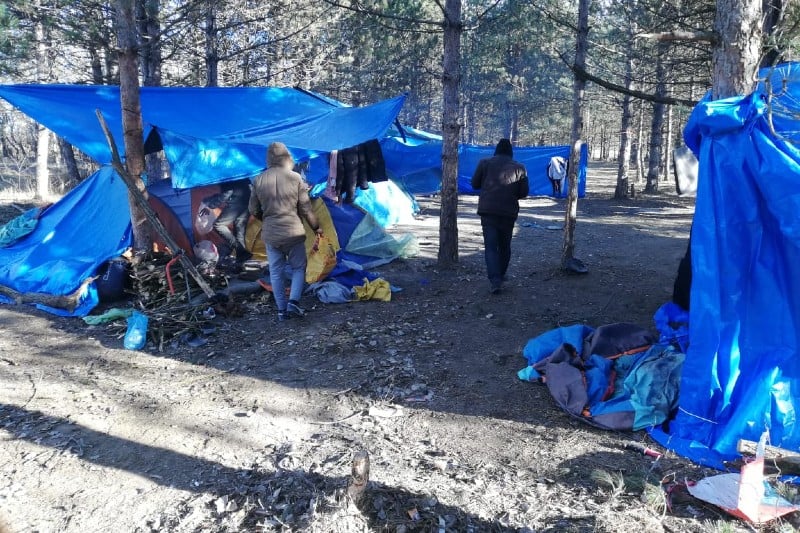
Thousands of people, of different nationalities, are still flocking to Turkey’s borders, waiting for the earliest opportunity to enter the territory of Greece or Bulgaria.
This comes at a time when the governments of neighboring Turkey and Greece are exchanging accusations of “tolerance towards irregular migration” and “weak security control at the borders.”
Hespress contacted a large number of Moroccan “Herraga” (Irregular Migrants in Darija), who are present these days on the Serbian-Hungarian border, and with others stuck in the forests in Greece and Bulgaria, who revealed part of their suffering, starting from extreme cold to hunger and fear of an unknown fate.
Speaking with Hespress AR, these young Moroccans revealed a set of problems that, not only the Moroccan “Herraga” face in general, stressing that crossing the borders of some countries requires paying people money to transport them from the border to the center of a nearby country, highlighting that The borders between Turkey and a number of countries close to Europe are controlled by organized dangerous international gangs.
Departure from Mohammed V Airport
The Moroccan “Herraga” journey, most of whom are young people between their twenties and thirties, begins from Mohammed V International Airport in Casablanca towards Istanbul Airport, to begin a new journey and adventure in unfamiliar lands in search of friends with experience in irregular migration.
Ali bin Muhammad, from Tinghir province, recounted part of his story in his interview with Hespress, saying: “Immediately after the arrival of Moroccan youth at Istanbul Airport in the morning, they head by bus towards the Taksim area with a ticket price of 52 Turkish Lira,” adding: “From the region of Taksim You must go again via bus No. 76D to the Esenyurt Square area, which is a center where international delegations of young people who wish to cross the borders of the Balkan countries towards Europe meet.
Ali bin Muhammad revealed that there are mediators who provide those wishing to migrate with a service to transfer them from the Turkish, Greek and Bulgarian borders in exchange for sums of money exceeding 2,000 euros (20,000 Moroccan dirhams).
Stories of suffering youth
“Esenyurt Square” is a Turkish area close to the Bulgarian-Greek border, where various young people gather who wish to cross the border towards the “European Paradise,” says Hassan bin Al-Hussein, one of the young people who are also present at the Serbian-Hungarian border, stressing that young people from different nationalities of the world set out from “Esenyurt Square” towards Europe.
The same spokesman explained, in a telephone statement to Hespress, that the “Herraga” leave guarantee money to an intermediary in Turkey, after which he transfers them to the Turkish-Bulgarian border for “three hours by car, then they must walk in the forest, and pay attention to the security and army patrols.”
Immediately after reaching the Turkish-Bulgarian border, the spokesman tells Hespress, a team of irregular migrants cut the wires and run quickly for an estimated distance of more than five kilometers to avoid falling into the grip of the Bulgarian army, and then they head towards the point agreed upon with the “Herraga” that requires five days of walking in the woods.
Regarding how to obtain water and food, Hassan bin Al-Hussein confirmed that young people buy a lot of foodstuffs from Turkey that will suffice them until they reach the capital of Bulgaria, “Sofia”, where the “Herrag” (Irregular migrant) transports them to in a private car, and there they are accommodated in a house and are forbidden to Exit permanently until the date of their transfer to the borders of Serbia.
For his part, Ali bin Yahya, also one of the “Herraga”, said that immigrants cross large distances in the forests from Turkey to Serbia, adding: “But fortunately the border between Bulgaria and Serbia is not difficult and is easily crossed,” adding: “After our arrival To Serbia, we go directly to the immigrant shelter in the Beirut area, where we enter and change our clothes, eat and drink, and rest for some days,” as he put it.
He added: “After spending a full week in the accommodation center located in Beirut, we went to the passenger station, and bought tickets to the Serbian capital, Belgrade, at a price of 21 euros per person, and directly from Belgrade station, other tickets were cut to the Siputica area, after which a taxi was rented to a small area called Paleš on the Serbian-Hungarian border.
The same spokesman confirmed that hundreds of irregular migrants are now at the Serbian-Hungarian border waiting for their turn to cross the border with the help of intermediaries who use large ladders in the process of crossing, stating: “The intermediaries will directly transfer us to Austria, and from there we will cut tickets to Italy or Spain, each one according to his needs, destination” he said.
Organized gangs control the borders
Identical statements obtained by Hespress from a large number of young men who are currently present at the Turkish border point, and the Greek-Bulgarian and Serbian lands, indicate that the borders in these countries are controlled by organized gangs, and army patrols often comb the area very quickly for fear of being attacked.
These young people, among others, lived through the experience of irregular migration across the Balkan countries revealed to Hespress how international gangs tighten their grip on a group of border points, stressing that irregular migrants offer sums of money to these gangs in return for their protection and providing them with food and drink until they cross into neighboring countries.
Ali bin Muhammad, a “secret” irregular migrant, said: “This area where we are located between Serbia and Hungary is controlled by a gang of Kurds, all of whom are armed with firearms. They rent a guarded area for irregular migrants and provide them with all the requirements until they cross into Hungary.”
The same spokesman added in a telephone statement to Hespress: “Frankly, despite the danger of these gangs, they deal humanely with delegations of clandestine immigrants,” noting that these gangs often confront each other with firearms, as each gang desires to control the situation at the borders. He stressed that “despite the economic conditions, Morocco remains the best country in the world in terms of security and peace.”








add your comment
Terms of publication : Not to offend the writer, people, sacred things, or attack religions or the divine self, and refrain from racist incitement and insults.