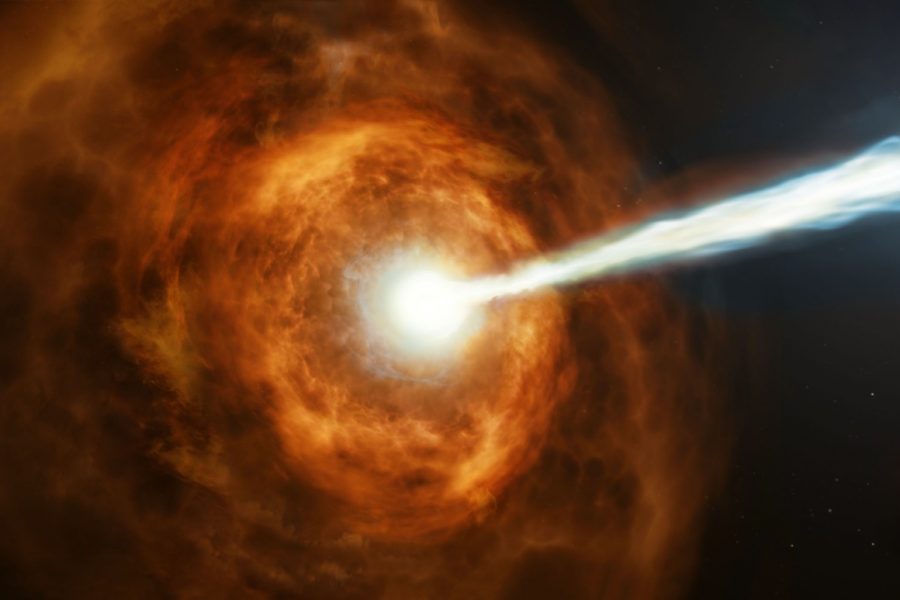
Recent observations by numerous National Aeronautics and Space Administration (NASA) telescopes showed a gigantic black hole ripping apart an unlucky star that strayed too close.
It was the fifth-closest instance of a black hole obliterating a star ever seen, declared NASA on December 20, noting that it was situated around 250 million light-years away from Earth in the center of another galaxy.
Astronomers noticed a sharp increase in high-energy X-ray light around the black hole after the star had been totally shattered by the black hole’s gravity.
This demonstrated that the star created a corona, a very hot structure above the black hole, as it was drawn into its destruction.
The closest space telescope capable of observing these light wavelengths is NASA’s NuSTAR (Nuclear Spectroscopic Telescopic Array) satellite, and the event’s proximity provided an unmatched view of the corona’s formation and evolution, according to a recent study published in the Astrophysical Journal.
The research shows how the destruction of a star by a black hole, also known as a tidal disruption event, can be utilized to learn more about what happens to matter that a black hole captures but doesn’t fully consume.
The majority of black holes that astronomers can observe are encircled by hot gas disks that are billions of miles wide and have evolved through many years, sometimes millennia, of accumulation.
According to NASA, these disks can occasionally flash more brightly than entire galaxies.
Even in the proximity of such powerful sources, and particularly in the vicinity of far less active black holes, a single star being shattered and consumed stands out, and it frequently just requires a few weeks or months to complete the process from beginning to end.
Astronomers are now particularly interested in tidal disruption events because of their observability and brief duration.
They might now study how the black hole’s gravity affects the surrounding matter to produce amazing light displays and novel physical properties.





add your comment
Terms of publication : Not to offend the writer, people, sacred things, or attack religions or the divine self, and refrain from racist incitement and insults.