
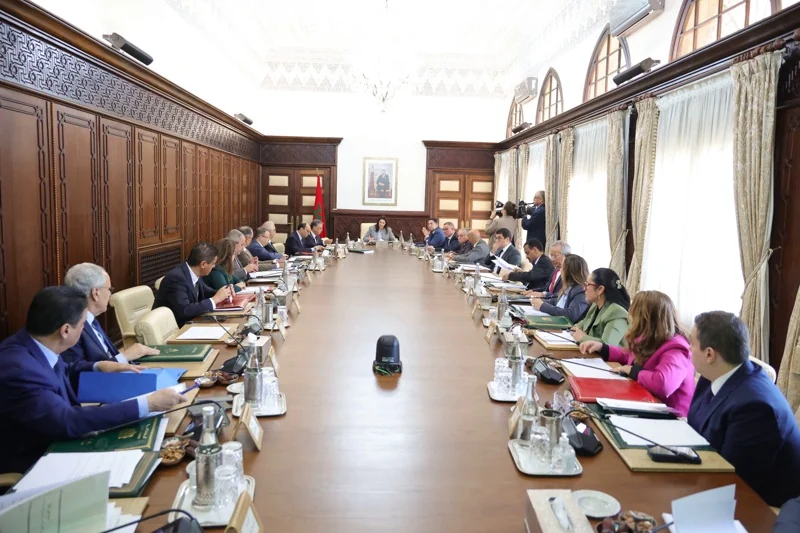
King Mohammed VI approved the general directions of the draft finance law for the 2023 year on Tuesday during a Ministerial Council, outlining the priorities of this fiscal year’s budget and projects.
The bill details new requirements, including the approval of direct financial support for the acquisition of housing and tax reductions.
According to a presentation by Minister of Economy and Finance Nadia Fattah Alaoui, the directions of the draft Finance Law for 2023 are based on four axes, pertaining to the social, economic, territorial and fiscal aspects of financial governance.
Universal public health insurance
The first axis concerns the implementation of the various components of the generalization of social protection, which includes compulsory health coverage for all social groups, and the gradual generalization of state-backed family allowances and benefits.
With direct targeting of vulnerable and underprivileged groups, the Ministry aims to initiate the project through the unified social registry, and accelerating its conception throughout the Kingdom.
It is expected that the national health coverage system will continue to be rehabilitated by increasing the funds allocated to the health and social protection sector.
Education reform
The education reform road map is the second social project the bill was designed to focus on, which includes training and improving graduates’ employability.
Encouraging the full participation of women in all economic fields, safeguarding their rights, and working to integrate people with disabilities are additional guidelines for the reform, that will be translated into fiscal and financial appropriations in the finance bill.
Easing access to housing
Considering the importance of facilitating access to housing and ensuring decent living conditions, the Ministerial Council approved direct support from the state in this field, for the benefit of target groups. It is expected that these eligible categories and the required conditions for their eligibility will be determined following the bill’s introduction.
Grand focus on investment
The second pillar aims to revive the national economy by supporting investment, per King Mohammed VI’s speech to Parliament last week.
With the newly approved investment charter, implementing the commitments established within the framework of industrial investment projects, activating the Mohammed VI Investment Fund, and giving a new dynamism to public investment, the Moroccan government is seemingly in unison when it comes to the Importance and timeliness of investments in the country, both domestic and foreign.
According to the Minister’s presentation in the council, public investment will be bolstered by directing it to infrastructure projects and ambitious sectoral strategies, in a way that enhances competitiveness, and strengthens national food, health and energy sovereignty.
Tax reform
Given the important role of the tax system in achieving the current economic challenges, and reaching the desired ambitions in reviving the economy tax reform will be significant in this year’s bill.
Through this reform, the executive aims to allow a visual clarity of economic actors, through a comprehensive reform of the corporate tax, as well as the banking and insurance sectors, all while alleviating tax pressure on the middle-class.
Regionalization, again
The new finance bill additionally focuses on a concern that all its predecessors have eyed for nearly a decade now: advanced regionalization.
The consolidation of spatial justice was highlighted as once of the primary concerns this year, with the Ministry of Finance aiming to continue its implementation, thanks to a program to reduce spatial and social differences, accelerating administration reform by simplifying procedures, and launching a new national strategy for digital transition.
In addition to continuing efforts in the field of administrative decentralization, and the use of the Amazigh language in various areas of national life, the bill will focus on regional economic equality, a logical long-term goal considering the strong emphasis on investment.
Financial margins in turbulent times
The fourth and last pillar of the upcoming bill aims to restore financial margins in order to ensure the sustainability of reforms, by mobilizing all available financial resources, through tight collection of levies and the adoption of innovative financing mechanisms.
The Ministry wishes to ensure the rationalization of management expenses, activate the reform of public deals, reassessing the public portfolio public and improving its overall performance.









add your comment
Terms of publication : Not to offend the writer, people, sacred things, or attack religions or the divine self, and refrain from racist incitement and insults.