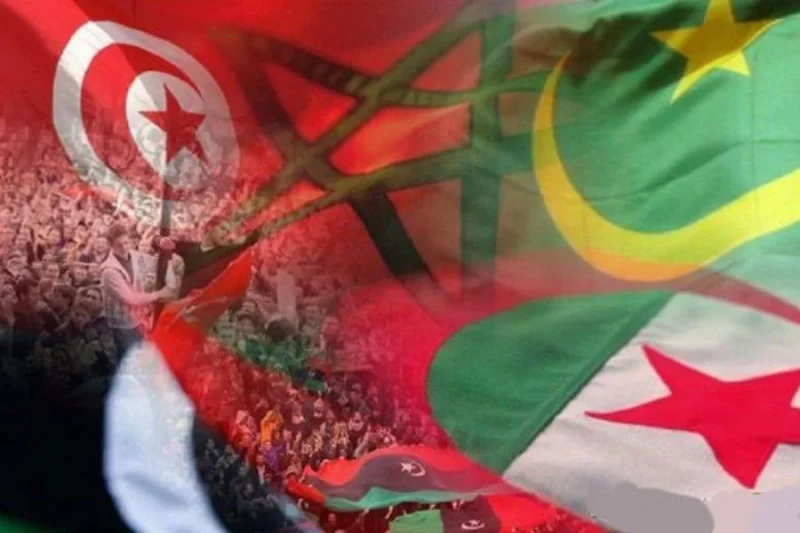
It was at the critical juncture of the 1980s that saw Morocco, Algeria, Mauritania, Tunisia, and Libya reach an agreement and spearhead the establishment of the Arab Maghreb Union (AMU). Although motivated by common goals of economic integration and security concerns, the five nations, gripped by intrinsic national interests, engaged each other in a perverse othering process that not only led to the failure of the AMU but which lingers till today between the rival neighbors.
Prospects for a Maghrebian Union were in high gear in the late 80s. A worsening Algerian economy led the then Algerian President Chadli Benjedid to take a more nuanced approach to regional issues and establish together with late King Hassan II a surprising alliance with Morocco. In the eastern end of the region, Ben Ali’s coming to power in 1987 reduced the violent tensions that had erupted between Libya and Tunisia and set the stage for greater cooperation among the Maghreb countries.
Economic struggles have likewise contributed to the idea of a Maghrebian Union, whose founding nations suffered in a context marked by reduced exports to Europe after Spain and Portugal joined the European Community in the late 80s, as well as a series of droughts and an oil crisis.
In February 1989, President of Tunisia Zine El Abidine Ben Ali, Leader and Guide of the Revolution of Libya Muammar Gaddafi, King Hassan II of Morocco, President of Algeria Chadli Bendjedid, and President of Mauritania Maaouya Ould Sid’Ahmed Taya emerged to the public in a balcony in Marrakech, holding hands, waiving high and announced the establishment of The Arab Maghreb Union.
“In response to the deep and firm aspirations of these peoples and their leaders to establish a Union that would reinforce the existing relations and provides them with the appropriate ways and means to gradually proceed toward achieving a more comprehensive integration among themselves,” read the Instituting treaty of the Union.
Within a few years, this integration began to show cracks, starting with the Union’s refusal to stand by Libya when Ghaddafi was blamed for being the culprit in an explosion of a bomb onboard Pan Am Flight 103, killing about 300 people in 1988. The incident drove Ghaddafi from the Union and towards a reorientation of Libyan foreign policy towards Africa.
What followed sent waves of shock in the Union. Mauritania in 1999, and without consultation with the member states, established diplomatic relations with Israel, and when the Gulf crisis and the war of the 1990s erupted the union could not make a common stance, worsened by its structure which stipulates that “Only the Presidential Council shall have the authority to take decisions, and its decisions shall be taken unanimously.”
The Presidential Council, the body which has the authority to take decisions has met only irregularly. The Council met six times and the last was in April 1994. The Union has not been effectively involved in any of the events that followed.
Economically, the Union also fell short of expectations. Intra-regional trade accounted for 3% of total AMU trade in 1989, while Maghreb trade between European states accounted for 40%.
While the Maghreb states have not shown sufficient willingness to develop their economic relations, they have signed bilateral trade agreements between themselves outside of the AMU.
The weak economic integration was consolidated further with the signing of bilateral free trade agreements with Europe by Morocco and Tunisia in 1996 and Algeria in 2001.
Each of the five Maghreb countries would benefit from a minimum 5% increase in GDP if they were integrated. According to a World Bank report on economic integration in the Maghreb, deeper integration, including service liberalization and investment rule reform, would have increased per capita real GDP by 34% in Algeria, 27% in Morocco, and 24% in Tunisia between 2005 and 2015.
The AMU is sustained through a secretariat in Rabat and represented at regional meetings. In the latest series of rivalry that erupted between Morocco and Tunisia, the AMU president, Taieb Baccouche said in despair, “ We are preparing for Tunisia to lead the mediation between Algiers and Rabat, and here we are surprised by a new crisis.”
“ We are preparing for Tunisia to lead the mediation between Algiers and Rabat, and here we are surprised by a new crisis “, is in despair Taieb Baccouche, secretary general of the Arab Maghreb Union.”





add your comment
Terms of publication : Not to offend the writer, people, sacred things, or attack religions or the divine self, and refrain from racist incitement and insults.