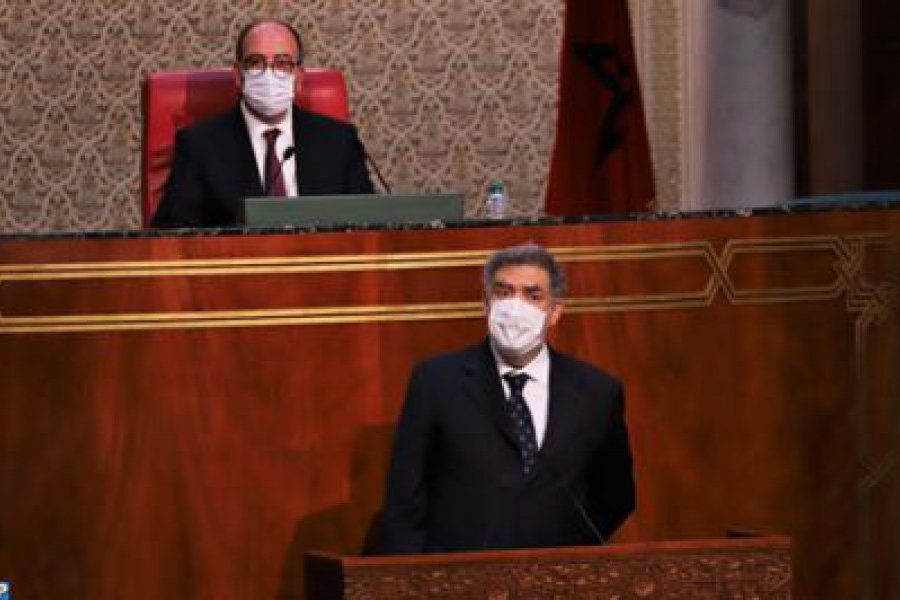
The organic bills governing the electoral system aim to enshrine a culture of fair and equitable competition between the parties concerned, in order to produce solid and coherent representative institutions, said, on Friday to Rabat, Interior Minister Abdelouafi Laftit.
Presenting these legal texts during a general legislative session in the House of Advisors, Laftit underlined that their aim is to produce solid representative institutions which reflect the evolution and changes experienced by Moroccan society in various fields.
These are the draft organic law N° 04.21 modifying and completing the organic law N° 27.11 relating to the House of Representatives, the draft organic law N° 05.21 modifying and completing the organic law N° 28.11 relating to the House of Advisors, the draft organic law N° 06.21 modifying and completing the organic law N° 59.11 relating to the election of members of the councils of territorial authorities and the draft organic law N° 07.21 modifying and completing the organic law N° 29.11 relating to political parties.
The Minister stressed that the achievement of these noble goals remains dependent on the willingness of all political actors to prioritize the public interest, calling on all parties, including the government, political bodies, parliament and civil society to spare no effort to ensure the success of the next elections.
Laftit explained that the four draft organic laws aim to improve the Moroccan electoral system, to support the changes and dynamics experienced by the Moroccan society, as well as to enrich the current texts with more electoral guarantees, in addition to shoring up the credibility and moralization of electoral operations.
The draft organic law relating to the House of Representatives provides for replacing the national electoral constituency by regional constituencies, with the distribution of the seats currently allocated to the national electoral constituency (90 seats) to the regional constituencies and this, according to two basic criteria, the first of which takes into account the legal population of the region, while the second is determined by the representation of the region, taking into account its constitutional position in the territorial organization of the Kingdom.
Regarding the electoral system, Laftit stressed that the bill includes an amendment approved by the House of Representatives by majority concerning the revision of the rules applied for the voting system, by adopting a new electoral quotient based on the number of voters registered in the electoral constituency instead of the number of votes obtained by the lists eligible to participate in the distribution of seats, hence the amendment, the minister went on to say, would lead to the removal of the requirement to obtain 3% of the votes cast to participate in the seat allocation process.
With regard to the organic law on the House of Advisors, the Minister explained that given the need to preserve the professional organizations of the most representative employers within their own parliamentary group, the candidacy for the seats allocated to the representatives of these organizations will be limited to their affiliated members, in order to allow them to express the concerns of economic actors and the aspirations of national companies.
The minister also referred to the main amendments that have been incorporated into the local electoral system, the most important of which is the amendment approved by the House of Representatives aimed at reviewing the rules for applying the voting method for the election of the members of the councils of regions and the councils of communes subject to the list regime, which provides for the adoption of an electoral quotient extracted by dividing the number of voters in the regional electoral constituency or in the commune or the local district, as the case may be, by the number of seats to be filled, while omitting the percentage of votes required to participate in the process of allocating seats, currently set at 6% of the votes cast.
Furthermore, the minister explained that the proposed electoral system includes explicit requirements according to which at least one third of the seats are allocated to women in the councils of prefectures and provinces. This system also proposes to increase the number of seats allocated to women at local councils in a tangible way.
The majority of political groups in the House of Advisors underlined, during the general discussion of the drafts of these organic laws, the importance of these organic texts to immunize democratic gains and strengthen political pluralism and fair competition among the parties, so as to ensure a stronger representation in the next electoral stages.
It also underlined the great importance of the drafts of these organic laws, which respond effectively to several problems linked to the achievement of equity, the cancellation of certain electoral privileges, the opening of the way to a real inter-party competition and the fostering of the political process, noting in particular the efforts to increase the representation of women in elected bodies.






add your comment
Terms of publication : Not to offend the writer, people, sacred things, or attack religions or the divine self, and refrain from racist incitement and insults.