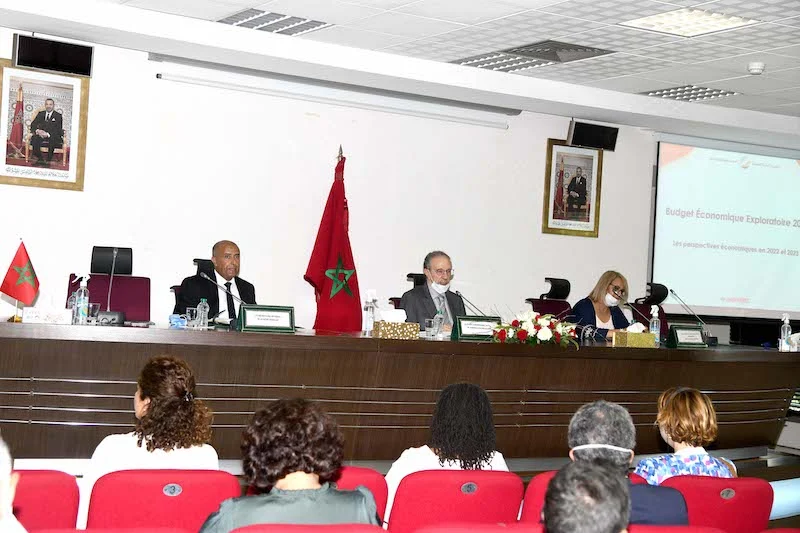
The High Commission for Planning (HCP) said that the growth of the gross domestic product (GDP) will slow during the current year to reach about 1.3%, compared to 7.9 % in 2021, affected by the decline in the added value of the agricultural sector by about 13.5 %.
The delegate presented its forecasts for the years 2022 and 2023 this Thursday in Rabat, during a press conference chaired by High Commissioner Ahmed Halimi Alami.
The delegate stated that the expected growth for the current year will be affected by the drought that marked the current agricultural season, which will negatively affect economic activity, not to mention the repercussions of the unfavorable international environment.
Alami pointed out that rainfall recorded during the months of March and April contributed to achieving a national cereal production of about 32 million quintals, a decrease of about 69% compared to the last agricultural season.
Ayash Khallaf, Secretary General of the High Commission for Planning, said that the coming year will achieve an economic growth rate of 3.7%, based on the assumption of an average agricultural season.
He added that these expectations were mainly affected by the dry season locally, the current geopolitical conditions in the world, and the resulting inflation and price hikes.
The agricultural sector is expected to achieve an added value of about 11.8% during the next year, compared to minus 13.5 % during the current year, and a plus 17.6% in 2021.
The commission stated that inflation will reach 4.9% during the current year, and return to 0.8% next year.
It is evident from official data that the trade deficit will be recorded during the current year at about 17.9% of the gross domestic product during the current year, while the budget deficit will be around 5.4%, with a total public debt rate of about 83.3%.
General increases in prices will lead to noticeable imbalances in the level of supply and demand, which will greatly affect the purchasing power of families and the state budget, and economic activity will be affected by the poor results of the agricultural sector.
Domestic demand and unemployment
After the significant increase in domestic demand in 2021, it is expected to record a noticeable slowdown in its growth rate during 2022, when its pace will not exceed 1.3%.
The High Commission for Planning attributed the decline in the rate of domestic demand mainly to the expected decline in the rate of growth of household consumption to about 1.6%, whose contribution to GDP growth will drop to about 0.9 points in 2022 instead of 4.8 points in 2021, as a result of a decline in household incomes, especially agricultural ones, and a decrease in remittances from Moroccans living abroad, compared to the large increases recorded during the past two years.
The consumption of Moroccan families will also be affected by the strong rise in energy prices, which will lead to an increase in the prices of other basic products, which will result in a decrease in the purchasing power of families by about 1.5% in 2022 instead of increasing by 1.1% as an annual growth rate for the period 2015-2019.
With regard to the labor market, the commission indicated that it will see a decrease in the activity rate by 0.9% after its increase by 1.1% in 2021, provided that the unemployment rate at the national level will stabilize at 12.2% in 2022.
With regard to the year 2023, the delegate said that its forecasts are based on a moderate growth pace of the global economy that will lead to a slowdown in global demand directed towards Morocco and on the continuation of global commodity prices to record high levels.
These prospects remain, according to the delegate, dependent on the extent of the development of many manifestations of anxiety and risks associated mainly with developments that will be known in the geopolitical situation and the repercussions thereof, especially the imbalances defined by storage chains and the weak reserve of basic products.
What to do?
In this difficult global context that is known for successive shocks, from the health crisis to the Corona epidemic and the Russian-Ukrainian conflict, the delegate stressed that the risks and the decline in confidence will continue to exacerbate, which will result in imbalances at the level of production and consumption, which will lead to a significant rise in the prices of basic products.
As a country importing energy and food products, Morocco will be greatly affected by the repercussions of this crisis, and imported inflation this year, as is the case for many countries of the world, will reach exceptional levels that will lead to a significant deterioration of purchasing power and a decline in the profitability of some productive sectors.
Faced with this situation, the High Commissioner for Planning stressed the need to give priority in public policies to support purchasing power and target economic sectors that will help turn the wheel of the economy.
The delegate also drew attention to the challenges faced by the agricultural sector, given the important position it occupies in the national economy, as it called for appropriate measures to be taken to combat the effects of climate change, which requires encouraging agriculture capable of facing these effects and ensuring food security while preserving water resources.
The delegate stressed the need to strengthen the foundations of food sovereignty in order to meet basic food needs and avoid the consequences of a potential crisis, and this goes through the adoption of an integrated and effective system of governance and horizontal comparison to meet the current challenges.




add your comment
Terms of publication : Not to offend the writer, people, sacred things, or attack religions or the divine self, and refrain from racist incitement and insults.