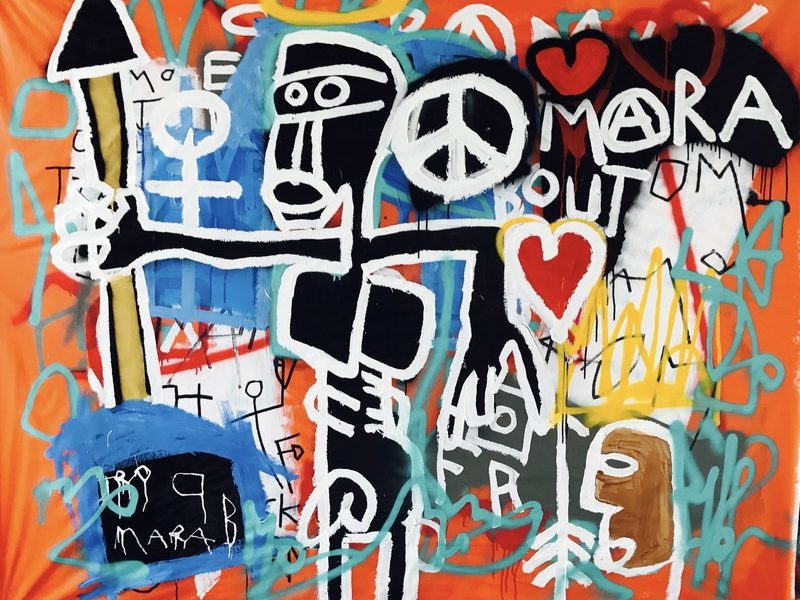
“Painting is my outlet, my oxygen, my water, and my freedom. My paintbrush is the indicator of my emotions, the snapshot of my truths, both conscious and unconscious. My artworks are a concentrate of the fruit which is my inner projection. Coded like many riddles, I love that an emotional dialogue sparks between them and other… without facades.” _ Kokian.
Jean Christophe A, known as “Kokian,” is one of the heirs of the Neo-Expressionist movement of Bad Painting.
Born in 1971 to French parents, the artist grew up going back and forth between Burma and Morocco and living in Rabat for a good portion of his childhood, considering both of his parents worked overseas.
The painter mentions his nanny as a major influence to his earliest creative outbursts, saying that together, they had created their own language, a dictionary of words that they mix with representations, which later became the DNA of the artist, and his work.
Following a period of tagging graffiti on Parisian streets, Kokian moved to New York in 1995 where he found and polished his own style: off-beat, satiric and disturbing.
Since then, his colorful paintings with graffiti and interrogative slogans about society’s many injustices caught contemporary art critics’ attention.
The artist, during the process of creating and splashing paint onto canvas, constantly questions himself, his pencils, forgets, and repeats for greater freedom of gesture and artistic expression.
His trademark characters are black female figures, icons embodying idealized maternal shapes, mixing his “Kokianas” with words and colorful motifs.
He describes the facial expressions on his canvases as “masks and not faces, like the one I have worn and many others have worn,” adding that he “wants cheerful, upbeat, emotionally charged, filled with [his] energy, and with which [he]identifies, like mirrors.”
In an interview held with Hespress EN, the artist shared a glimpse of his motives, background, and where he draws his inspirations from.
When asked about the significance of his nickname, the artist responded that “the name Kokian, is a concentration, a free choice and a creation.”
“My art is driven by the desire to differentiate myself from the conventional in this art field, and to express myself without restraint on the canvas, and without the rules taught at the fine arts school.”
“My art represents my way of thinking, the desire to share with others,” highlights Kokian while speaking of the projections of his art, which emulates his thoughts in non-verbal manners.
“My inspiration is the human nature with all its complexity, which generates happiness, hatred, jealousy, defiance, anguish, and inspires an alchemy towards peace,” said the artist about what ignites his passion.
Answering a question about Morocco’s significance to him, the artist stated that “since [he] grew up in Rabat, Morocco is naturally in [his] heart,” he continued, revealing his nostalgia towards his childhood growing up in the capital, saying that he “still experiences the odors from his childhood there.”
Kokian is known to be a very productive artist focusing on themes that unify his creations. When asked about what he is currently working on, he answered that he’s working on “the cradle of humanity with all its wealth and culture, with Africa being an epicentral element.”
A common misconception is that he does “Basquiat” inspired work, because his output reminds many art enthusiasts of the late American artist Jean-Michel Basquiat.
Kokian tackled this misconception saying that Basquiat is a grand artist whose works he greatly admires, and thanked art enthusiasts for making such a comparison, saying that “it’s a compliment.”
However, he adds that “comparing [ him ] to Basquiat is like comparing Mozart to Beethoven, not that [ he ] sees [ himself ] as Beethoven, that equals the likes of Mozart, but they are both classical music composers, one preceding the other, yet if one listens attentively, their styles are quite different to the trained ear, even if both are of the same classical genre.”
Kokian can draw up to 100 drawings, but he will only keep two or three, channeling his output. The rest is put away for future modifications.
Before the canvas leave his workshop, he edits his artworks as he always manages to find mistakes, negative emotions, and “can only be satisfied with the best.”
Each of his paintings and drawings are the result of the first throws of paint, which are then “fixed” as he puts it, in order to “meet his expectations.”
Art critics describe his paintings as addictive, without filters, spontaneous, impulsive and freed of restraints.
Kokian’s urban expressionism is well recognized and can be found in numerous international collections.




add your comment
Terms of publication : Not to offend the writer, people, sacred things, or attack religions or the divine self, and refrain from racist incitement and insults.