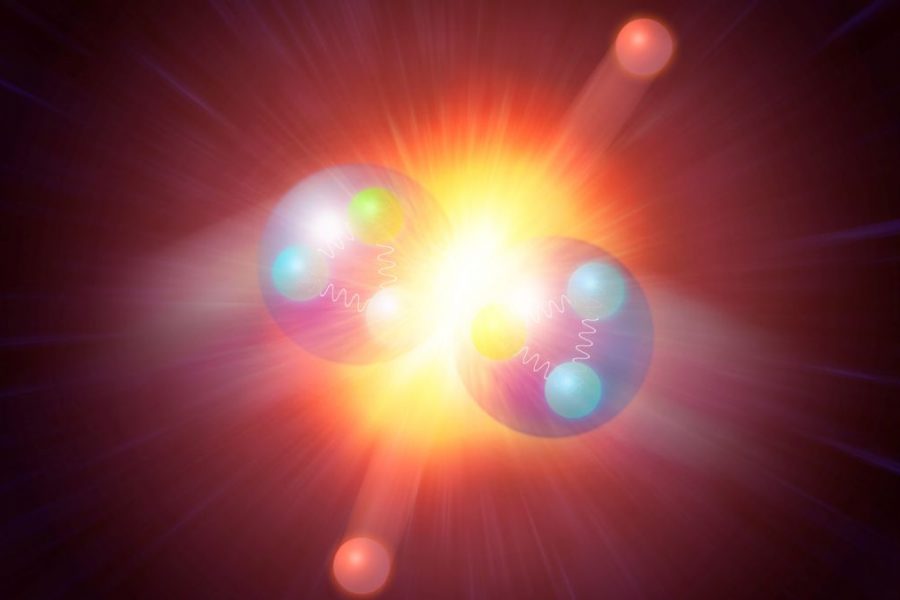
The international collaboration at the Large Hadron Collider (LHC) has observed three never-seen-before particles: a new kind of “pentaquark” and the first-ever pair of “tetraquarks”, which includes a new type of tetraquark.
The findings, presented at a European Council for Nuclear Research (CERN) seminar on Monday, add three new exotic members to the growing list of new hadrons found at the LHC.
They will help physicists better understand how quarks bind together into these composite particles and contribute to the explanation of how our universe was formed.
The new particles exist for just a hundred-thousandth of a billion of a billionth of a second and are built out of quarks, the tiniest particles ever discovered.
Atoms contain smaller particles called neutrons and protons, which are made up of three quarks each, while this “exotic” matter is made up of four and five quarks, known as tetraquarks and pentaquarks.
The particles discovered are one new pentaquark and two tetraquarks, taking the total number found at the Large Hadron Collider in Switzerland to 21.
Researchers are excited about their new findings because there are now enough of these particles to start grouping them together in a way that is similar to the chemical elements in the periodic table.
Chris Parkes, professor of experimental particle physics, at the University of Manchester stated that ‘’finding exotic particles and measuring their properties will help theorists develop a model of how these particles are built, the exact nature of which is largely unknown.’’
Parkes added that “it will also help to better understand the theory for conventional particles such as the proton and neutron.”
Exotic particles were first hypothesized by theorists about six decades ago, but only in the past 20 years have they been observed by Large Hadron Collider and other experiments.
Quarks are elementary particles and come in six flavors; up, down, charm, strange, top and bottom. They usually combine together in groups of twos and threes to form hadrons, such as the protons and neurons that make up atomic nuclei.
More rarely, however, they can also combine into four-quark and five-quark particles, or ‘tetraquarks’ and ‘pentaquarks’. Particles made of quarks are known as hadrons.
While some theoretical models describe exotic hadrons as single units of tightly bound quarks, other models envisage them as pairs of standard hadrons loosely bound in a molecule-like structure.
Only time and more studies of exotic hadrons will tell if these particles are one, the other, or both.
In just 10 years, physicists have made tremendous steps forward in our understanding of the universe, not only confirming early on that the particle discovered in 2012 is indeed the Higgs boson, also known as the God particle, but also allowing researchers to start building a picture of how the pervasive presence of a Higgs field throughout the universe has established a tenth of a billionth of a second after the Big Bang.
“The discovery of the Higgs boson was a monumental milestone in particle physics. It marked both the end of a decades-long journey of exploration and the beginning of a new era of studies of this very special particle,” says Fabiola Gianotti, CERN’s Director-General and Project Leader, of the ATLAS experiment at the time of the discovery.
Gianotti added that “I remember with emotion the day of the announcement, a day of immense joy for the worldwide particle physics community and for all the people who worked tirelessly over decades to make this discovery possible.”
The Large Hadron Collider (LHC) is the world’s largest and highest-energy particle collider. It was built by the European Organization for Nuclear Research (CERN) between 1998 and 2008 in collaboration with over 10,000 scientists and hundreds of universities and laboratories, as well as more than 100 countries.
The LHC lies in a tunnel 27 kilometers in circumference and as deep as 175 meters beneath the France–Switzerland border near Geneva.




add your comment
Terms of publication : Not to offend the writer, people, sacred things, or attack religions or the divine self, and refrain from racist incitement and insults.