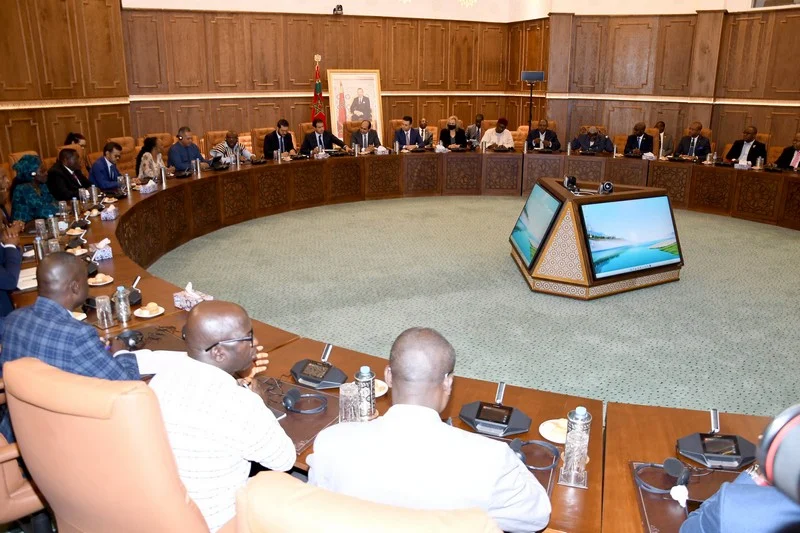
Morocco’s foreign ministry and the chief of border security summoned today ambassadors from allied Sub-Saharan nations to present findings on the attempted crossing of thousands of migrants to Melilla that ended with at least 23 people dead.
The ambassadors were shown photos and videos on the violent incidents that took place in the surroundings of the Melilla fence before the African representatives took turns to make condemnation statements of the assault.
Bashir Ibrahim Al Husseini, Nigeria’s ambassador, said that what happened was “very unfortunate”, and expressed his country’s support for what the Moroccan authorities had done to stop the infiltration of illegal immigrants to another country.
Minko Abu Bakr, Gabon’s ambassador in Rabat, said that the meeting was an opportunity to brief the ambassadors on what happened in Nador, and indicated that Morocco tried to protect its borders.
Bakr stressed that “illegal immigration will not be encouraged and we will raise awareness of this issue among our citizens,” expressing his encouragement for the policy taken by Morocco under the directives of King Mohammed VI in the field of migration.
Chad’s ambassador in Rabat, Mohamed Abdel Rasoul Abdel Amin, said that his country supports King Mohammed VI’s policy in the field of immigration management and the resulting settlement of the situation of many immigrants.
Abdel Amine explained that “what happened in Nador has an external link to question Morocco’s immigration policy.”
He continued, “Social media published photos and videos that give the impression that Morocco has not taken responsibility, and this is not true. The reality is otherwise, and we know how our Moroccan brothers treat our fellow students and immigrants.”
“There is a network that is working to strike at what Morocco is doing in the field of migration management, especially that the African Union has entrusted this file to King Mohammed VI,” he said.
In a joint statement, the AMDH and other NGOs from both Spain and Morocco called out the “failure of security-based migration policies” in the Mediterranean, in light of the recent events of Friday.
“The 27 dead and hundreds injured both on the side of the migrants and the Moroccan police forces are the tragic symbol of the European Union’s (EU) and Morocco’s border policies,” said the statement.
According to the NGOs, the deaths alert the activists to “the deadly nature of security cooperation on immigration between Morocco and Spain.”
The AMDH and associations demanded that adequate and quality health care be provided to all those hospitalized in the wake of this tragedy, and that “Moroccan authorities proceed with the identification and return of the remains of the victims to their families, in collaboration with the migrant communities.”
“We demand the immediate opening of an independent judicial investigation by both Morocco and Spain,” read the statement, while calling for the “end to the criminal policies financed by the European Union and its many accomplices, states, various international organizations, and various civil society organizations,” with regards to border control.



add your comment
Terms of publication : Not to offend the writer, people, sacred things, or attack religions or the divine self, and refrain from racist incitement and insults.