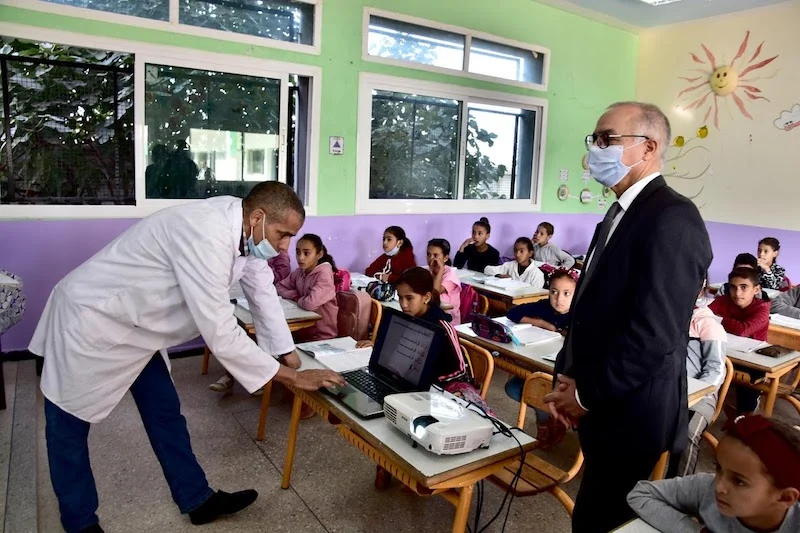
Moroccan Minister of National Education Chakib Benmoussa recently revealed the outline of educational reform, which will change the training norms for future teachers.
The program promises to train 50,000 teachers by 2025, which will require teachers to earn a higher education degree, equivalent to an MA. Today, teachers are integrated into the public education system starting with a three-year university degree.
However, the Ministry of Education intends to reform the training norms for future teachers, “to ensure the quality of education in Moroccan public schools,” as training will be at the heart of the improvement reform, undertaken since Benmoussa’s nomination as head of national education.
This June 13, the Ministry of National Education, the Ministry of Higher Education, and the Ministry of Economy and Finance signed a joint agreement launching the training program, which will include 50,000 teachers of primary and secondary cycles, with a budget of MAD 4 billion.
The agreement is intended to implement the new model of teacher training and was said to provide major changes in the training process of the teaching staff in the primary and secondary cycles.
Under this agreement, the duration of teacher training will increase from three to five years after the baccalaureate high school degree.
The first three years will be dedicated to basic training in one of the fields of the Bachelor of Education (CLE) cycle. The fourth-year will be dedicated to a professional qualification in a regional center for education and training, while the fifth year will be dedicated to a supervised internship in a school.
These trainings will take place at the Ecole Normale Superieure (ENS) at the Faculty of Education Sciences (FSE) in Rabat.
In addition, the agreement accounts for a MAD 1,000 monthly grant in favor of the students, in return for “educational actions” in the form of academic support, leading extracurricular activities, or assistance with administrative tasks in schools. This allowance is accumulable with other grants.
Benmoussa explained, in a statement to the press on Monday, that the public education reform program will gradually produce 80% of the teaching staff needed by public schools in Morocco, noting that the remaining percentage will be allocated to graduates of majors in public universities.
Alaa Berrani, a French linguistics Ph.D. student and teacher in a private school in Meknes welcomed the reform, saying “this will contribute to improving and homogenizing the quality of public education.”
“Many parents are exceedingly turning to private schools for their children’s education for the quality and competence of the teachers in the private sector, which guarantees this quality is primarily highly educated humane resources, and close follow-up by the institutions’ administrations,” the educator tells Hespress EN.
Many parents, students, and pedagogical professionals such as Alaa have welcomed the Ministry’s project, arguing it will improve education’s quality and raise the standard for public sector teachers.
According to the report on the 2020-2021 school year published by the Ministry of Education, Morocco continues to suffer from a teachers shortage, despite the efforts made in recent years.
Considering the Ministry’s plans to create a direct humane resources funnel to feed the public sector, the reform is also expected to counter the teachers’ shortage.
However, considering the ongoing dissatisfaction of contractual teachers with their status, and the continuous national strikes hindering Moroccan students’ education, the reform is being met with ample criticism from some practicing teachers.
The ongoing sectoral reform is “moving steadily and smoothly,” said Benmoussa, but against the backdrop of massive discontentment among contractual teachers, who have been renewing national strikes, demanding their “full integration” with the public sector.
Nasser B, a contractual teacher and organizer with a regional contractual teachers group expressed disappointment at the reform’s “disregard towards the current contractuals’ plight, who have been in this situation for years now.”
“Dialogue is necessary, but the Ministry refuses to even consider our primary condition, which is full inclusion, but they are already working on training and recruiting more teachers as we continue to protest? It doesn’t make sense,” he says.
Minister Benmoussa is counting on “improving the attractiveness of the public teacher job,” as he believes this will help with the shortage, but Nasser says that “attractiveness can only be achieved when the ministry resolves its pending dispute with contractual teachers.”







add your comment
Terms of publication : Not to offend the writer, people, sacred things, or attack religions or the divine self, and refrain from racist incitement and insults.